
Photo courtesy of Wandalie Marie Taveras.
By Wandalie Marie Taveras
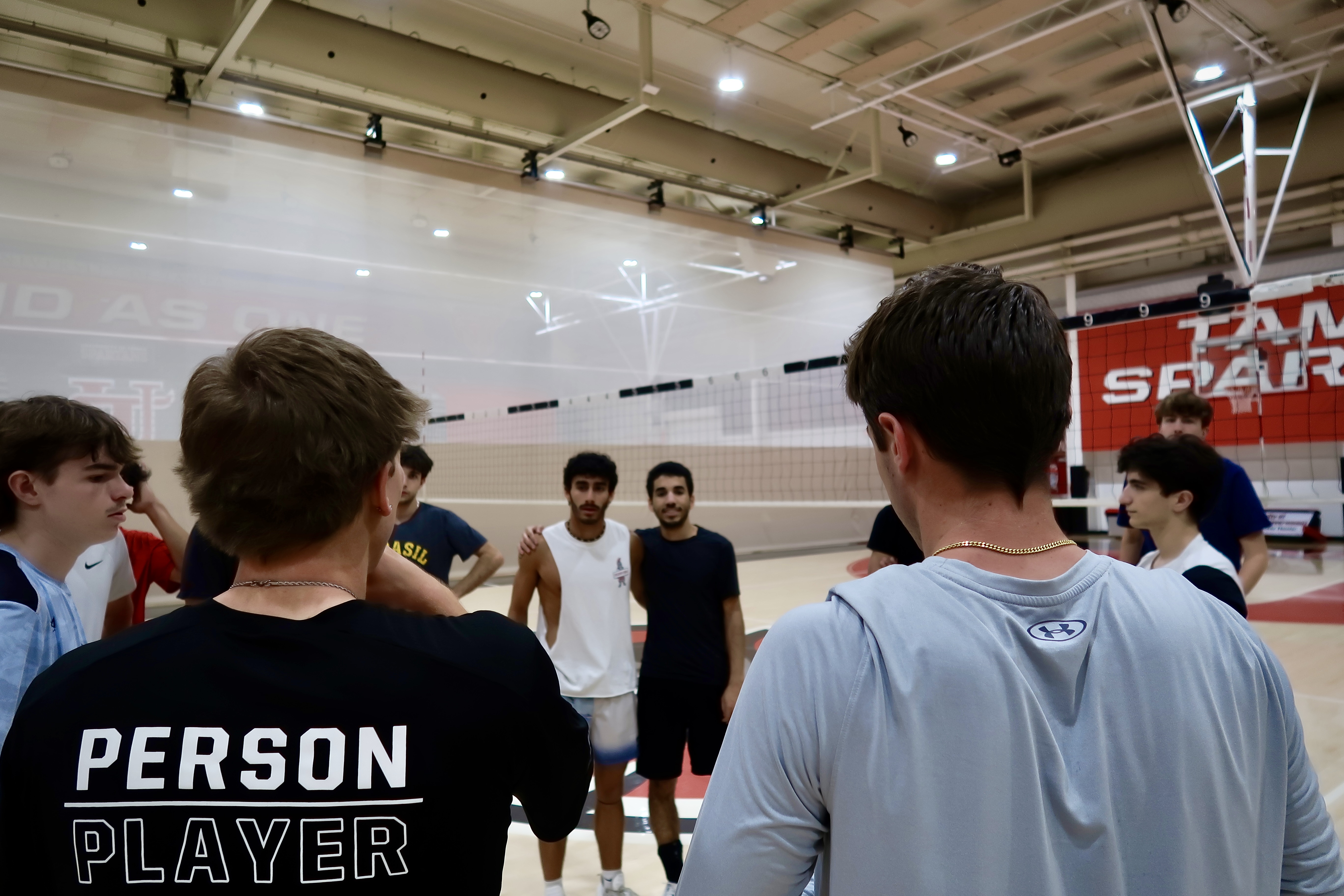
TAMPA, Fla. — Players trickled into the gym one by one as club president Tanner Garner, junior psychology major, and vice president JT McCormick, sophomore entrepreneurship major, set up the volleyball net.
Shoes squeaked against the hardwood floor as players warmed up. Some stretched and chatted while others launched volleyballs toward the rim of the basketball hoop. Laughter cut through blasting music as teammates shouted across the court, joking with one another during an impromptu shooting contest. Garner called for everyone to huddle up. The team joined him by the net. Practice had begun.
The men’s club volleyball team is a recent addition to the University of Tampa’s club sports program. Founded six years ago, it has grown rapidly in both membership and competitiveness. The team competes in the Eastern Collegiate Volleyball Association (ECVA) and is currently ranked third in the Men’s Division II Southeast. The team was born out of students’ shared passion for the sport, but its longevity is sustained by its community and leadership.
“Volleyball’s my favorite hobby. I played in high school, I loved it,” Rocco Fabrizi, a graduate student pursuing an MS in finance, said. “It kind of just made sense for me.”
Fabrizi and his teammates commit to late-night practices and dedicate their weekends to competing against other schools. They credit their love of the game to the success of the team.
From joking around during warmups to saying hello when they see each other on campus, no one on the team is a stranger. The camaraderie between the players has transformed the team into a community. During practice, players feel comfortable enough to dance to the music and laugh between plays or drills. Garner, as club president, has played a large role in facilitating this community, players say. Another player, Luigi Zemlickas, a junior computer science major, has also made quite an impression.
“He never gets mad, really,” Dylan Carroll, sophomore human performance major, said. “I feel like he has the best mental state on the court. If I watch him and he hits the ball out, he’s gonna make a joke, he’s gonna take it on the chin, he’s gonna move on. And for me… that’s inspiring to see.”
Although the culture of the team is mostly relaxed and laid-back, they can easily shift their focus to competitive performance on the court. The players, who come from various backgrounds and have a range of skill levels, are held together and supported by the executive board. Garner and McCormick have created a structured routine that fuels competition while balancing community.
With no official coach, Garner takes on the responsibility of creating practice drills, scrimmage team matchups, and game lineups.
“I will give suggestions, but we are always open to what our players have to say,” McCormick said.
Despite the laid-back nature of the team, competition between players is unavoidable. During each practice, players still have to prove themselves to be the best member to see the court during game time.
“I’m still on the court, and not everyone on the team can say that,” Malachi Houston, former club treasurer and current member, said.
There’s only room for six players on the court, and with the team pushing to be more competitive and get more wins under their belt, they need to put their best six out there.
Garner has the final say in playing time, but he decides this based on players’ performance in practice.
When it comes to practices getting more competitive than games, Carroll didn’t hesitate to say, “Oh hell yeah. I think that just fosters good relationships between teammates, because who doesn’t butt heads?”
Players not only have to prove their competitive drive and skill to the executive board, but also to the Office of Campus Recreation. The team said they need more funding from UTampa to support the future of the team. With club expenses, increased interest, and lack of funding, the club doesn’t have enough room to grow, Houston explained.
“We qualified for the ECVA Championships for the past two years in Maryland,” McCormick said.
The team has maintained a consistent level of competition and has been recognized by the ECVA and invited to play against teams outside of the regional tournaments in which they usually play. Receiving extra funding is a foundational step toward expanding the team and helping it grow. The best way to do that is by showing a higher level of competition.
“We try to keep our standards high,” Houston said. “Because we have a lot to compete for.”
The men’s club volleyball team is one of 26 teams playing in the ECVA DII Southeast conference. The team is currently ranked third in the conference behind the University of Florida (B) team with a record of six wins and two losses.
When the team split up for a six-on-six scrimmage, Houston stepped behind the service line, slapping the ball against the floor before tossing it into the air for a hard, fast serve. The ball flew forward, only to land on his teammate’s back with a loud slap followed by an eruption of laughter at his mistake.