
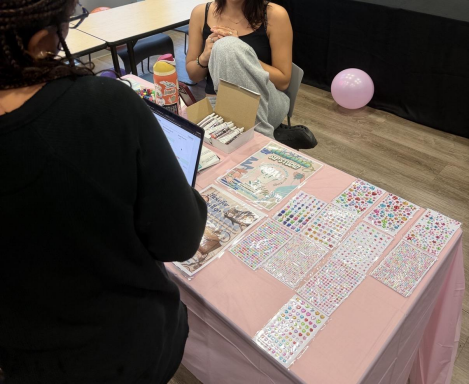
Photo courtesy of Melanie Mirnaya
By Melanie Mirnaya
TAMPA, Fla. — A conversation about the new season of Dancing With the Stars turned into a discussion about the struggles of college life, the possibility of transferring schools, and a trip to the airport. For one University of Tampa Resident Assistant, a routine shift on duty became an unexpected opportunity to get to know a resident better.
Conversations like these are part of a job that extends far beyond sitting at the front desk. Resident Assistants help students feel at home, respond to problems, inspect
rooms, write incident reports, and organize community events, all while managing their own personal life and academic responsibilities. Although residents may see their RAs throughout the dorm building, much of the work that goes into forming a community happens behind the scenes.
Petra Mirnaya, a second-year psychology student at The University of Tampa and a first-year RA in Urso Hall, did not initially know everything the position would involve.
She first became interested in the role after her older sister introduced her to the idea.
During her freshman year, Petra approached her own Resident Assistant to learn more about the position and eventually decided to apply. The selection process included an introductory meeting, preliminary application questions, hypothetical scenarios, program planning, and an interview. After being accepted, Petra attended a week of training from 8 a.m. to 5 p.m. each day before move-in week at the start of the semester. The training introduced her to the technical information and responsibilities required for the position, including planning floor programs and decorating the residence hall.
“I have a video of me getting the acceptance email that I was an RA, and I did not even see that I was assigned to Urso. It said ‘Congratulations,’ and I saw the confetti, and I was like, ‘Yay!’ I was so excited,” said Petra.
For her, the creative side of the position was one of its most appealing aspects. Decorating residents’ doors and planning themed activities allowed her to incorporate her interests into her work.
“That’s a very creative process that a lot of RAs don’t like, but that is my favorite part,” she said.
However, the position has also changed how Petra sees the people around her. Interacting with residents has exposed her to different perspectives and personalities, challenging some of the assumptions she held before beginning
college. Living and working alongside students with different experiences has shown her that people cannot always be understood through first impressions.
One of the most challenging parts of the job, she said, has been building relationships with residents who already have established friendships and routines. Even three months into the semester, Petra is still trying to connect with some of the students living in her building.
“I thought making connections would be the easiest part, but there are very closed-off people who don’t really care about the fact that I am supposed to be there to help them,” said Petra.
Building those relationships takes more than simply being available; she also has to encourage residents to respond to messages, participate in conversations, and provide feedback on community activities. While these interactions may seem small, they help her understand what residents need and how they experience life in their living space.
“Sometimes I ask for feedback on things or post information, and there is only a small minority of people who actually respond and give me a reaction,” she shared.
The difficulty of connecting with residents highlights an unexpected part of the job, and being available to people does not necessarily mean they will feel comfortable reaching out.
For Petra, building community requires patience and repeated attempts to engage with people who may not immediately see the value of those interactions.
A typical week for Petra includes one or two shifts, during which she answers calls and messages, completes rounds, and responds to residents’ questions. Her responsibilities vary depending on the situation, and working alone can make certain moments more challenging.
“It is not the worst thing in the world, and I have a lot of experienced people on my team, but when I’m alone, and I don’t know what to do, and the form of communication is through text, that’s difficult,” she said.
The responsibilities do not always end by daytime.
During overnight shifts, RAs may need to respond to calls from residents, assess whether an issue can be resolved over the phone or go downstairs to handle it in person.
For example, a person who has lost a key may need assistance even in the middle of the night. Additionally, responsibilities such as room inspections, where the RAs have to inspect rooms for damage and document their condition, required Petra to learn how to identify issues she had not previously considered. This revealed that this position involves learning responsibilities that residents may never think about.
What appears as a ready-to-move-in room had actually gone through required preparation and attention.
Community programming offers Petra a different way to approach this role. Planning activities and decorating residents’ doors allows her to create a welcoming environment while sharing her interests with others.
One example was her Alice in Wonderland-inspired decorations. The theme gave residents something recognizable to respond to and created an opportunity for conversation.
“A couple of residents walked up to me and said, ‘Oh my God! So fun!’” shared Petra.
Balancing these responsibilities with college life is an ongoing part of the job. Petra has to make time for classes and assignments while completing her RA duties and remaining available during her work hours.
During our conversation, she showed me her schedule on her computer. It was carefully organized, extensively detailed, and color-coded. Although Petra did not
specifically describe her scheduling system as a strategy for managing the position, the level of detail showed the planning involved in keeping track of her academic and work responsibilities.
This role has also helped Petra become more confident in situations that once felt unfamiliar. Being available and starting conversations are now part of her responsibilities, giving her opportunities to practice interacting with people she might not otherwise approach.
“I feel more confident with the help of the role of being an RA. My freshman year, you would not catch me talking with random people,” she said.
The confidence is particularly important because RAs can be perceived primarily as authority figures. Residents may associate them with rules, reports, and consequences rather than seeing them as fellow students who are also navigating college life.
Petra wants her residents to remember that RAs are students and young adults, too, and that their role is not limited to policies.
“Sometimes when I talk with residents, I ask if they are going out tonight. and they say, ‘Yeah, maybe.’ and I’m like, ‘You can tell me that you are going out. You don’t have to share specific details, but I am not going to get you in trouble,” she said.
For Petra, being approachable is part of creating the kind of community she wants residents to experience. The position requires her to navigate rules and responsibilities, but it also gives her opportunities to have conversations that might not happen otherwise. She hopes her residents will see her as someone they can speak to rather than someone they need to avoid.
“I remember meeting an RA last year at a volleyball game, and she said, ‘Oh, but, I’m an RA, so I don’t know if you guys want to hang out.’ I was like, ‘What?’” shared Petra.
The Interaction stayed with her because it reflected the distance that can form between RAs and the students they work to support. She does not want the position to prevent her from having ordinary conversations with residents. Instead, she hopes that being an RA can help create those connections.
The conversation about Dancing with the Stars illustrates how an ordinary interaction can become more meaningful. What began as small talk gave Petra and the resident an opportunity to discuss college life, including the possibility that the student was struggling to feel settled at the university. Continued conversations could give the resident a chance to feel heard and recognized as part of the community.
After the resident left to go to the airport, Petra returned to the quiet of the festively decorated Urso Hall. The front desk remained in place, along with the responsibilities that came with it. But the conversation offered a reminder that the work of an RA is not always defined by a task, a shift, or a written report. Sometimes it begins with taking the time to talk with someone.