
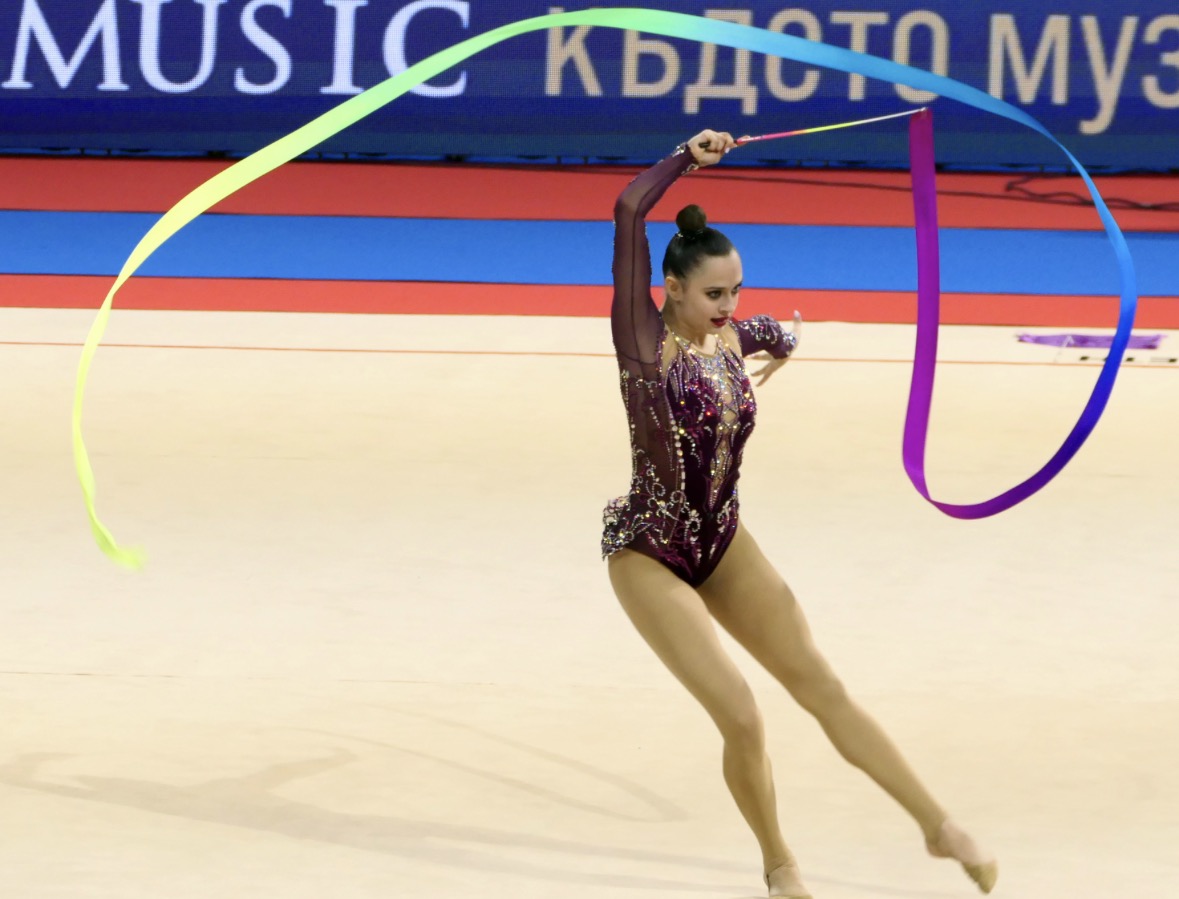
“Annaliese Dragan 2024 Sofia World Cup Ribbon QF 1” by FloweringDagwood is licensed under CC BY 4.0.
After moving across the world to train, Annaliese Dragon transformed a childhood passion into an Olympic dream, overcoming challenges and self-doubt to compete on the global stage.
–
By Genesis Muckle
TAMPA, Fla. — At the 2024 Paris Olympics, surrounded by the world’s most elite athletes, Annaliese Dragon had a moment where everything felt surreal. “I was in shock,” she said. “I couldn’t believe I was there.”
What started as a childhood curiosity became something more. Today, Annaliese is an Olympic rhythmic gymnast who represented Romania at the 2024 Paris Games.
At six years old, Annaliese Dragon wasn’t thinking about the Olympics; she was thinking about ribbons. “I liked all the pretty costumes and the leotards,” she recalled, “and the ribbons, it was really cool.”
Growing up in California with two athletic parents, her mother a gymnast and her father a track and field athlete, she tried everything from swimming to volleyball, but rhythmic gymnastics is what stood out to her.
After starting in artistic gymnastics, she transitioned to rhythmic and never looked back. “I just fell in love with it,” she said. “I feel it is so much better.”
That early passion eventually evolved into something bigger. Watching the 2016 Olympics around age 10 became a defining moment. “I remember thinking, ‘That’s where I want to end up. I want to be one of those girls.’”
At 13, Dragon made a major decision to further her career; she moved from California to Romania to train at a higher competitive level. While her parents remained in the United States, she and her sister, who also competed in rhythmic gymnastics, relocated across the world.
“It was easier to train in Europe,” Dragon said. “The sport is bigger there, and most of the major competitions are there.”
The move came with challenges, including time away from home, but it also provided opportunities to train with elite coaches and compete internationally. Throughout the transition, Dragon relied heavily on her support system.
“My family was always there for me,” she said. “And [with] my sister, we were like a team.”
While rhythmic gymnastics is often associated with elegance and performance, Dragon emphasized the intense mental demands behind the sport. She worked closely with a sports psychologist, whom she credits as a key factor in her success.
“The mental size is huge,” she said. “I feel like I qualified in a large part because of that support.”
Like many athletes, Dragon experienced moments of self-doubt, particularly when it came to competing against top-tier gymnasts. “You question yourself,” she said. “Like, ‘Am I good enough? Why am I here?’”
Over time, she learned to overcome those thoughts by building confidence and focusing on her place among the world’s best. “You have to realize you belong there too,” she said.
Training for the Olympics required a rigorous schedule. Dragon’s routine included morning workouts, followed by up to seven hours of practice in her gym. Her days often ended with additional cardio sessions and recovery work such as physical therapy.
“It was a lot,” she said. “Especially that year.” Despite the demanding schedule, Dragon said she found joy in the process. “It was worth it,” she said. “And it was fun.”
Her hard work paid off when she qualified for the Olympics at the 2023 World Championships in Spain.
Although born and raised in the United States, Dragon competed for Romania, her parents’ home country. She described representing the country on the Olympic stage as both meaningful and unforgettable.
“It was such a unique experience,” she said. “You can’t even imagine it until you’re there.”
Living in the Olympic Village, surrounded by athletes from around the world, was a highlight of the experience. “It felt like a big campus,” she said, “but with all these incredible people.”
Now a student at the University of Tampa, studying criminology and criminal justice, Dragon is focusing on her education while considering a return to competition. She has not ruled out the possibility of competing in the 2028 Olympics in Los Angeles.
“I would love to try again,” she said. “It would be in my backyard.”
For now, she hopes to resume training and find a balance between academics and athletics.
Reflecting on her journey, Dragon emphasized the importance of perseverance and self-belief. “Be confident. Do what you love. Work hard,” she said. She believes that dedication is ultimately more important than natural talent.