
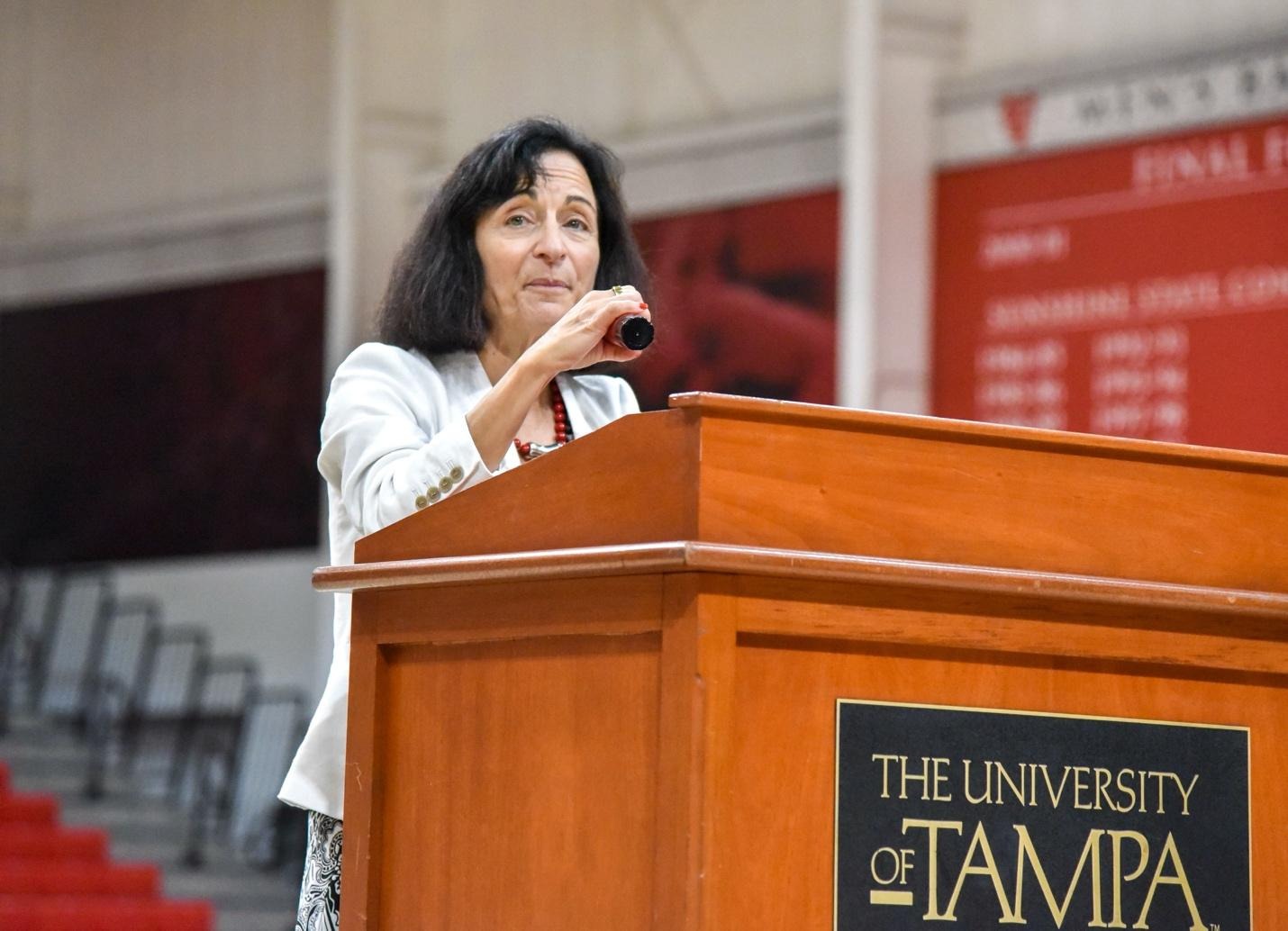
Photo courtesy of Hannah Walls
By Sade Reyes
On Friday, Oct. 16, the University of Tampa put out a global message that its president, Teresa Dahlberg, would be resigning for personal reasons after two years of service. The stepdown has been followed by expressions of discontent with the president’s term and gratitude for her time at the University of Tampa.
On Oct. 19, Ryan Cragun, a professor of sociology at the University of Tampa and the vice president of the faculty senate, posted the first of three articles on a personal blog illustrating his feelings about the former president, within the constraints of his NDA. Throughout his three posts, he expresses various frustrations, including his belief that President Dahlberg “never should have been selected for this position,” that she was “aggressively incompetent” during her tenure, and his hope for the future operation of the university.
In his article, Cragun explains his belief that the selection of President Dahlberg was a mistake from the beginning; his first post discusses his hesitation with her work as an academic, which he wrote he was, “not particularly impressed by her scholarly record when measured by the typical standards we use to evaluate academic research: publications and citation counts.”
However, Cragun’s hesitation extended beyond concern for her “merit as a scholar.” It was also because of Dahlberg’s track record as a dean at Cooper Union, a university in New York.
Cragun explained that during her time at Cooper Union, Dahlberg tried to propose a new curriculum without faculty approval. While faculty do not have an exclusive say, they are heavily involved in the development and approval process.
“Students may not know this, right? This is useful for students to know. Faculty control the curriculum,” Cragun said.
He said that Dahlberg’s proposal was rejected after criticism from a group of alumni, faculty, and students over allegations of plagiarism and bypassing faculty governance structures. The controversy also led to an investigation by the New York State Attorney General.
“But the big key takeaway is that she skirted the faculty who set curriculum and tried to go right past them and go to the board of the New York Board of Education to get curriculum approved, and nobody should ever do that,”. Cragun said.
Dr. Dahlberg resigned from Cooper Union shortly after the controversy.
While much of this information is now public, Ccragun said, “I think that information should have been shared with anybody who was going to interact with who became president on there.’’
In his second blog post, he describes his own personal negative interactions with the former president and describes her as “aggressively incompetent.”
However, Cragun said that one of his biggest frustrations during Dahlberg’s term was his understanding of Dahlberg’s relationship with UTampa faculty.
“I can’t say what she intended. I have no idea what she intended. But my takeaway is, [Dahlberg] refuse[d] to work with faculty. That’s not a great start.”
He said that his understanding is that the faculty senate’s connections with administration struggled under Dahlberg. He said she “wanted to pull faculty off” subcommittees on the board of trustees, which he said is a violation of the Faculty Policies and Procedures Handbook.
He said the impression he got from her leadership was: “Do not communicate with anybody else in my cabinet. If you have a question, go through the provost. I refuse to read the committee’s report. I refuse to meet with the committee.”
The president also received positive reviews for her time at UTampa.
Student government president, Caden Raymond, said He received the information that the president stepped down only hours before the rest of the university at the board of trustees meeting.
“I think everyone was pretty surprised and everything about the stepping down. In terms of student government, I definitely like prepped my team in terms of how we were gonna navigate it because we’re the people that students come to answer questions and everything,” Raymond said.
Raymond explained that he found out about the president and said that he and his vice president Alexander Lloyd’s relationship with the president was generally positive.
“Alex and I built a great relationship with President Dahlberg and the university cabinet deans and everyone else throughout this entire summer, which is why we’ve been so heavily involved in everything that’s been happening around the university,” Raymond said.
Raymond also said that in terms of student frustrations with the president’s term, it can be challenging to identify where it is fair to assign blame.
“I think from a student perspective, I think a lot of people think that President Dahlberg was the deciding factor in a lot of things, which of course, like she’s the figurehead,” Raymond said. “I think there’s been negative comments and positive comments, but I think, from a student perspective, you’re gonna be mad at the person who is the figurehead, right?… So I think students were upset about some specific things, and she’s the fall person, whether she made the decision or not.”
Raymond said that historically, the student government president has been involved in the selection of the future president of UTampa, and he will work for student visibility on any future administration he is a part of.
Cragun said that in the future, there are changes he wants to see.
“Whether it’s the search firm or the search committee, there needs to be much more careful vetting of candidates.’’
He called for higher standards for a president’s academic merit and interpersonal relations. He also stressed the importance of communication between the president and other members of the university.
“There have to be open lines of communication between faculty, students, staff, and the board of trustees,” Cragun said.