
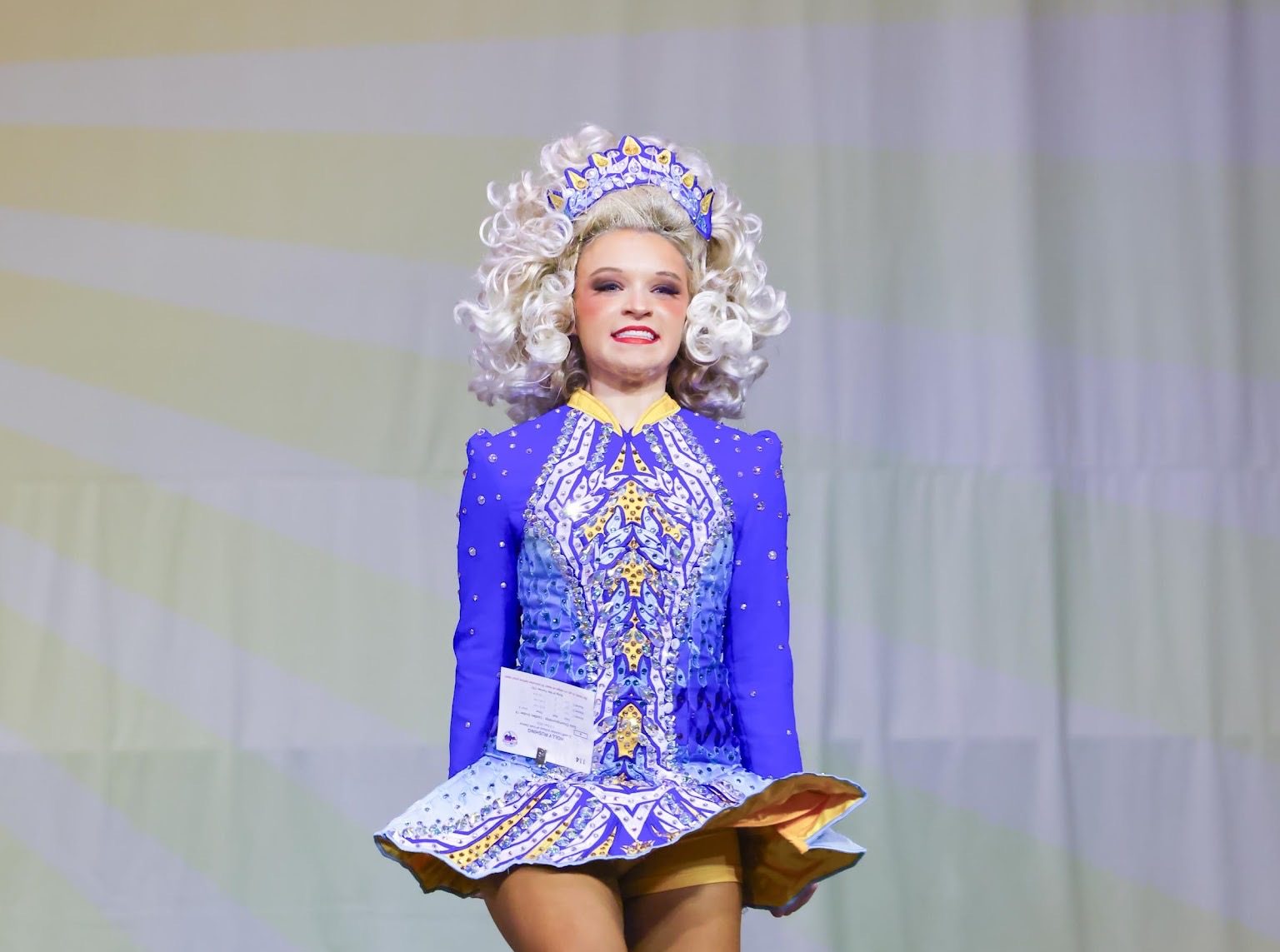
Photo courtesy of Holly Rushing.
For 16 years, University of Tampa senior Holly Rushing has traded sleep, free time, and two healthy feet for Irish dancing.
–
By Genesis Aviles
TAMPA, Fla. — The Thursday evening air inside the Scariff School of Irish Dance carries the sharp rhythm of hard shoes striking the floor, a sound somewhere between a tap dancer’s shuffle and a horse’s gallop at a parade. Children as young as 7 years old stretch their legs while teenagers drink blue slushies from the store next door. 21-year-old Holly Rushing carefully wraps white tape around her hard shoes.
“To make them tighter,” Rushing said. “And to make them look pretty.”
It is a small, deliberate ritual, one of hundreds she has repeated over her 16 years of Irish dancing. The University of Tampa senior, who will graduate this spring before heading to Texas Christian University for graduate school, has spent nearly her entire life inside studios like this one, chasing a form of movement most people only recognize from a Riverdance clip. For Rushing, it is something far more personal than a performance.
“Every year in school, I’m known as the girl who does Irish dancing,” Rushing said. “People ask me to do a little dance for them, even in college, which is kind of crazy.”
Rushing’s mother, Emma Rushing, enrolled her in Irish dance classes at age 6 in Clearwater, though neither of them could fully explain why at the time. Holly’s grandfather is Irish, but she is quick to point out that heritage was never the main pull.
“I think I’ve developed my own love for it,” she said with a smile. “It definitely is tied to my identity now.”
That identity was forged, in part, through competition. Irish dancing’s structure moves from local feiseanna, grassroots competitions hosted by individual dance schools, up to regional qualifiers called oireachtas, and then to the National and World championships. Rushing has competed at 14 Oireachtas since she was 8 years old, qualified for the World Championships seven times, and competed in three of them, in Montreal, Greensboro (North Carolina), and Dublin.
Emma Rushing, 56, said she has watched her daughter bring home medals in hard shoe, soft shoe, and overall categories at the World Championships in Montreal in 2023 and at the All-Irelands in Killarney in both 2023 and 2025.
“I’m so incredibly proud of Holly and all she has accomplished,” Emma Rushing said. “She dances with such joy and freedom. She is definitely happiest when she is dancing.”
Irish dancing splits into two disciplines, soft shoe and hard shoe, each with its own demands. Soft shoes, known as ghillies, are flexible lace-up shoes not unlike ballet slippers, worn over crew socks. Hard shoes, which resemble tap shoes fitted with a split sole and rhinestone-decorated block on the top, similar to a leprechaun shoe, produce the signature floor-trembling sound that defines the art form.
On a late March Thursday at the Scariff studio, Rushing transitions between both pairs in a matter of minutes, taking off the ghillies to reveal feet that tell the story of a career: toes pressed close together, a slight bunion forming at the joint, the kind of wear that accumulates quietly over a decade and a half of pointed feet and forceful landings. She tapes her index toe before putting on hard shoes, a habit she developed to protect skin worn down by friction.
Once the shoes are on, she stands on her toes like a ballerina and begins a series of jumps. The floor shakes. Her upper body stays rigid, arms pinned at her sides, the symbol of Irish dance’s distinctive style, while her legs move with what looks like effortless precision.
The physical cost of that precision is real. At 11, Rushing was diagnosed with Sever’s disease, a growth plate condition that caused severe pain in her Achilles tendon. A year later, at 12, she flew to the National Championships in Montreal wearing a medical boot. Her father pushed her through the airport in a wheelchair. She walked onto the stage and competed anyway.
“I don’t think that’s always good, to push through injuries and to push through pain,” she said. “But through Irish dance, I’ve really learned how to push through things.”
She knows dancers who have had hip and knee replacements before age 20. She considers herself fortunate.
The competitive side of Irish dancing, especially at the championship level, is a world unto itself. Rushing describes the preparation for major competitions as something that looks, from the outside, almost like a beauty pageant: large custom wigs, professional makeup, elaborate custom dresses that can cost thousands of dollars — many ordered directly from Ireland — and competition tans applied through wipes, lotions, or specialized tanning services.
“It almost looks a bit like a beauty pageant, which I don’t love,” Rushing said, “because I feel like it takes away from how rigorous a sport Irish dancing is. I want people to see it as that, as a rigorous sport.”
But inside that world, she found a moment that cut through all of it. At the 2023 World Championships in Montreal, she stepped onto the stage and recognized the musicians who would be playing her music live: Anton and Celli, a duo she had listened to on repeat since she was 6 years old.
“I remember I stepped onto stage at the world championships, and I realized that these were going to be the musicians that were playing music for me live,” she said. “Something about that just really hit.”
It was, she said, her “I made it” moment, not a trophy, but a recognition that she had arrived in the same world she had dreamed herself into as a child.
Back at the Thursday night class in Tampa, the room holds its own kind of community. Stephen, the instructor, commands the youngest student, a 7-year-old named Roisin, to try extending her leg toward her nose mid-jump. A parent watches quietly from the side. The middle schoolers gossip in the corner. To celebrate St. Patrick’s Day, Stephen brings out mini cupcakes for the class, and everyone, from the youngest to the oldest, takes one.
Fellow dancer Edward Higgins, who has been involved in Irish dancing about as long as Rushing, put her talent plainly.
“You’re a much better dancer than I am,” Higgins said of Rushing.
The community Rushing has built through Irish dancing does not stop at studio walls. Julia Salazar, 15, has been dancing alongside Rushing for eight years, their paths crossing at competitions as much as at practice.
“In a competition setting, Holly is very strong and determined,” Salazar said. “She is very sharp and has a good command of the stage. Even though she’s focused on her dancing, she always finds time to say hello to her friends.”
Salazar said resilience is as much a part of Rushing’s reputation as her technique.
“Whenever Holly is upset with her results, she comes back to the next competition determined and ready to show everyone what she can do,” Salazar said.
She also wants people outside the sport to understand what championship-level commitment actually costs.
“Most people don’t understand how much time it takes to become a championship-level dancer,” Salazar said. “Most dancers training for a major competition are practicing 10 to 14 hours a week on top of school, jobs, and responsibilities with friends and families.”
Rushing stopped competing about a year ago, not from burnout but from a sense of completion. Graduate school applications, research commitments, and the natural arc of a career she had given everything to for 16 years all pointed toward a transition.
“It wasn’t quitting,” she said. “It was kind of just realizing I had done what I wanted to do.”
Rushing’s time at UTampa has been defined by more than dance. She has co-authored four research papers alongside her faculty mentor, Dr. Colter Ray, two of which have been published in peer-reviewed journals. One paper recently earned a Top 4 Paper Award at the Western States Communication Association’s annual convention in San Diego, California.
She heads to TCU in the fall. The hardest part of leaving, she said, will not be leaving campus. It will be leaving the Scariff studio and the teacher and classmates she has known since she was a first-grader learning to point her toes.
“The dance teacher, Mr. Stephen, he’s like family,” she said. “And everyone else there, there are dancers that I’ve been dancing with basically since I was little.”
Whatever Irish dancing looks like for her in Dallas and Fort Worth, whether it be gigs around St. Patrick’s Day, sessions at local pubs, or dancing with Irish bands, she is certain of one thing.
“I don’t think I’ll ever stop Irish dancing in any capacity,” Rushing said. “It’s something that I love.”
Emma Rushing said the lesson her daughter carried out of the studio is the one that will travel farthest.
“Irish dance has taught Holly that she can do hard things,” Emma Rushing said, “and that hard work pays off.”