
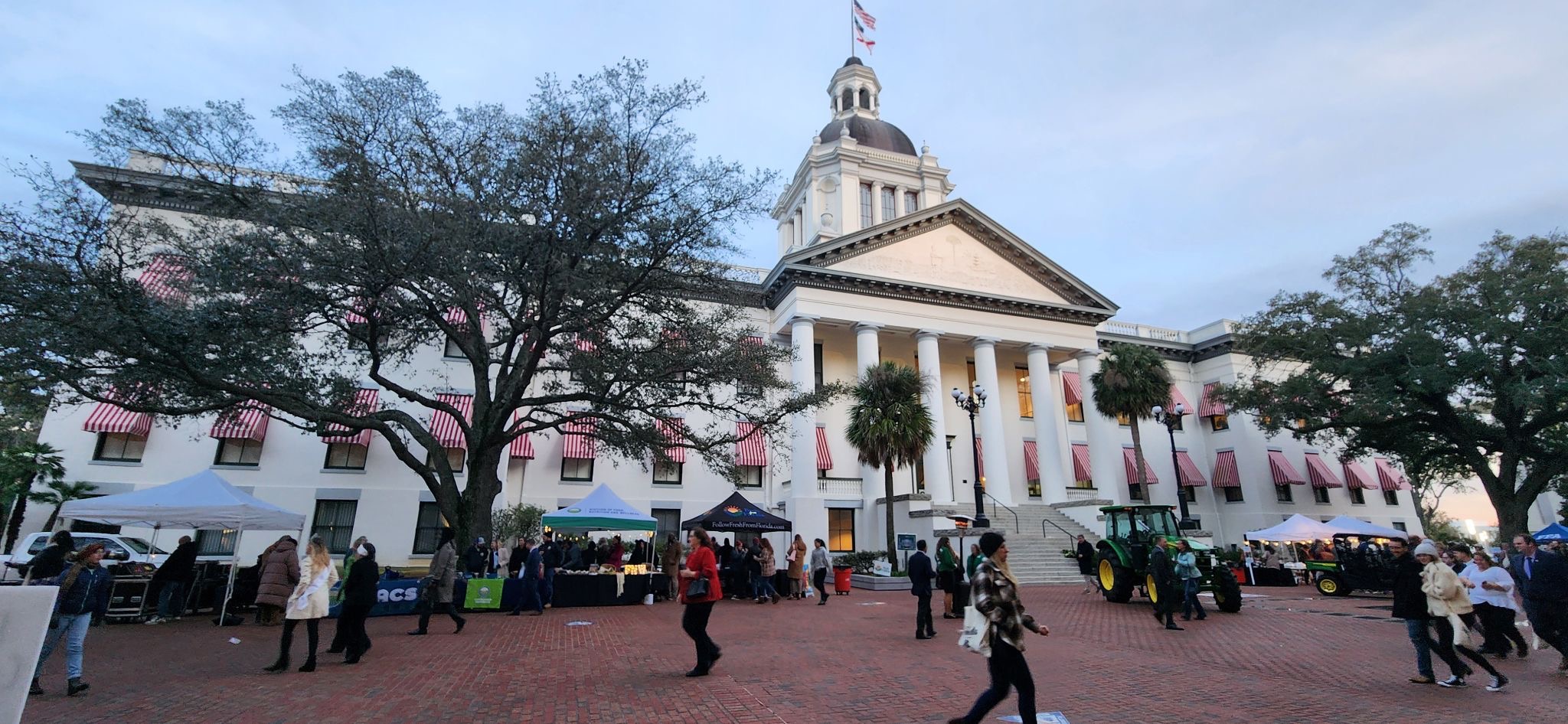
Florida’s Old Capitol Building, 2024. Photo courtesy of NRCS Florida via Flickr, PMD 1.0
The regular session passed a total of 192 bills, but no state budget.
–
By Nicole Droeger Stephens
TALLAHASSEE, Fla. — The 2026 Florida Legislative Session concluded on March 13 with a total of 192 bills that passed through both the House and Senate. A state budget has yet to be implemented despite the state’s Constitution requiring the Legislature to pass a budget during the regular session.
Governor Ron DeSantis initially scheduled a special session to begin on April 20. However, the Tampa Bay Times reported on April 16 that DeSantis moved the starting date to April 28. The session will include talks about congressional redistricting, artificial intelligence regulations and vaccines. There are no mentions of a state budget discussion.
DeSantis announced his budget proposal for the 2026-27 fiscal year on Dec. 10, 2025. The proposed budget brings a total of $117.4 billion, including $16.75 billion in reserves and $250 million towards debt reduction. However, both the House and Senate proposed different budgets, leading to a disagreement within the Legislature.
Lissette Campos, moderator of the political roundtable “Florida This Week” on WEDU PBS, emphasizes the importance of a state budget.
“Lawmakers are required to fund the operating budget of the state FIRST–that’s education, transportation, health, administered funds, etc.,” said Campos. “Whatever money is left, after lawmakers cover these basics, is made available for local projects and lawmakers’ initiatives.”
Campos notes that the lack of a state budget leads to consequences for Florida’s education system.
“Districts are having to allocate staff and resources without the guardrails of knowing how much money they have to operate,” said Campos. “During the first quarter of each fiscal year, school districts are hiring, firing, expanding, and contracting programs.”
“Now is the time when teachers get their ‘assignments’ for the fall. This is when they know IF they will be needed in their current school, being moved to another school to accommodate district needs, or even being laid off.”
The lack of a state budget and other district concerns have led to 250 teachers being laid off in Pinellas County, 180 in Sarasota, and three school campuses shutting down in Hillsborough.
Previous legislative sessions led to a higher number of bills that were passed. In 2025, lawmakers passed 269 bills, and 2024 had 325 bills.
Two 2026 bills have already been signed by DeSantis. House Bill 1471 allows the state government to label a group as a terrorist organization and “dissolve” them — meaning to disband or prohibit the group’s operations. The bill will go into effect on July 1, 2026.
HB 991 changes citizenship proof requirements during elections. Floridians will have to prove citizenship status via driver’s license, birth certificate, or passport in order to vote. Student IDs will no longer be accepted. Names on either accepted document have to match the name mentioned in the statewide voter registration system. The bill goes into effect on July 1, 2027.
Campos notes that obtaining a driver’s license will be more difficult for certain voters. Florida’s Department of Highway Safety and Motor Vehicles now requires driver’s license exams to be given in English.
“The policy change calls for ALL 3 driver’s license knowledge and skills testing to be conducted only in English (the learner’s permit, behind-the-wheel test, and the vision test)…without the option of an interpreter,” said Campos.
Campos highlights that proof of citizenship is not required for registering to vote in Florida. The deadline to register to vote for the Florida primary is July 20, 2026.
Various Senate bills have passed through the House and await DeSantis’ signature. Notable ones include SB 1134, which will prohibit counties from funding, promoting or “taking official action” with diversity, equity, and inclusion initiatives. If an official is caught promoting DEI initiatives, they could be removed from office. If signed, the bill will go into effect Jan. 1, 2027.
SB 484 aims to place the financial burden of resource usage on data center companies rather than citizens. Data centers use up a lot of natural resources, such as water to cool the servers for internet and AI processing. SB 1296 will require unions to have at least half of their membership participate in elections. If signed by the governor, both bills will take effect on July 1, 2026.
As the special session approaches, voters should be aware of their registration status. Visit registertovoteflorida.gov to verify or register to vote.