
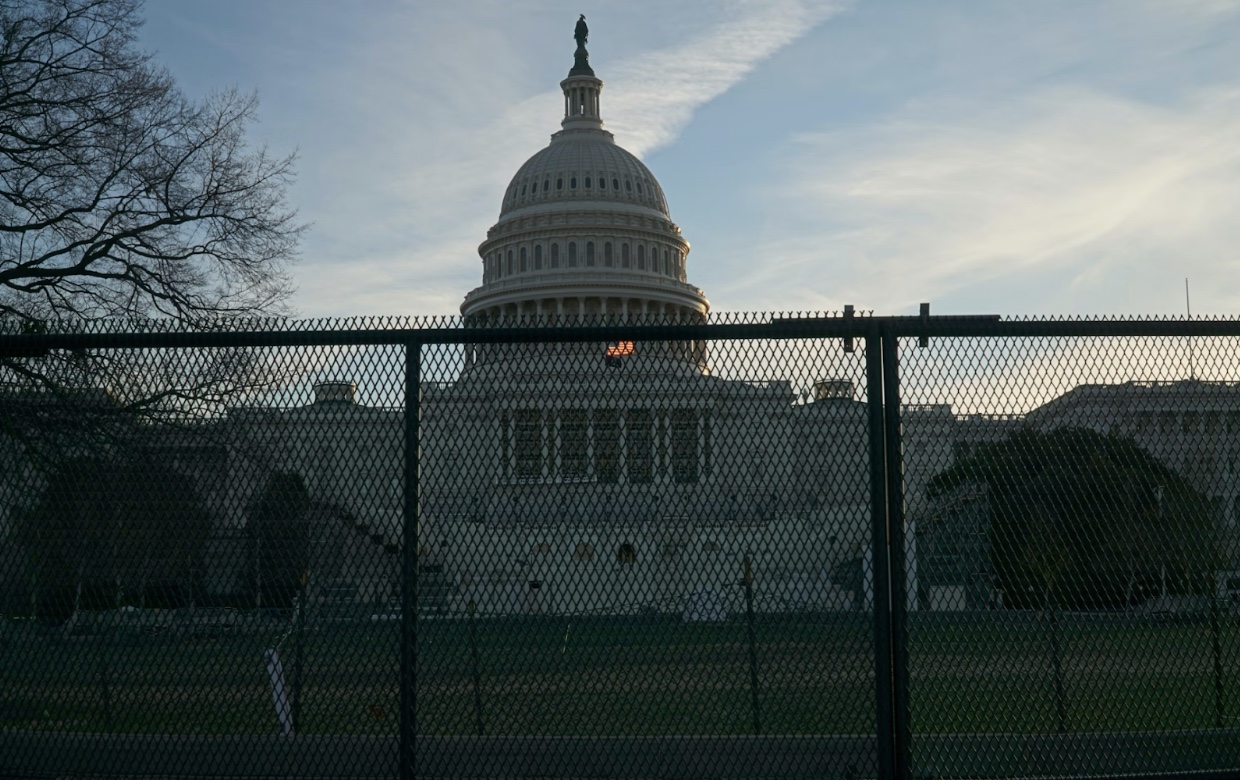
Photo courtesy of Ian Hutchinson via Unsplash.
Americans like to believe “fascism” could never take root here, that it belongs to the pages of German and Italian history, or to distant, war-torn nations. Yet history reveals a darker truth: when fear, desperation, and elite ambition collide, our Republic has teetered with ease to the edge of authoritarianism, threatening the very freedoms we take for granted.
–
By Juan Davalos
TAMPA, Fla. — The idea of half a million armed and trained veterans, backed with millions from Wall Street, marching on Washington in an attempt to install a fascist regime may sound outlandish, but it was a frighteningly real possibility known as the “Business Plot.”
The outcome of this plot hinged entirely on one unlikely man: Major General Smedley D. Butler.
Smedley Butler started his very successful military career when he was 16, enlisting in the Marine Corps and being swiftly sent to Cuba to fight in the Spanish-American War. Butler would go on to fight in World War 1 and become the most decorated man in Marine Corps history up to that point, even becoming one of only 19 men to win the Medal of Honor twice.
Given his success, he was fast-tracked to promotion. After the war, he was tasked with installing American-friendly regimes in Nicaragua and Haiti, and even going so far as to rig an election in Nicaragua. These events took a toll on Butler, instilling in him a deep disillusionment with both the U.S. military and its role in the geopolitical world.
Butler’s last overseas deployment would be during the Chinese Civil War between Chiang Kai-shek and Mao Zedong, where he was tasked with saving an American Standard Oil Refinery from a fire.
On Aug. 21, 1931, he retired from the Corps, and he finally came back home, just as the Great Depression began.
“I spent 33 years being a high-class muscle man for big business for Wall Street … I was a racketeer for capitalism. I helped in the [siege] of half a dozen Central American republics for the benefit of Wall Street. I had a swell racket. I was rewarded with honors, medals, promotions,” Butler said, quoting from his book during a speech at Connecticut’s American Legion in 1932.
For the respected general, it seemed he spent more time as a Marine protecting American business interests than he did American lives.
The anti-business and anti-war rhetoric within his speeches resonated very well with a nation recovering from World War 1 and in the midst of the Great Depression, gaining him fame and a large, loyal following.
However, this escalated as the economic hardship caused over 20,000 veterans to begin camping at the edge of Washington, D.C., in the summer of 1932.
They demanded the immediate payment of the post-war bonuses they were promised; Butler, of course, was firmly supporting their side.
According to historian Sally Denton’s book on The Business Plot, these men would end up being referred to by the press as the “Bonus Army Butler.”
In early 1933, Butler was approached by Gerald C. MacGuire, a Wall Street bond salesman, and Bill Doyle, a prominent figure in the American Legion.
At first, the visits to the general at his home were to convince him to attend the American Legion conventions for speeches. However, this would quickly change as they began trying to coerce Butler into plots and schemes, all of which were suspiciously well-financed.
MacGuire claimed to represent a powerful cabal of financiers and industrialists who were deeply opposed to Roosevelt’s New Deal and worried about the direction of the country. They also had the support of Bill Doyle and The American Legion, an openly fascist political organization popular among veterans.
According to Denton, these schemes grew in size, significance, and funding until MacGuire wanted Butler to lead 500,000 angry veterans to the Capitol to pressure President Roosevelt into resigning in favor of a figurehead government, with Butler taking over a new, unelected role: “Secretary of General Affairs,” which was a position of near-absolute power.
These men would be compensated for their work, armed by the Remington Rifle Company, and financed by the DuPont Chemical Company, JPMorgan, members of the Rockefeller family, among other wealthy individuals, and even George Bush’s grandfather, Prescott Bush.
In the McCormack-Dickstein Committee report, Butler testified that MacGuire reportedly claimed to have access to $300 million from the backers of the plot.
The general was to use his reputation as an anti-war and anti-business war hero to ironically start a revolutionary war that was financed by Big Business. Butler, wary yet curious, pretended to play along. He invited MacGuire to walk him through the plan, but he also brought in a reporter, Paul Comly French, as a witness.
It would later be revealed what exactly MacGuire had told Comly French during that meeting: “We need a Fascist government in this country … to save the nation from the Communists who want to tear it down … The only men … are the soldiers, and Smedley Butler is the ideal leader. He could organize a million men overnight.”
As they dug deeper, the plot’s scope became clear: this wasn’t just a political protest; it was a conspiracy for a military takeover. Rather than capitulating, Butler blew the whistle and, in November 1934, he testified under oath before the McCormack-Dickstein Committee, a special House committee formed to investigate “un-American activities.”
“The fascist plot which General Butler exposed … had in it three elements which make successful wars and revolutions: Men, Guns, and Money,” said Denton.
The committee, chaired by Representative John W. McCormack and Vice-Chair Samuel Dickstein, conducted closed-door hearings. Their final report, submitted in February 1935, concluded that “attempts were discussed, were planned, and might have been placed in execution if backers thought it expedient.”
A few names were publicly called to testify besides Butler, and many of the powerful figures he implicated denied everything. As an alarming result, no one was prosecuted, and those responsible were protected by the very government they sought to destroy.
But why would wealthy American businessmen want to install a fascist regime?
Historically, fascist governments protect big capital by crushing labor, suppressing dissent, and aligning state power with corporate interests. In the early 20th century, industrialists in Europe and in the U.S. saw fascism as a bulwark against communism and socialist reform, which, for them, the New Deal represented. It was viewed as a way to maintain order, property, and profit in the midst of economic peril.
Butler warned that the wealthy see the country as something to be owned, not governed. He warned that war was a racket that enriched the few and drained the many. That desperation, poverty, and inequality were the perfect breeding ground for authoritarianism long before the word “authoritarianism” was fashionable.
The Business Plot exposure was not just a window into the fragility of American democracy in the 1930s; it was a reminder that when economic despair, apathy towards governance, and elite ambition converge, even the most stable of republics can be pushed into agreement with fascist rhetoric.
Historians often compare the modern American political landscape to the fall of the Roman Empire. Yet, as someone like Butler might argue, the closer parallel is not the empire’s collapse but the fall of the Republic and the rise of dictators like Julius Caesar and Octavian Augustus.
During that time, Rome had just finished multiple wars of conquest that enlarged their reach to new heights but ultimately benefited a very small group of the wealthy aristocratic class.
These wars crushed the middle class, concentrated land in the hands of the wealthy, and created widespread homelessness. Millions of enslaved people were brought in to work the land, displacing veterans and farmers and eliminating opportunities for Roman-born citizens.
The parallels to our present situation are stark. The United States has currently fought crippling wars in the Middle East for decades, benefiting a small class of war-profiting contractors while leaving the broader public to bear the human and economic costs. Housing has been consolidated by firms like BlackRock, and corporations exploit immigrants and outsource labor to reduce costs, undercutting opportunities traditionally held by citizens.
In both circumstances, crises created the perfect conditions for fascist and authoritarian ideologies to take root. The question we must ask ourselves now is whether we are seeing the same forces converging, and whether the institutions meant to safeguard liberty are strong enough to withstand them.
Republics, whether Rome or the United States, do not fall because their citizens failed them; they fall because the Republic failed its citizens. In Rome, land reform only came under the rule of Julius Caesar, a respected war general and eventual populist dictator, whose rise, very much like Butler’s, was financially backed by the elite and justified as defending the people against systemic inequality.
War is a racket, and the oldest one there is. If democracy ever dies in America, it will not be at the hands of the poor, but of the powerful.
As Warren Buffett said to the New York Times, “There’s class warfare all right, but it’s my class, the rich class, that’s making war, and we’re winning.”
Major General Smedley D. Butler was a respected man of conviction and virtue who saw the importance of democratic systems and their people, but perhaps in the future we may not get so lucky with our next appointed “Business Caesar.” Reminding us of the importance of “Sic Semper Tyrannis,” or Thus Always to Tyrants, the Latin phrase immortalized by Marcus Brutus after assassinating Julius Caesar.