
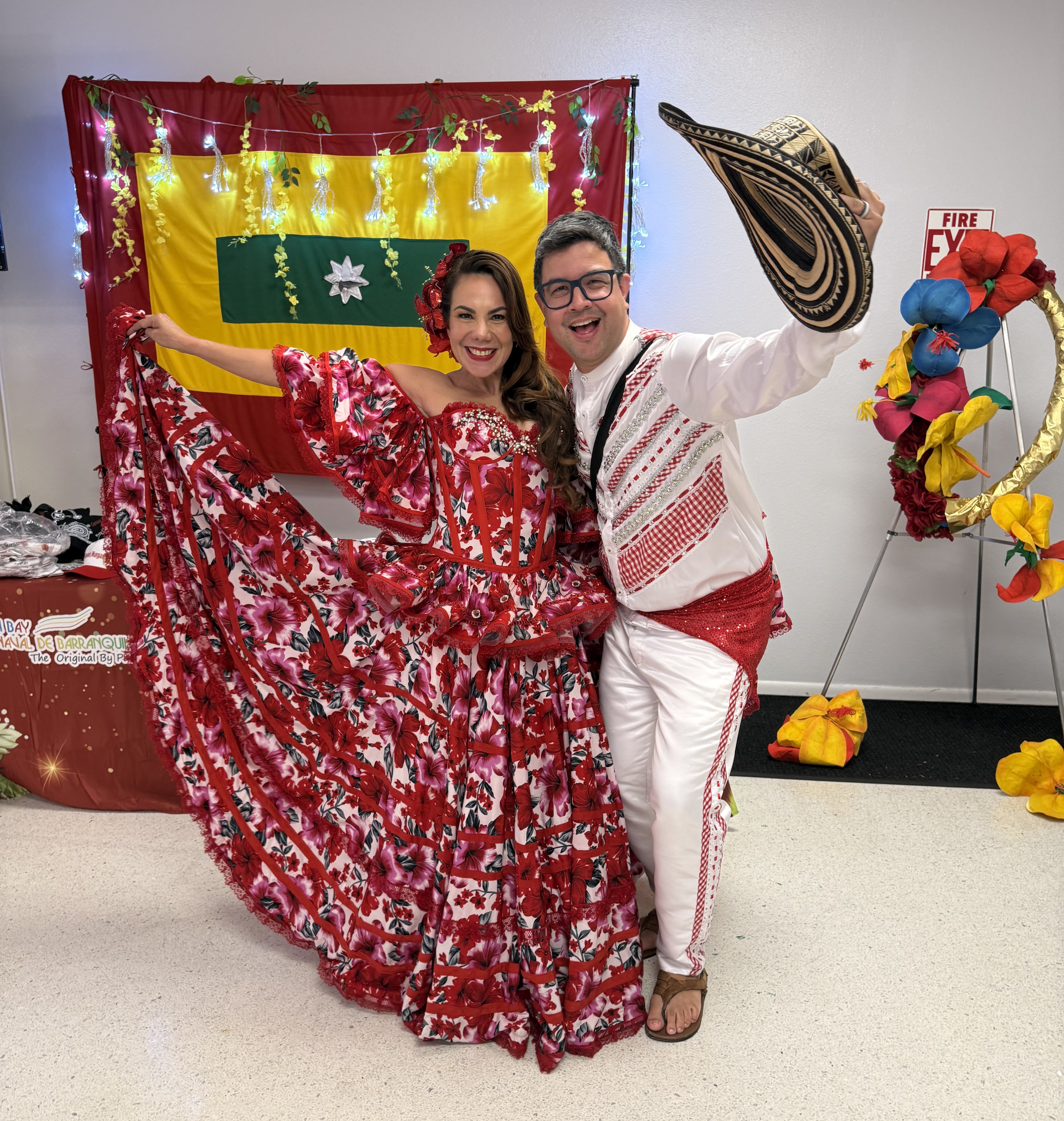
Yamirca Colina (left) and Daniel Gutierrez (right) dressed up to showcase their roles as Reina Carnaval and Rey Momo, respectively. Thumbnail photo courtesy of Felipe Camargo.
Tampa Bay celebrates its version of Colombia’s Carnaval de Barranquilla, becoming more than just a parade, but a thriving cultural bridge between two Sister Cities. Daniel Gutierrez, a UTampa professor and the 2026 Tampa Bay Rey Momo, and Tampa Bay Reina Carnaval Yamirca Colina carry the spirit of Barranquilla’s most vibrant celebration within Tampa.
Editor’s Note: Yamirca Colina’s interview was conducted in Spanish and translated into English for publication.
–
By Franchesca Murrugarra
TAMPA, Fla. – Daniel Gutierrez, an advertising and public relations professor at The University of Tampa, never once imagined that he would become Rey Momo — the king of the 2026 Tampa Bay Carnaval de Barranquilla (Barranquilla Carnival). Although he has danced around the world, including Tampa, he has never performed in the parade for his hometown of Barranquilla. When asked if he would like to become Rey Momo for Tampa in 2026, Gutierrez eagerly accepted the role.
He had long seen himself as an ambassador for Barranquilla’s vibrant culture, always happy to share about his hometown with others, so the invitation felt like a meaningful way to continue sharing his heritage with the Tampa Bay community. Today, Gutierrez proudly embraces the title of “king” as he represents Colombia’s greatest cultural tradition.
Beyond being the hometown of celebrities such as Shakira and Sofía Vergara, the Caribbean coastal city of Barranquilla, Colombia, also acts as the birthplace for the Carnaval de Barranquilla — a parade celebrating one of Latin America’s most vibrant cultural events. Dating back to the Spanish conquest and colonial era, the carnival blends Indigenous, African, and European influences into four days of dance, costume, and storytelling.
“It’s a diversity of cultural heritage that we’re displaying with dances, characters, spectacles, choreographies, and music,” said Gutierrez.
The festivities begin long before the actual event with a pre-carnival season, starting in the Plaza de la Paz (Peace Town Square), where the mayor of Barranquilla gives the new Reina Carnaval (Carnival Queen) the keys to the city for the upcoming festivities. For the 2026 celebration, Michelle Char Fernández has been named the new queen for Barranquilla. She will read the Bando (an edict or decree) alongside Rey Momo and the kings of the Children’s Carnival to kick off the night parade of the Guacherna.

Gutierrez (left) posing with Char (right) during her visit to Tampa in early September to celebrate 60 years of Tampa-Barranquilla sister city relations. Photo courtesy of Felipe Camargo.
Four days before Lent, the official celebrations begin with La Batalla de Flores (The Battle of Flowers), a parade that fills the streets with dazzling, flower-covered floats, musicians, and dancers led by the Reina Carnaval and Rey Momo. Rey Momo, who is chosen for his charisma and joyful spirit, symbolically gives the city permission to celebrate.
“My favorite part, of course, is the music,” said Gutierrez. “The music is what brings everything together … each one has a tradition, each one has a way of dancing, each one has a history of where I came from, and each one of those types of music has a representation of characters and the way you dress and the way you dance and the way you perform for the parades.”
The following days continue to bring the Gran Parada de Tradición (Great Parade of Tradition) and Gran Parada de Comparsas (Great Parade of Troupes), where traditional dances such as the cumbia unfold in vivid displays of movement and rhythm. Each dance tells a story: the cumbia evokes courtship and cultural blending, while the garabato depicts a symbolic battle between life and death. The carnival ultimately concludes with La Muerte de Joselito (Joselito’s Death), a playful yet bittersweet parade that mourns the “death” of the festivities as the Christian season of Lent officially begins.
“Behind the scenes, there are hundreds and hundreds of people working all year round for these four days,” Gutierrez said. “There are masks that have to be made, costumes that have to be made, and those huge cars … it takes months. That’s their full-time job.”
But for Barranquilleros who have moved abroad, the celebration has found new homes across a multitude of borders, including right here in Tampa Bay.
This year marks the 60th anniversary of Tampa and Barranquilla’s Sister City relationship, a long-term partnership between two cities in different countries that promotes cultural, educational, and economic exchanges. The Tampa-Barranquilla sisterhood is the oldest of Tampa’s thirteen Sister Cities, dating back to 1966.

Colina (left) and Gutierrez (right) standing with Tampa Mayor Jane Castor on Sept. 7th, on the 60th anniversary of sister city relations between Tampa and Barranquilla. Photo courtesy of Carla Bord-Solano.
Gutierrez explained that this connection has led to significant exchanges over the years, from donated Tampa fire trucks to Barranquilla’s Gran Malecón park, which was directly inspired by Tampa’s own Riverwalk during a mayoral exchange years ago.
“Barranquilla is like the little sister to Tampa,” said Gutierrez. “It not only has ties in the cultural and now economic industry, but also in being a role model.”
That connection comes to life every year through the Tampa Bay Carnaval de Barranquilla, an event that mirrors the joy of the original celebration. This year, Tampa Bay’s Reina Carnaval, Yamirca Colina, carries that mission proudly.
“Es algo que quería. De hecho, es un sueño convertido en realidad (It’s something I wanted. In fact, it is a dream come true),” said Colina. “Estoy muy contenta de representar mis raíces [y] folclor en nuestro carnaval de Barranquilla (I am very happy to represent my roots [and] folklore in our carnival in Barranquilla).”
Her dedication has taken her far beyond Tampa. Earlier this month, Colina joined the Hispanic Day Parade in New York City, wearing a costume inspired by Marimonda, one of the most representative characters of the carnival, with its colorful mask. Her outfit was covered in lights, and even the shoelaces of her sneakers glowed bright.
Colina will also be representing Tampa in Barranquilla next February, while at the same time, Gutierrez will bring that same energy to Ybor City’s Sant’Yago Knight Parade on Feb. 14.
“[Colina] will be the representation of us in Tampa in Barranquilla, and I’ll be the representation of Barranquilla here in Tampa,” said Gutierrez.
They will showcase the same energy and presence that the king and queen embody in Barranquilla, helping Tampa to feel the joy and vibrancy of the original celebration across international borders.
“Somos unos embajadores (We are ambassadors),” said Colina. “Eso es lo que hacemos en cada presentación: dar a conocer nuestra cultura (That’s what we do in every presentation: to make our culture known).”
As part of their roles, Colina and Gutierrez take part in school events in the area where they perform traditional dances and teach students about Colombian folklore and culture. For Gutierrez, especially, awareness of the culture and history must be shared with locals and the youth, especially those with Hispanic backgrounds.
“People usually relate Colombia with only the capital, Bogotá, [or other major cities such as] Medellín or Cali,” said Gutierrez. “And usually it is not very positive things that they think about because they think of drugs and narco traffic and all that stuff. However, they don’t know that on the coast, it just brings joy, happiness, culture, dance, rhythm, folklore, and a lot of history.”
As Tampa and Barranquilla celebrate six decades of their cultural partnership, the saying, “quien lo vive es quien lo goza (those who live it are those who enjoy it),” feels truer than ever. For both cities, the Carnaval de Barranquilla is a bridge connecting two communities through history and festivities.
“Pay attention to these historic values, to these folklores, to this heritage that the world has to offer,” said Gutierrez. “It not only encapsulates Colombia, [but it’s] making sure the traditions of the world are being taken care of [so] that nobody forgets about them.”