
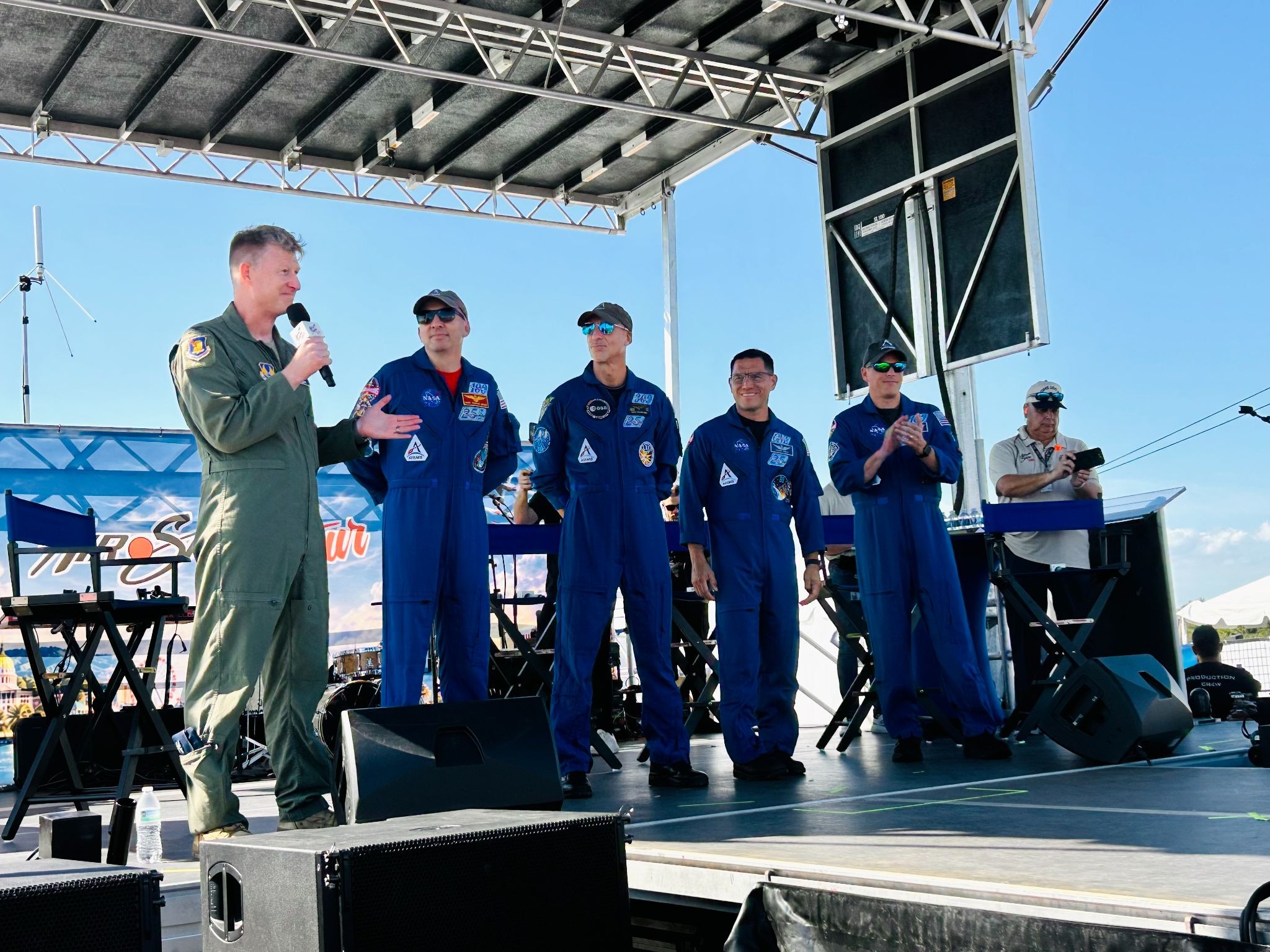
Former U.S. Air Force Thunderbirds commander Col. Justin Elliott introduces Artemis III astronauts Randy Bresnik, Luca Parmitano, Frank Rubio and backup astronaut Bob Hines. Photo courtesy of Sophia Romana.
By Sophia Romana
KENNEDY SPACE CENTER, Fla. — NASA held its inaugural MAX POWER aerospace expo and airshow at Kennedy Space Center’s historic Shuttle Landing Facility on Nov. 7-8, where the agency announced new astronaut recruitment opportunities, shared developments toward building a permanent Moon base and showcased aerospace technology.
One of the event’s biggest announcements came from NASA Deputy Administrator Matt Anderson, who revealed that the agency was opening applications for its next class of astronauts for the first time since 2024. Applications will remain available through Dec. 3.
A group of astronauts joined Anderson onstage as he addressed the audience, drawing cheers from a crowd that included many aerospace students.

NASA Deputy Administrator Matt Anderson addresses the crowd alongside a group of NASA astronauts. Photo courtesy of Sophia Romana.
“If we’re gonna win this second space race, build a Moon base, get to Mars, and continue to dominate in air and space, we’re gonna need the very best this country has to offer,” Anderson said during his presentation.
Anderson also highlighted the United States Space Academy, a NASA-led educational program announced earlier this year. Applications are expected to open in 2027, with the first students arriving in summer 2028. The program aims to prepare young Americans for careers in aerospace.
NASA also gave attendees a closer look at its upcoming Artemis III mission, which is planned for 2027. The approximately two-week mission will send four astronauts into low Earth orbit aboard NASA’s Orion spacecraft to test docking and other operations with lunar lander technology developed by SpaceX and Blue Origin.
These tests will help prepare NASA for Artemis IV, which aims to return astronauts to the lunar surface in 2028.
Artemis III commander Randy Bresnik, pilot Luca Parmitano and mission specialist Frank Rubio took the stage alongside backup astronaut Bob Hines for a discussion hosted by former U.S. Air Force Thunderbirds commander Col. Justin Elliott.
Following the discussion, the astronauts interacted with visitors near the stage, taking photographs, shaking hands and answering questions.
For attendee Joanne Cooper, meeting the astronauts was the highlight of the event.
“I think my favorite part of the event was meeting the Artemis 3 astronauts and listening to them talk on stage about what they were gonna do in the mission,” Cooper said.
NASA Administrator Jared Isaacman also participated in the airshow, flying an F-5 fighter jet and his personal MiG-29 before later parachuting onto the Shuttle Landing Facility runway in front of spectators.
After landing, Isaacman joined Elliott onstage for a sit-down interview about NASA’s upcoming missions and long-term goals.

NASA Administrator Jared Isaacman waves to the crowd alongside former U.S. Air Force Thunderbirds commander Col. Justin Elliott after their onstage interview. Photo courtesy of Sophia Romana.
During the discussion, Isaacman shared progress on Artemis III, saying much of the mission’s rocket was already assembled inside Kennedy Space Center’s Vehicle Assembly Building. He also discussed NASA’s partnerships with SpaceX and Blue Origin, which are developing the lunar landing systems needed for future missions.
Looking beyond Artemis, Isaacman emphasized the agency’s goal of establishing a lasting human presence on the Moon.
“We are building the Moon base because we are going back to stay,” Isaacman said.
He also discussed Space Reactor-1 Freedom, an uncrewed nuclear-powered spacecraft planned for launch toward Mars in late 2028. The mission will test nuclear electric propulsion, a technology that could allow spacecraft to travel farther into deep space more efficiently.
Isaacman also highlighted NASA’s plans to expand its experimental aircraft program, including the X-59, designed to test quieter supersonic flight, and the newly unveiled X-70 Fractal, which will test advanced flight-control systems and maneuverability.
Beyond the presentations, MAX POWER featured precision flying demonstrations by the U.S. Air Force Thunderbirds, skydiving performances, and exhibits displaying rocket engines and aerospace equipment.

The U.S. Air Force Thunderbirds perform a precision flying demonstration. Photo courtesy of Sophia Romana.
Looking ahead, NASA and its partners plan to expand the event into CAPEWEEK, a larger aerospace and technology expo scheduled for March 27 through April 2, 2028.
During his interview, Isaacman discussed plans for a new exposition center and expanded displays featuring aircraft, lunar rovers, spacecraft and other aerospace technology.
“What you are seeing today, imagine March of 2028, it will be 10 times bigger,” Isaacman said.