
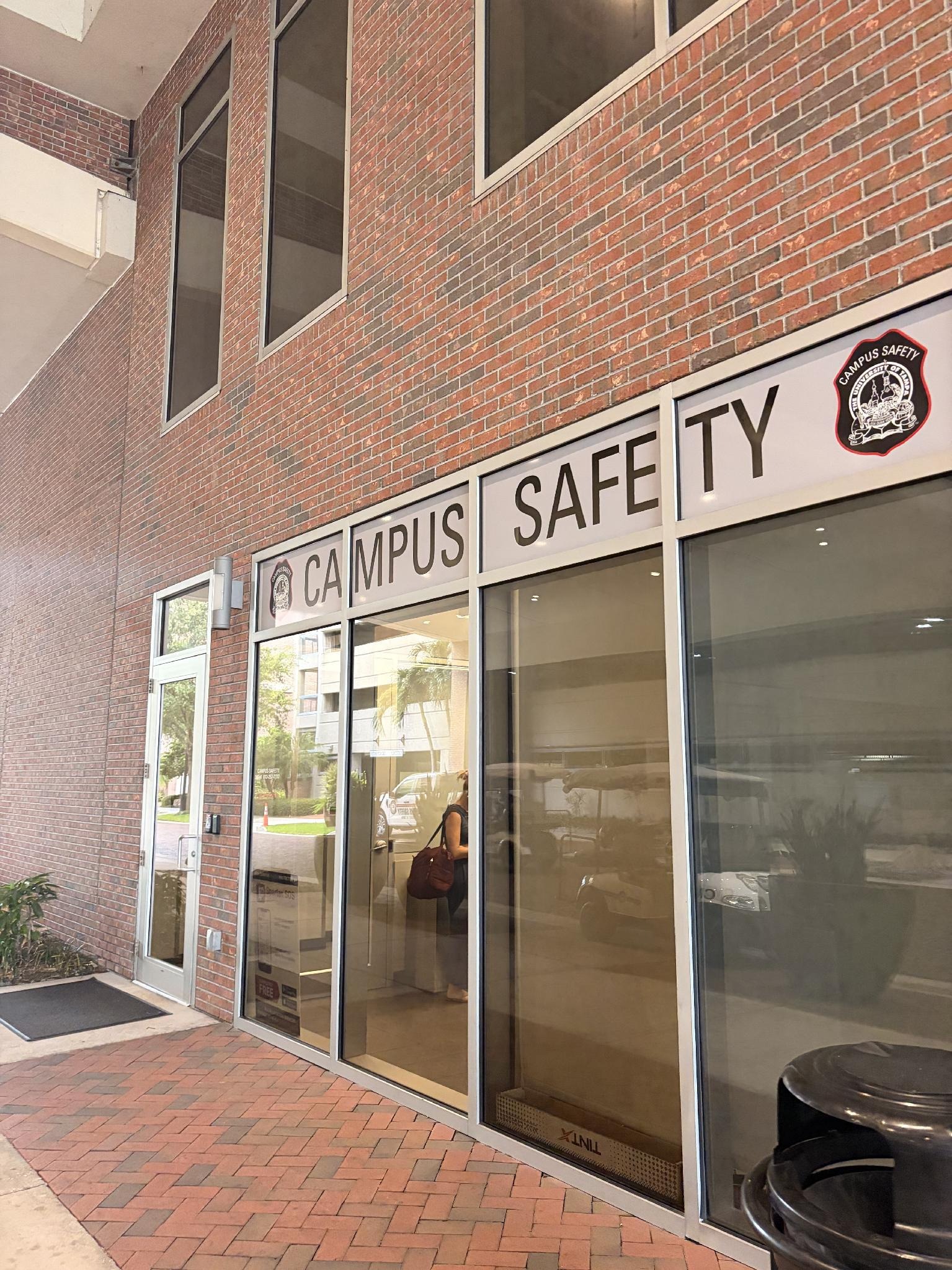
Photo courtesy of Sade Reyes.
TAMPA, Fla. — On Sept. 28 at approximately 12:50 a.m., the University of Tampa issued an emergency notification directing the on-campus students to shelter-in-place in response to a reported incident. The university said in an email the initial report was made by a third party directly to the Tampa Police Department, and police responded to campus to investigate at around 11:58 p.m.
By approximately 1:10 a.m. on Sept. 29, the university released another UTampa alert notification stating the report was investigated and thought to be unfounded. However, students reported seeing armed officers on campus and expressed wanting more communication about the safety incidents from the university. Tampa Police Department said that upon arriving at the university, they worked with campus safety to investigate the situation.
In an email, the Tampa Police Department said, “Officers searched university buildings and grounds and found no active threat. Based on preliminary information, it is believed to be a swatting call.”
A swatting call is a false report of a serious emergency intended to generate an immediate law enforcement response.
Loriane Daignault, UTampa’s vice president for marketing and communications, said the university worked and does work with Tampa Police when threats occur.
“TPD is the lead law enforcement agency in situations such as this, with the University of Tampa Department of Campus Safety serving as a cooperating agency,” Daignault said in an email.
Daignault also said that the original alert was not sent to all UTampa students.
“The emergency notification was directed to the residential community because the incident occurred during the overnight hours, when residential students were the primary campus population affected,” she said.
However, for some students, not receiving a notification from the university led to more confusion. Carmelo Traina, a junior at UTampa, said he mostly relied on his roommate and on-campus friends for information. Being an off-campus student, he did not receive the alerts from the university.
“I figured it out through someone else’s phone,” Traina said, explaining that he did not receive information from the university directly.
While the university did send out a campus-wide email that Traina did receive later in the day, he and his friends found themselves searching for information elsewhere before formal UTampa communication.
“I looked on other resources … schoolwide, as some people used YikYak.”
The social media site YikYak is an anonymous community app for college students that lets users post and message with their campus.
“I saw a post of people asking why there were cops outside of Straz Hall, and then a couple minutes later, I continued to look on YikYak, and I found out there that the cops were doing a campus-wide search,” Traina said.
Traina said that in the future he hopes for better communication between the university and its students.
“I think that the way TPD resolved the issue was great. I think they were very much in communication with the university. However, I just wish the university would communicate more to its students,” Traina said. “I’d rather the students find out through the university and not finding out through other sources and other people.”
In a university-wide email on Thursday, Oct. 1, the university released more information about the incident and safety communication moving forward. The email expressed that UTampa’s student government aided the university in expressing the concerns of students and recognized that these types of alerts can be alarming for students.
Jay Nikolai is a senator for UTampa Student Government. He explained that the student government worked with students to understand their concerns, then later with the university to relay their messages.
“As members of the Senate, we had a discussion with the group regarding the incident. This discussion stemmed from comments we heard from the student body and staff. The most important thing for us as Student Government officers is to listen to students about incidents like this. Most of this comes from word of mouth,” Nikolai said in an email.
The senators explained that after their discussion with their team, they also met with members of the university staff.
“… the Student Government President and Vice President met with the University and explained the discussion we had. They told the school our comments, and they already sent out a message explaining everything,” Nikolai said.
In the university’s latest email on the situation, they said that they have updated the approach to emergency notifications: “Moving forward, life-safety alerts will be sent to students, faculty, and staff across the University community. Life-safety alerts are emergency notifications that require members of the campus community to take immediate protective action, such as sheltering in place, evacuating an area, or avoiding a specific location.”
For more information:
Additional emergency preparedness information: Emergency Website
Sept. 28 Alert information: Here