
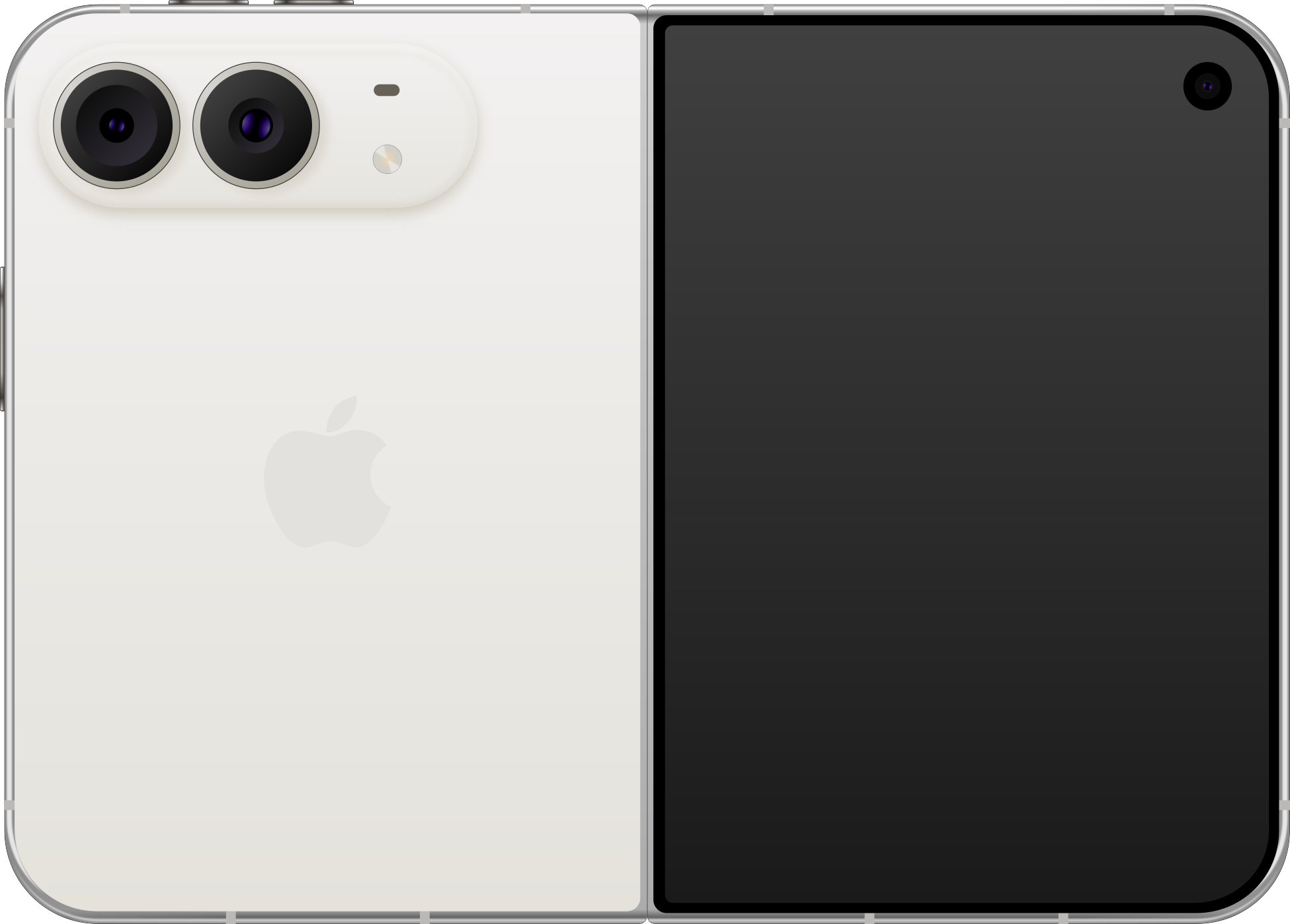
Image courtesy of Rafael Fernandez/Wikimedia Commons, licensed under CC BY-SA 4.0
Tech giant reveals the biggest design change in recent iPhone history
By Tyler Berlin
TAMPA, Fla. — On Sept. 9, 2026, Apple CEO John Ternus announced the iPhone Duo, the company’s first foldable smartphone.
Foldable phones have been around since 2018, coming to the U.S. market in 2019 with the announcement of the Samsung Galaxy Fold. Since then, many companies like Google, Motorola, and Huawei have made their own versions. Ternus said that many existing foldables feel compromised because of their square displays, and said that Apple designed the Duo around “a larger display that feels as natural and intuitive as iPad.”
The iPhone Duo features two displays: a 5.4-inch outer display and a 7.6-inch Super Retina XDR inner display, making it the largest screen ever offered on an iPhone. The device is made with Grade 5 titanium for increased strength and is rated with IP68 for water and dust resistance. To prevent distortion, Apple uses viscoelastic adhesives, which, according to Apple Chief Hardware Officer Johny Srouji, “Allow these layers to glide relative to one another during folding, like pages in a book, so the panel doesn’t distort over time.”
To connect both screens together, Apple designed a custom hinge mechanism that supports the display’s center and helps keep it flat when opened. The hinge provides a smooth opening and closing experience and uses magnets to help keep the device securely closed. The design also allows the phone to remain partially folded at different angles for different tasks.
According to a livestream of Apple’s latest event, the Duo includes Apple’s new A20 Pro chip, the most advanced iPhone chip to date. The device also has two rear cameras consisting of a 48-megapixel Fusion Main camera and a 48-megapixel Fusion Ultra-Wide camera. The main camera also supports a 12-megapixel, 2x telephoto option and can shoot up to 4K 120 FPS video. The front-facing camera is an under-screen camera, a first for Apple. Apple also brought back Touch ID, replacing Face ID.
Apple has also made many changes to its iOS to adapt to the new design. The Dynamic Island, Control Bar, and the dock are all right-aligned to maximize the space on the screen. Users can simultaneously use two apps in Split View. The software also automatically adjusts as the device is folded, unfolded, or rotated.
Emma Dawber, junior business information technology major at the University of Tampa, believes the Duo has both advantages and drawbacks.
“It does give you more room for reading and different things like that, but it’s harder to use, like, social media, text, and take photos, which is obviously more common features that people use day to day,” she said.
Dawber is not a fan of the design choice and believes it “seems more like an iPad compared to an actual phone.” She was also surprised that Apple didn’t include a better camera. “I’m kind of surprised it doesn’t have a strong camera, especially compared to the other iPhones, one of their key features.”
She believes foldable smartphones will not become more common in the future because “it’ll remind people of the flip phone, and I don’t think people will be that into that.”
The iPhone Duo will come in two colors, Star White and Night Sky, and starts at $1,999 for the base model. It will be available for purchase in stores starting on Oct. 23, 2026, and preorders will go on sale on Oct. 16, 2026.