
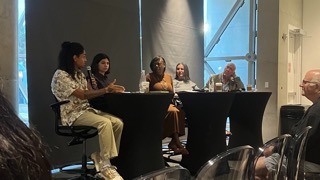
Photo Courtesy of Kawthar Ebrahim
Art, Conscience, and Public Square Panelists at The Dalí Museum
UTampa Philosophy Professor Joins Dalí Museum Panel on Art, Conscience, and Public Square
By Kawthar A. Ebrahim
TAMPA, Fla. — What is the true purpose of art in public spaces, and what happens when that art unsettles us? These were the central questions at The Dalí Museum’s recent panel discussion, “Art, Conscience and the Public Square.”
The event brought together thinkers and community members to discuss the ethical boundaries of artistic expression. Representing The University of Tampa was Zoe Anthony, a philosophy professor who brought an academic lens to the debates surrounding provocation, censorship, and institutional responsibility.
The discussion focused on apolitical art. Panelists argued that attempting to extract politics from a piece of art only proves that politics were embedded in it from the start.
Kai Tomalin, an artist and panelist, noted during the panel how audiences “see the color of the hands that made the art before seeing the colors used in it.”
For student artists on campus, that connection between identity and expression is central. “A lot of my work is centered around my nationality and my ethnicity,” said Ana Sofia Perez, a senior graphic design major from Panama. “Even if it’s not super obvious, you can tell it’s part of my intention behind it. All art is political in one way or another.”
The panel also addressed the blurry distinction between offense and harm. While offensive art can push boundaries and force audiences to confront uncomfortable worldviews, harm threatens public safety and civic well-being.
Because the line between the two is constantly debated, panelists emphasized that institutions that hold public spaces must make their values clear when displaying controversial work.
“I think art is like a venue to explore ethical questions,” said Zoe Anthony, assistant professor of philosophy. “Moral views are part of works of art that you can engage with… Yes, we love art in itself, but art is not divorced from its social and ethical context — these things matter.”
Another major theme was the danger of separating art from the artist. Panelists pointed out that historically, Indigenous art was stripped of its creators’ identities when taken or displayed in museums without proper origin.
When an artist’s voice is lost, and an object is treated purely as a commodity, its true cultural meaning and human impact are severely damaged. Perez emphasized how important that context is for people who go to museums.
“If you take the time to actually read the stories behind the work, you will find it way more interesting… regardless, you still take something home with you,” said Perez.
“We do periodize and contextualize types of works of art,” Anthony said about how institutions group objects. “When we group different works of art, it changes how we think of it as a large structural group versus individuals creating different things.”
For UTampa students in attendance, the panel offered a rare opportunity to see classroom theory applied to real-world cultural debates right in the Tampa Bay community.
“My initial understanding of the ethical implications of art was that it was mainly from a creation standpoint,” said Lauren Herring, senior communication speech studies and applied sociology major.
She said, “Through this talk, I realized that ethics come into play well beyond creation. It’s about the message you put out, the people who will receive it, and whether or not you give space to hold dialogue”.
Perez also highlighted the value of UTampa students engaging with local institutions like The Dalí and the Tampa Museum of Art, noting how supportive faculty and museums are in championing student voices.
“I think it’s very important to get involved as it will actually help you in your practice,” Perez said. “Museums are taking their part in trying to highlight student work as much as they can because they know that we are the artists of the future.”
As community spaces and educational institutions continue to navigate public discourse, the panel reminded us that art remains a tangible expression of humanity, meant to challenge us, provoke debate, and reflect who we are.