
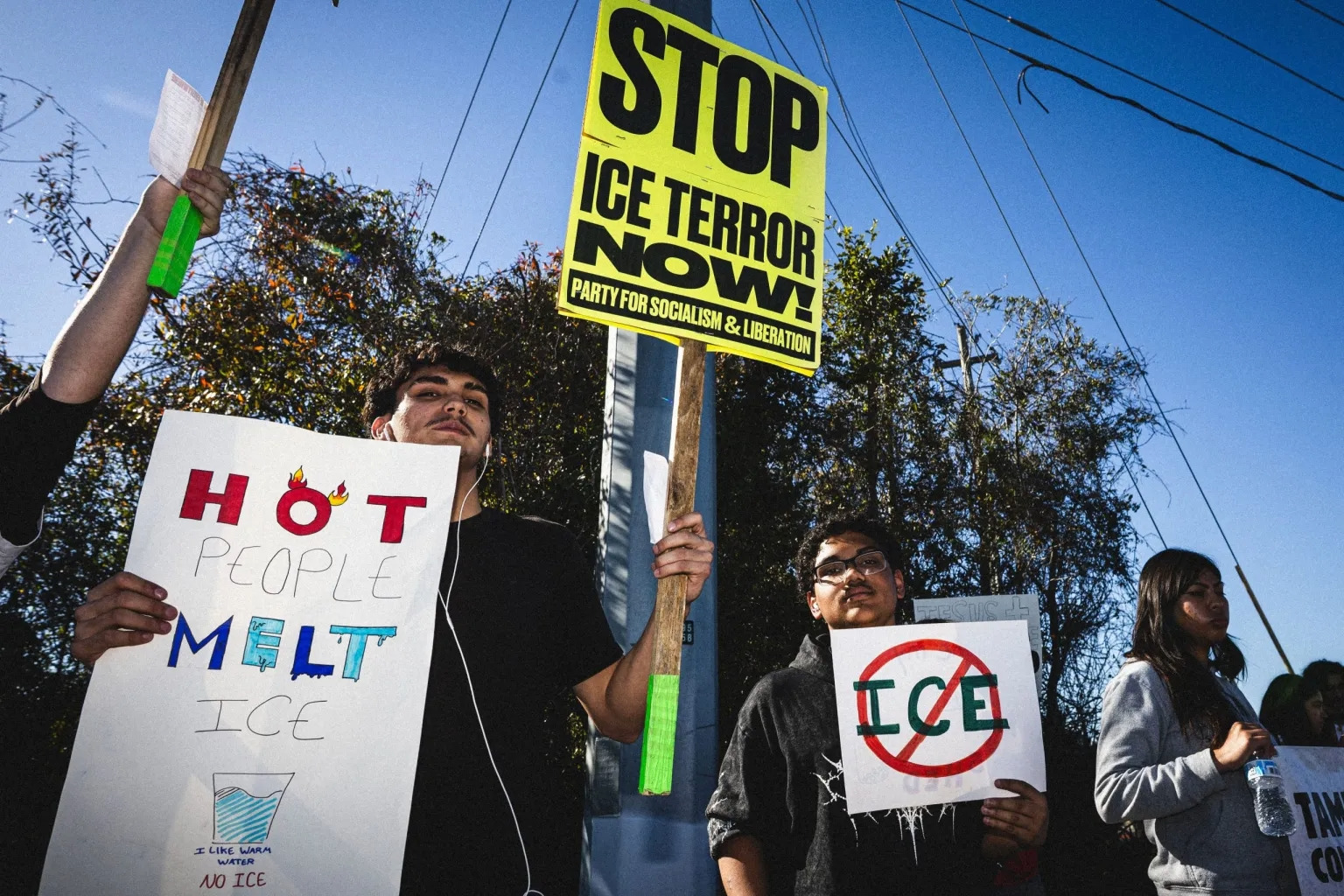
Students from Wharton High School protest ICE activity. Photo courtesy of Dave Decker.
Florida lawmakers warn students and school administrators about the consequences of classroom disruption.
–
By Nicole Droeger Stephens
TAMPA, Fla. — On Friday, Feb. 6, multiple high school campuses had planned student walkouts. According to a report from the Tampa Bay Times, students from St. Petersburg and Hollins high schools protested in Pinellas County, while students from Wharton, Blake, Plant, Hillsborough and Alonso high schools protested in Hillsborough County.
The walkouts were a response to Immigration and Customs Enforcement activity in Minnesota, as well as the deaths of protestors Renee Good and Alex Pretti. A report from The New York Times shares that the Trump administration is halting the deployment of ICE agents in Minnesota, effective Feb. 12.
These protests follow a student walkout that occurred on Jan. 30 at Lennard High School in Ruskin. State Representative Danny Alvarez Sr. called for the termination of Lennard Principal Dennis Savino on X, claiming the effort was coordinated among school faculty. Tampa Bay 28 reports that the Hillsborough County School District is investigating the incident and has yet to find evidence of Savino’s involvement.
In response to the protests, Florida Education Commissioner Anastasios Kamoutsas released a statement claiming the state “will not tolerate educators encouraging school protests and pushing their political views onto students, especially ones that disparage law enforcement.” Governor Ron DeSantis reposted this statement, adding, “Our kids are not pawns for political activism. Education, not indoctrination.”
The Hillsborough Classroom Teachers Association released a statement on Feb. 13 in response to lawmakers calling for disciplinary action. They said that student walkouts are not uncommon in the district and that the School Board already has policies in place to ensure safety.
“What is new is the attempt by state officials to place school employees in the crosshairs of political disputes,” the statement reads. “That approach puts educators and administrators at risk of being unfairly targeted for actions they did not initiate or control.”
Students maintain their freedom of speech in public school settings as protected under the First Amendment of the United States Constitution. The Tinker v. Des Moines (1969) Supreme Court ruling states that prohibiting a student’s free speech is not permissible if there is no “evidence that the rule is necessary to avoid substantial interference with school discipline or the rights of others.”
In Bethel School District v. Fraser (1986), a student delivered a speech containing sexual innuendos during a school assembly. The Supreme Court ruled in favor of the school district, stating, “it is a highly appropriate function of public school education to prohibit the use of vulgar and offensive terms in public discourse.” These allow schools to restrict speech that disrupts the
learning environment, and “the determination of what manner of speech is inappropriate properly rests with the school board.”
The Associated Press reported that funding for the Department of Homeland Security expires on Feb. 15. Democrats in the Senate are pushing for policy changes with ICE to reach a funding deal with Republicans.
As the investigations into the walkouts continue, the full consequences Tampa Bay school districts face have yet to be determined.

Photo courtesy of Dave Decker.