
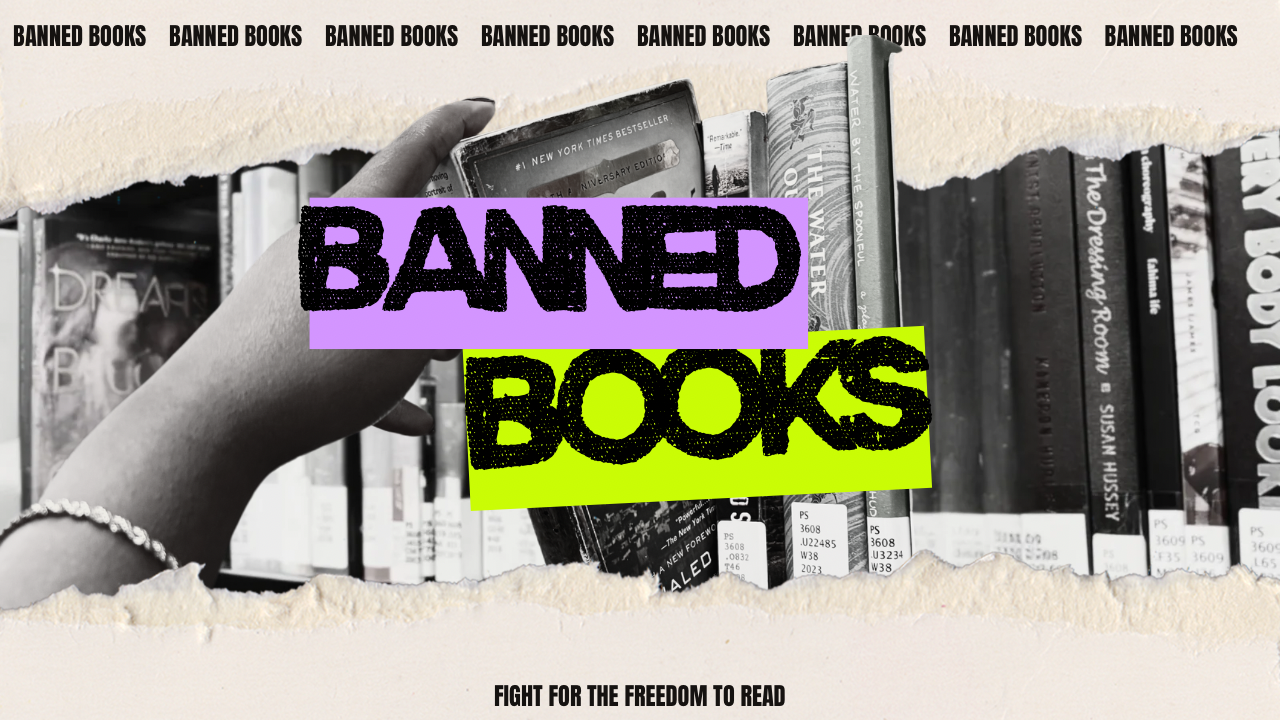
Photo courtesy of Genesis Muckle
From classrooms to public libraries, books have been the foundation for young readers to grow their literacy skills and be able to form their own opinions. Analyzing and seeing characters that are not usually represented in other parts of media, students can form their own morals for their futures.
TAMPA, Fla. — Over the past several years, the number of books banned in public schools has continued to increase. PEN America, a nonprofit organization whose mission is to protect free expression and human rights through literature, found that, since 2021, more than 21,000 books have been banned from public schools nationwide.
Books such as “The Perks of Being a Wallflower” by Stephen Chbosky, a coming-of-age novel surrounding the complexities of high school — and “The Kite Runner” by Khaled Hosseini, a novel about friendship, guilt, betrayal, and redemption — have been removed in states such as Florida and Texas.
The first record book ban dates back to 1637 and was an example of how early censorship was rooted in religion and political control. When it was published, New English Canaan by Thomas Morton was heavily criticized because it mocked the Puritan leaders of the Massachusetts Bay colony, including leaders such as Governor John Winthrop.
In his book, Morton criticized harsh religious laws, hypocrisy, and the mistreatment of the Indigenous people. This first book ban was an early precedent that highlighted society’s fear of ideas and perspectives that challenge authority. Years later, that fear still motivates modern book bans, but public institutions such as libraries have continued to be a vital defense against censorship.
Books should be thought-provoking, encouraging the next generation to question authority when needed, teaching them to think critically. Libraries continue to play an important role in intellectual freedom today. Leslie Vega, a librarian at the McDonald-Kelce Library at The University of Tampa, believes that librarians play a crucial role in intellectual freedom.
“We manage books, right? We manage the materials that come into our libraries,” Vega said. “A lot of us speak out against book banning and for freedom to read, freedom of speech.”
Book bans restrict diverse viewpoints and can delay literacy development. The lack of exposure to these books could lead to a less informed and less empathetic generation. Social media does not help the issue, becoming a platform for people to hide behind phones and share misinformation and cruel content.
Unlike books, social media has many platforms that make it more difficult to censor one’s freedom of speech. Book bans target a collective curriculum and institutional knowledge, while social media censorship targets individual expression.
Some argue that social media censorship is just as dangerous as book bans. These platforms have used the method of “shadow banning,” which means the algorithm suppresses the user’s content without their knowledge.
Vega describes this as a murky area, saying, “I think it’s harmful, but there is a line.”
She explains that while hate speech becoming restricted is something people would like to see, this can lead to the restriction of all speech as long as someone finds it hateful.
Social media censorship is also a global issue. Platforms such as TikTok and Instagram have become a way for people to be informed of important political movements — but when those movements threaten the views and beliefs of other powerful individuals, they are quickly taken down. This form of selective censorship goes against the idea that social media is used as a form of expression.
While these points are valid, we must protect intellectual freedom in all forms. As human beings, we need to learn to fight for our right to knowledge and open ourselves up to diverse ideas that could change the way we view the world.
Limited freedom of expression also limits our ability to learn. Freedom is a fundamental human right, and it doesn’t disappear when we delete a post or tweet; it disappears when we choose to close the book.