
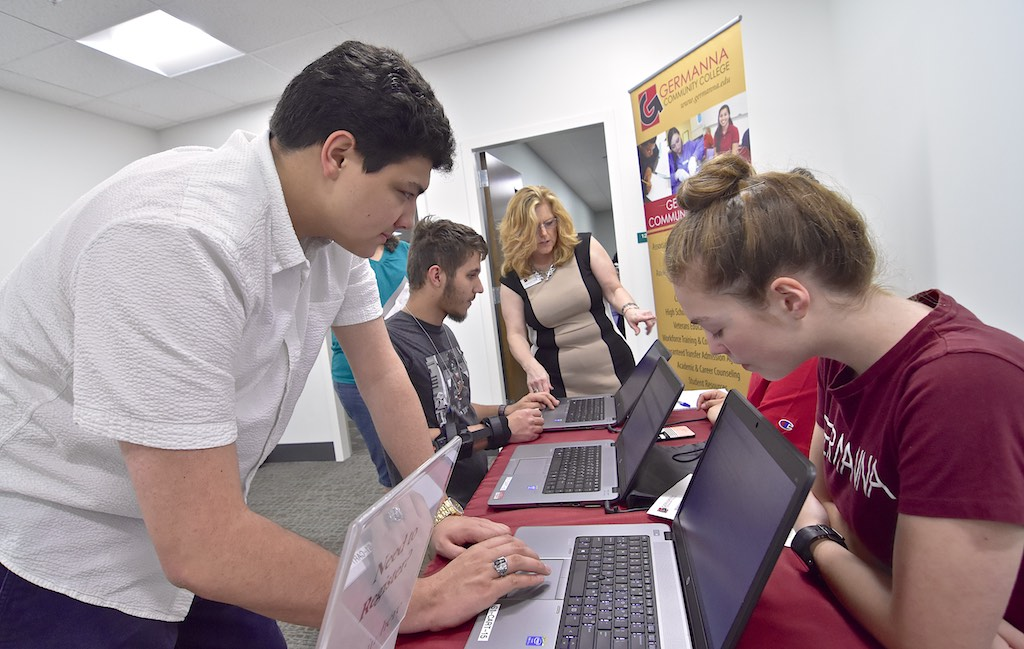

Photo Courtesy of Robert A. Martin / Germanna Community College, via Wikimedia Commons (CC BY 2.0).
By Valentina Nezaj
TAMPA, Fla. – The University of Tampa is notorious for its registration process, and how hard it is for students to get into the classes they want to take. Registration is available to students based on their graduation dates, so that seniors graduating soonest can secure the required classes they need. This leaves many freshmen on waitlists and rearranging their whole draft schedules by the time their registration window opens up.
Online resources like Rate My Professor come in to play for many during this time of year. Browsing online for your professors seems like an advantage, but the process can become really stressful when the professors with higher ratings fill up within the first few days of registration.
Reigns Bushara, a freshman, is the first time she will be registering on her own since her first semester classes were created by advisors at the UTampa. Even as a freshman, Bushara is aware of Rate My Professor and how it can be useful when crafting her dream college schedule. She avoids professors who not only have low ratings, but those who have a large number of low ratings.
“I guess if they’re too harsh with grading or if they’re just rude or not cooperative with their students, that’s something that I heavily consider,” said Bushara. “Also if they’re just not teaching the material well, it’s definitely something to consider when registering.”
Annabelle Cox, a sophomore, is more used to how registering at UTampa works, relies on Rate My Professor before choosing which professors courses she will take.
“I look at the reviews to see whether or not I’d be willing to take that professor,” said Cox. “If they have a bad rating I kind of steer away from choosing that professor, so it definitely influences my choice a lot.”
A commonality amongst students is that a professor’s overall rating is not the only thing that matters. Looking at the number of reviews and whether many students share similar experiences can help them decide how much weight to give a rating.
Samuel Gelfand, a junior finance major, said that he pays close attention to reviews when deciding which classes to take. Through his years at UTampa, he has always found Rate My Professor as a helpful tool in such a stressful time.
Over time, he has developed a technique that hasn’t failed him. If he sees that a professor has negative feedback, he would rather wait for a spot in a class with a professor he prefers rather than registering for a class with someone whose reviews concern him.
“I definitely think it influences what classes I take, ” said Gelfand. “I try to look at that and also, like, meeting patterns, but honestly, if a teacher has a really bad review, I will try my best not to get them.”
Gelfand said he also considers the circumstances behind a student’s review instead of immediately trusting every comment he reads.
“I will usually look at the person’s persons and then their review because if they have a bad grade, then they’re going to review the teacher badly, so I kind of take it with a grain of salt,” said Gelfand.
Gelfand, as well as many other students, looks for consistency between reviews, saying that overwhelmingly positive feedback is more convincing than a mix of positive and negative class experiences.
While students use these reviews to make decisions about their schedules, professors are also aware of how much their online ratings can influence registration.
Zelly Martin, assistant professor of Communication at UTampa in the communications and media studies department, said she periodically checks Rate My Professor to see what students are saying about her classes and uses the feedback as an opportunity to make adjustments to her teaching.
“I do check so that I can make adjustments in class to make sure that students are learning and also, as much as possible, enjoying class,” said Martin.
Martin also said she has noticed students checking the website as she advises students during registration periods. She is aware that it is a big part of students deciding what their next semester will look like. She is one of those professors that students become relieved when they secure a seat in her class.
“I’ve definitely noticed there are waitlists in all of my classes, which I really appreciate, and I wish I can get more people in,” said Martin.
Although online ratings are mainly used to help students decide which classes they choose, Martin hopes students continue to have positive experiences in her classes.
“I’m hopeful that my good ratings will continue so that people continue taking my classes, and I hope they’re not sad when they get in them,” said Martin.
For students trying to put together their schedules, Rate My Professor can be another tool to help make decisions before registration. While reviews may not tell the whole story of what a class will be like, they give students a chance to hear from others who have already taken the course. Ultimately, students are left balancing professor preferences with the limited class options available when it is finally their turn to register.