
By Katie Dellota
Two days before their planned visit to the Tampa Museum of Art, four University of Tampa students got sidetracked by an Asian cuisine food truck on Tuesday, Sept. 29. The group had not checked the museum’s closing time and, after spending nearly 45 minutes at the food truck, arrived too late.
Determined to experience something new, they returned Thursday, Oct. 1, for their first museum visit.

Emma Spektor and Micheal Royzman look toward artwork displayed in a gallery at the Tampa Museum of Art in Tampa, Florida, on Thursday, Oct. 1, 2026. Their shared attention illustrates how viewing art can encourage curiosity and create opportunities for visitors to experience and discuss artwork together (UT/Katie Dellota).
Art has an impact on young minds. It captivates the soul and creates a sense of deep emotional connection. Many young people, just beginning their journeys through life and their careers, yearn for a sense of being seen in their wonder, curiosity or even their loss of direction.
Just across the Riverwalk from the University of Tampa, four students stepped into the Tampa Museum of Art, leaving behind the stress of college life for an afternoon of exploration. As they entered the building, they were greeted by a world of color, creativity and interpretation, where art offered a chance to see life from a different perspective.
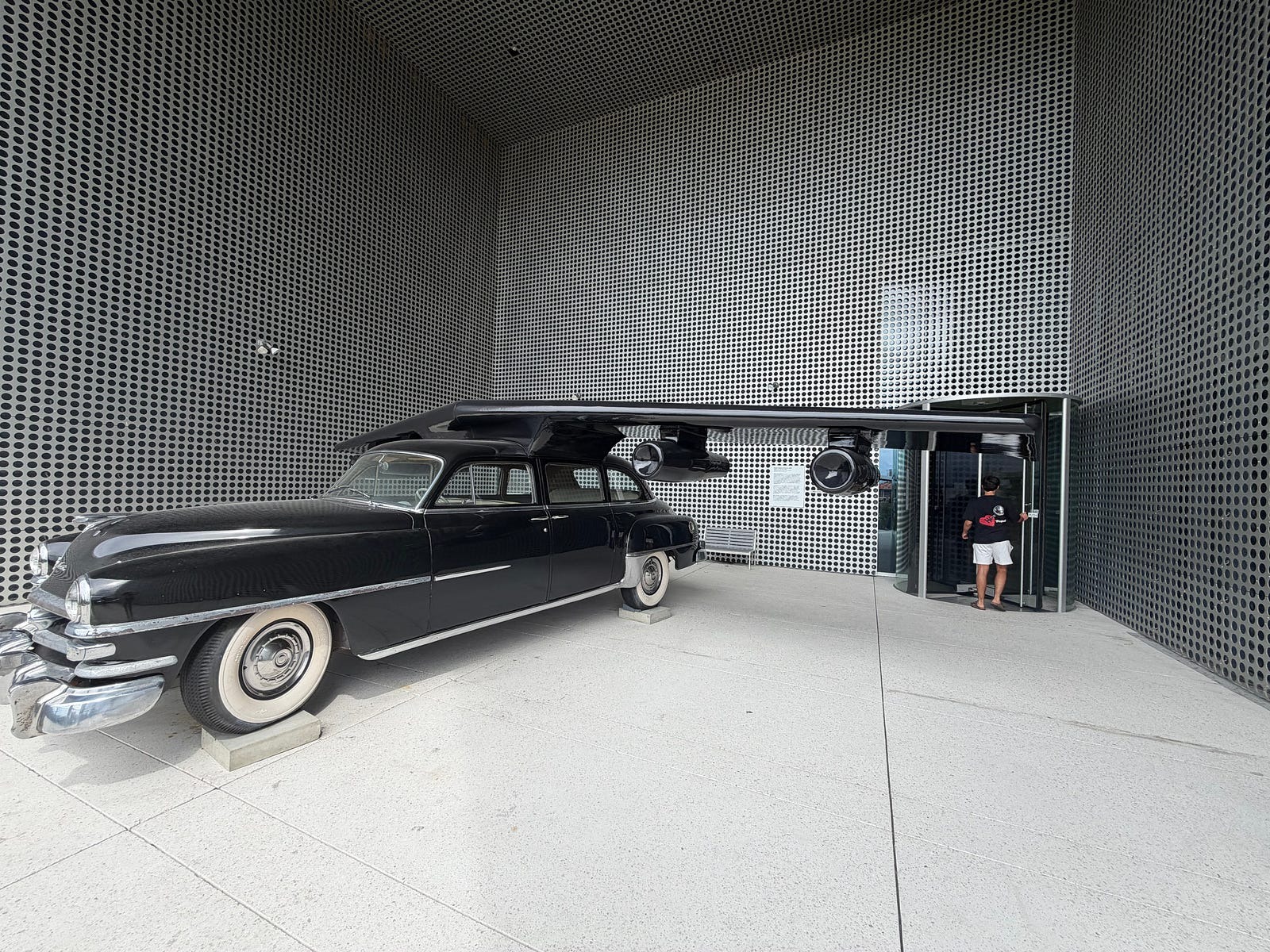
Hybrid of a Chrysler (2016), a sculpture by Cuban artist Esterio Segura, sits on the outdoor patio of the Tampa Museum of Art on Thursday, Oct. 1, 2026. The sculpture combines a vintage Chrysler automobile with aircraft components, transforming a classic car into a flying vehicle. (UT/Katie Dellota).
After ascending a beautiful wooden staircase from the museum’s lobby, the group was led onto a patio featuring a black flying car. Students, Braden Moller, Emilio Franco, and Micheal Royzman’s eyes widened as they took in the unexpected sight, immediately drawn to the unusual vehicle.
Emma Spektor examines framed paintings in an abstract exhibit at the Tampa Museum of Art on Thursday, Oct. 1, 2026. The arrangement of artwork along the gallery walls allows visitors to explore a variety of artistic styles and interpretations (UT/Katie Dellota).
Walking down the halls decorated with hundreds of canvases featuring peoples’ interpretations of life brought to mind the word sonder, which describes the realization that each person has a life as complex and vivid as one’s own, with unique experiences and perspectives.
Artwork from “Purvis Young: Redux” fills the walls of a gallery at the Tampa Museum of Art on Thursday, Oct. 1, 2026. The exhibition gives visitors an opportunity to explore how Purvis Young uses painting to portray everyday life and social issues (UT/Katie Dellota).
The artwork in “Purvis Young: Redux” immediately connected with the group. The friends had to look upward to take in the vastness of the work. Grins formed on their faces as they absorbed the colorful canvas, but as they looked closer, their brows furrowed in intense focus as they studied the details of the many faces and shapes throughout the piece. It offered a vision of the uncertainty a college student might feel in life, not knowing what they are doing or where they want to go. Various faces were painted abstractly in different colors and variations, creating a vision of yellows and oranges, greens and browns. The work looked overwhelming yet cohesive, conveying a message that young people do not need to have it all figured out.
Braden Moller smiles while viewing artwork in a gallery at the Tampa Museum of Art on Thursday, Oct. 1, 2026. His reaction captures the personal enjoyment visitors can experience while exploring artwork in a museum (UT/Katie Dellota).
Art is colorful and subjective. To one person, it can mean one thing; to another, it can mean something completely different.
Where one person might see movement, another might see slowness or stillness.
This is similar to how young people interpret life, as their mindsets influence the situations they put themselves in. In a university setting, people come from different walks of life. Many students come to college having lived lives of privilege, while others come from very little. Some students spend the coming years unfocused and without a vision. At the same time, other college students have a narrow focus and pursue who they want to become and what they want to accomplish.
Art connects with the heart, creating a sense of joy.
From left, Emma Spektor, Michael Royzman, Emilio Franco and Braden Moller examine artifacts in the “Mysteries of the Nile: Ancient Egypt” exhibition at the Tampa Museum of Art on Thursday, Oct. 1, 2026. The displays allow visitors to explore ancient Egyptian history and learn about its culture through surviving artifacts (UT/Katie Dellota).
The group made its way to the ancient history artifacts, featuring hundreds of large and small pieces that take visitors back in time.
These artifacts allow people to reflect on where they are in life. They give college students perspective on how far they have come and where they are going. They can spark curiosity, bringing pieces of history almost into the palm of a visitor’s hand.
Emma Spektor points toward the Collar with Falcon Heads, an ancient Egyptian jewelry piece featured in “Mysteries of the Nile: Ancient Egypt” at the Tampa Museum of Art on Thursday, Oct. 1, 2026. The artifact gives visitors a closer look at the craftsmanship and artistic traditions of ancient Egypt (UT/Katie Dellota).
Student, Emma Spektor, sat with a museum employee near Good Morning, Sunshine, a painting by Kelly Rysavy. She listened intently as the employee discussed her experience working at the museum and shared which pieces were her favorites. Together, they discussed the painting’s meaning.
From left, a Tampa Museum of Art employee and Emma Spektor, sit together on a gallery bench on Thursday, Oct. 1, 2026, discussing Good Morning, Sunshine, a painting by Kelly Rysavy. Their conversation shows how sharing perspectives can help visitors connect with and better understand artwork (UT/Katie Dellota).
Increasing numbers of young people are making their way to art museums. Young people today are greatly inspired by art. At every turn, Franco made a striking remark about a piece, always finding something joyful to smile at or peculiar to giggle at.
It isn’t boring for them anymore; it’s inspirational.
Emilio Franco raises his cellphone to photograph a framed artwork in the surrealism exhibit at the Tampa Museum of Art on Thursday, Oct. 1, 2026. His photograph shows how visitors document individual works and preserve memories of their experiences with art (UT/Katie Dellota).
As the group made its way through the museum, Franco documented the experience by taking pictures of the artwork that caught his attention. Each photo became a way to preserve a moment, capturing not only the art itself but also the experience of discovering something new.
For young people, taking pictures can be a way to hold on to memories as they navigate the changes and uncertainty that come with college life.
Emilio Franco smiles at a painting at the Tampa Museum of Art on Thursday, Oct. 1, 2026, as Emma Spektor runs behind him through the gallery. The contrasting actions capture how visitors experience art differently, with some pausing to observe individual works while others move through the exhibition (UT/Katie Dellota).
Art offers young people a chance to experience joy in unexpected ways. In the middle of college classes, assignments and the pressure to figure out the future, a museum provides a space to slow down and appreciate the present.
Whether laughing at an unusual sculpture, admiring a colorful painting or discovering a piece that feels personal, students can find happiness in the freedom to interpret art in their own way.
Art does not always need an explanation or a deeper meaning to make an impact. Sometimes, the joy comes simply from exploring something new, sharing reactions with friends and allowing curiosity to lead the way.
Still Life with Curtains, a painting by David Hockney dated March 1986, hangs at the Tampa Museum of Art on Thursday, Oct. 1, 2026. The painting’s bold colors and shapes show how artists use color and form to create visual interest (UT/Katie Dellota).
Spektor aeventually settled on one of the few benches scattered throughout the museum to take in the artwork. As they sat together, Spektor interviewed Moller about his visit and the pieces that stood out to him.
What began as a conversation about art soon turned into laughter as the two shared their thoughts and reactions to the museum. Their laughter reflected the comfort of experiencing something new alongside friends, showing how art can bring people together through shared moments, unexpected discoveries and different perspectives.
Emma Spektor interviews Braden Moller about his experience and favorite pieces at the Tampa Museum of Art on Thursday, Oct. 1, 2026, as he laughs and covers his face while sitting on a gallery bench. His reaction captures a candid moment during the interview and shows the personal side of experiencing art (UT/Katie Dellota).
Lastly, the group stepped into a room full of numbers that eventually transformed into a series of sunsets over the ocean horizon. The friends stood in the room as the sunsets appeared and fell over the horizon. A loud “ahhh” rose throughout the room as each of the dozens of sunsets came to a finish at the exact same time.
Then, the screen went black. At first, Moller and Franco seemed confused as they tried to figure out the purpose of the digital artwork.
From left, Braden Moller and Emilio Franco observe a digital installation featuring projected numbers at the Tampa Museum of Art on Thursday, Oct. 1, 2026. The installation demonstrates how digital art transforms a gallery into an immersive experience that encourages visitors to engage with art in new ways (UT/Katie Dellota).
The rest of the group soon joined them in the room, entering through the small doorframe that led into the dark abyss. The artwork created a sense of interactivity and fully immersed the audience. The piece was the group’s favorite. It was as if they were entering a different realm, capturing the true purpose of art.
A museum is a place to be seen.
A place where someone else expresses how you feel, and all you can think is, “They get me.”
From left, Braden Moller, Michael Royzman and Emilio Franco view Sky (Tampa) by Leo Villareal featuring colorful sunset and ocean imagery inside the digital installation room at the Tampa Museum of Art on Thursday, Oct. 1, 2026. The display illustrates how digital art uses light, color and changing imagery to immerse viewers in a visual experience (UT/Katie Dellota).
Amid the stress and piles of homework in college, a museum became a breath of fresh air for these four students. It was a break from reality, where they could step into a world of interpretation and experience life in a different form.