
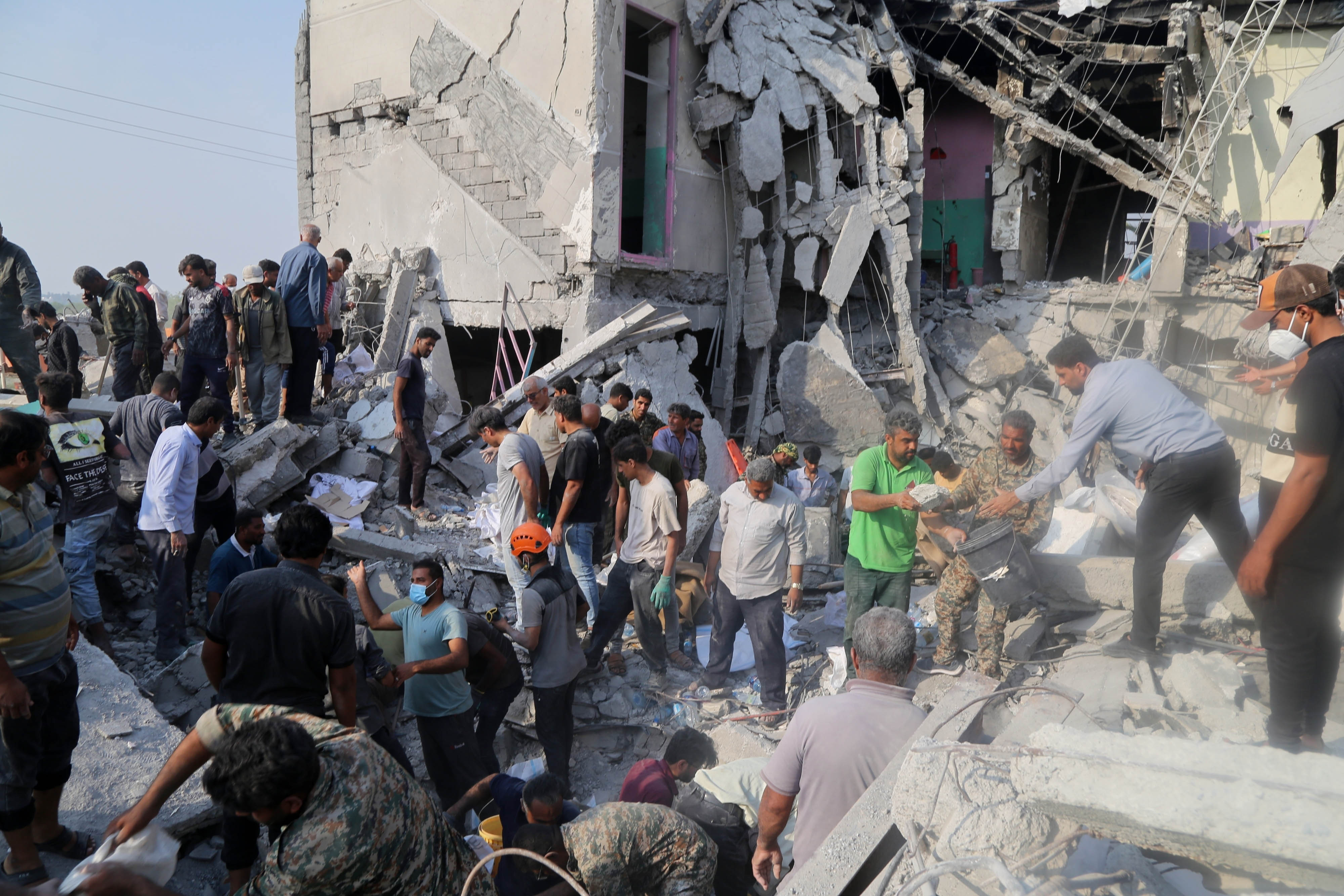
The aftermath of an elementary school in Iran when struck by U.S. and Israeli missiles. Photo courtesy of Felton Davis via Flickr, PDM 1.0.
Editor’s Note: This report is accurate as of 11:59 p.m. on April 9, 2026.
The U.S. is involved in yet another war in the Middle East, mirroring the conflict against ISIS in 2016.
–
By Nicole Droeger Stephens
WASHINGTON, Va. — In 2016, Donald J. Trump campaigned for the presidential election with the stance that he was against the United States waging war in the Middle East.
During the first debate against Hillary Clinton, Trump stated that he spoke with Fox News journalist Sean Hannity about the situation.
“He and I used to have arguments about the war,” Trump said, according to PBS Newshour’s coverage of the debate. “I said, ‘It’s a terrible and stupid thing. It’s going to destabilize the Middle East.’ And that’s exactly what it’s done.”
President Trump won the Republican primary vote in 2016. The New York Times reported that Trump launched bombs against an ISIS cave complex on April 13, 2017, countering his campaign stance that he was against U.S. involvement in the Middle East.
Middle East Conflict: 2016
The war in Iraq began on March 19, 2003, as a response to Saddam Hussein’s regime. According to George W. Bush’s official government library, the U.S. joined with other countries to initiate Operation Iraqi Freedom. This followed the campaign against terrorist activity in the Middle East and the Global War on Terror, which was initiated by former President Bush after the Sept. 11, 2001, terrorist attack against the World Trade Center.
Though Hussein was captured in 2003, the war in Iraq continued into 2016. According to the Human Rights Watch’s (HRW) 2017 World Report on Iraq, the U.S. led a coalition with other countries against the Islamic State (ISIS) in Iraq in 2014.
In 2016, ISIS kidnapped hundreds of children in the city of Mosul for religious and military training. Other human rights violations mentioned in the report are restricted rights for women, the destruction of Arab villages, and the placement of children in war zones, which often led to sexual violence and exploitation. The United Nations Assistance Mission in Iraq reported a total of 9,153 Iraqi deaths in 2016.
The U.S. was also involved in a war against Syria. According to PBS News, the conflict began on March 15, 2015, when protests occurred against then-Syrian President Bashar al-Assad. In response, Assad “moved quickly to crush the protests,” leading to many casualties and deaths.
HRW’s 2017 World Report on Syria stated that in Feb. 2016, the death toll in Syria reached 470,000. Around one million civilians were living in besieged areas, and 4,557 had been detained by the government between Jan. and June of 2016.
Trump pulled U.S. troops out of Syria in 2018, declaring victory over ISIS. The joint coalition against ISIS in Iraq withdrew troops in 2021, leaving fewer than 2,500. However, the U.S. left military base occupation in the country, signaling that tensions remain.
Iran War: 2026
On Feb. 28th, the U.S. and Israel launched missile strikes at Iran, targeting government compounds. The New York Times reported that the former Ayatollah Ali Khamenei was killed in the attack. As a response, Iran launched missiles against Israel as well as U.S. bases in the Middle East. One of the retaliatory attacks was against a U.S. base in Kuwait, which killed six service members.
The attacks followed President Trump’s warning in Jan. 2026, vowing to intervene after the Iranian government killed protestors.
On March 6, The Associated Press reported the missile that struck an elementary school in Iraq on Feb. 28 was most likely from the U.S. Satellite images and military information suggested that the order may have come from Central Command in MacDill Air Force Base, which is located in Tampa, FL.
On April 7, the U.S., Israel, and Iran agreed to a two-week ceasefire after Trump’s threats against Iran to reopen the Strait of Hormuz, a global trading route between the Persian and Oman Gulf. However, Israel launched attacks against Hezbollah in Lebanon, claiming it was not part of the ceasefire deal. The attack killed more than 180 people in the city of Beirut.
As of April 9, the latest update from the Associated Press reports that Israel’s Prime Minister Netanyahu agreed to talks with Lebanon. J.D. Vance is to lead the U.S. delegation with Iran in Islamabad, Pakistan. So far, both the U.S. and Iran have declared victory during the ceasefire.