
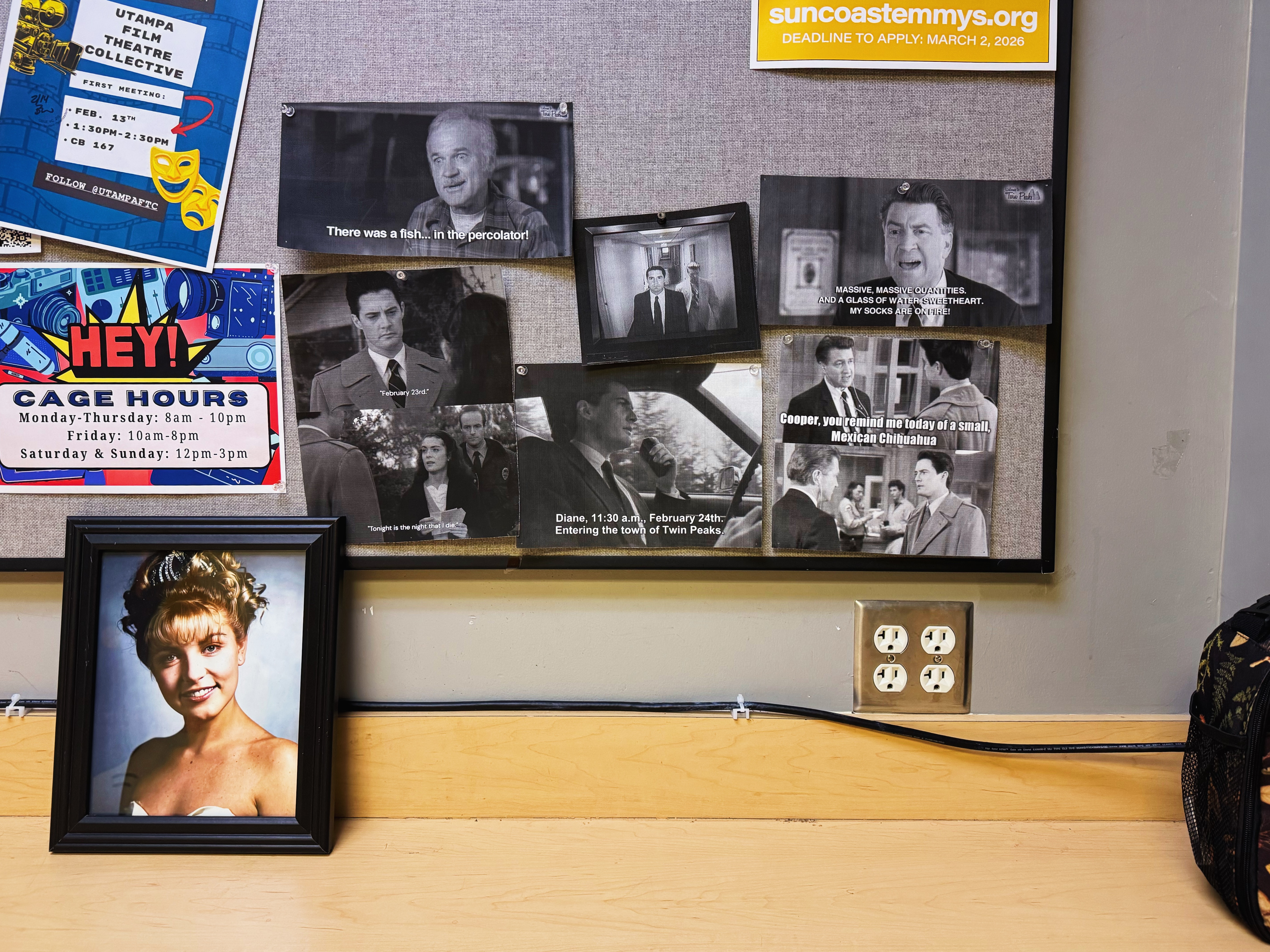
Photo courtesy of Andrew Miller.
Twin Peaks, David Lynch’s iconic television show, was recently shown for a handful of UTampa students, sparking new appreciation and, for some, outright obsession.
–
By Andrew Miller
TAMPA, Fla. — Thirty-six years ago, on April 8, 1990, the pilot episode of Twin Peaks premiered, co-created by David Lynch and Mark Frost. The Television Academy recalls how Twin Peaks instantly shook up the TV landscape:
“[Twin Peaks] was the most-watched TV movie of the 1989–90 season, seen by more than 34 million people.”
Those are numbers television rarely reaches, yet the show has seemed to quiet down in recent years, and when asked if people have seen the show or not, many first think of the restaurant.
Warren Cockerham, a University of Tampa film professor, recently gathered six film majors and decided to walk them through the show for the first seven weeks of the semester.
When asked his reasons for gathering the group together, Cockerham shared the excitement of watching one of his favorite pieces being experienced for the first time. The students were given the material to think about and actively dissected Lynch’s “cryptic” style.
“Everyone had fresh eyes,” Cockerham said. “This was the right group to do it with.”
Why does this material need to be “sat with?” Firstly, it’s a different visual style than most shows and films prior. Twin Peaks is riddled with dreamlike visuals and acting.
“It’s a different visual language,” Cockerham said. “It’s essentially the first ever cinematic television program.”
Nowadays, audiences are used to shows like Stranger Things that work as one long story, drawn out over the course of several seasons. Twin Peaks pioneered this technique, making long-form television storytelling common.
The main focus of the show is the story, not a common primetime plotline.
The pilot opens with the body of the local homecoming queen, Laura Palmer, being found on the beach. We learn, through the eyes of Dale Cooper, the FBI agent who comes to investigate the crime, the secrets behind the crime, the town, but also behind reality itself.
Without spoiling too much of the plot, you cannot talk about Twin Peaks without the theme of child sexual abuse.
Ollie Walter, a UTampa film major and one of Cockerham’s students, was impressed by David Lynch’s material, specifically the film that follows the show, Twin Peaks: Fire Walk with Me.
“I think it’s easy for directors, especially male directors, to really misconstrue a story like Laura’s,” Walter said. “David Lynch’s alternative approach, which is insightful and not at all perpetrated through the ‘male gaze.”
Lynch and Frost’s legacy continues to be greatly appreciated by the show’s cult following, and now Cockerham has spread that following to UTampa.
Students who have stopped in the Cass building cage recently to rent out any comm equipment, chances are you’ve seen the current Twin Peaks shrine.
Dante Peterson, another film student from Cockerham’s class, explains that although the show touches on severe material, there are many “meme-able” moments.
“Lynch has this unique humor,” Peterson said. “You may even miss it your first time around, not sure if you’re supposed to be laughing or not. But when Lynch makes you laugh, you LAUGH.”
Cockerham, Walter, and Peterson said the show’s legacy is alive and well, and encourage students to give it a chance. Find out for yourself, “Who killed Laura Palmer?”