
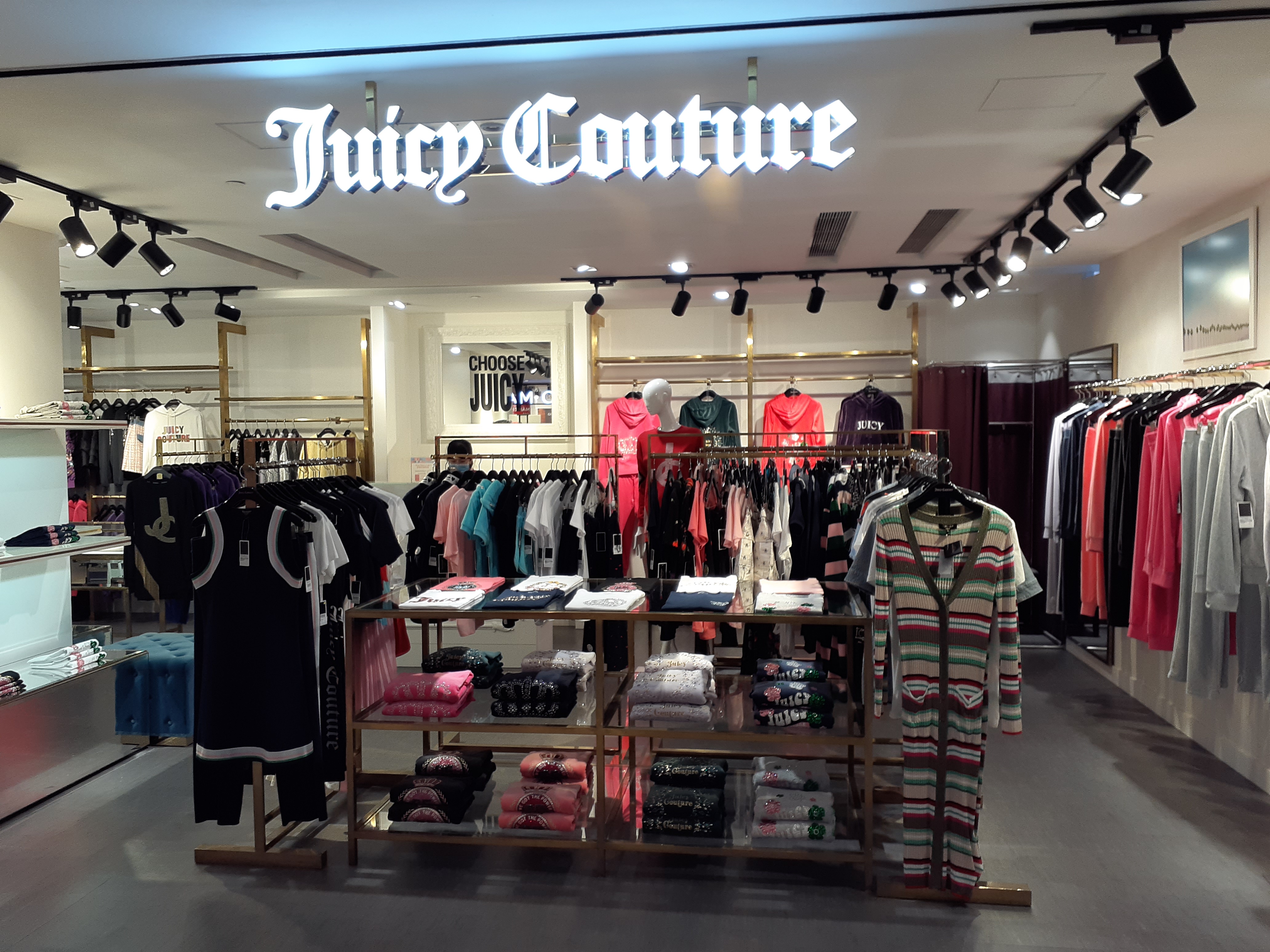
At Juicy Couture, bold style and velour dreams coexist with everyday luxury and soft glam. Photo courtesy of Leirus Yat Shung, CC BY-SA 4.0,via Wikimedia Commons.

By Jaide Edwards
TAMPA. Fla — Few companies in the early 2000s were able to capture the essence of casual elegance and celebrity culture like Juicy Couture. The brand became a mainstay in both pop culture and everyday fashion thanks to its distinctive velour tracksuits, rhinestone decorations, and daring, irreverent attitude. Juicy Couture is currently experiencing a comeback, as Y2K trends revive, reminding a new generation of why the brand once dominated both red carpets and closets.
When Pamela Skaist-Levy and Gela Nash-Taylor founded Juicy Couture in 1997, it was a tiny brand that sold maternity trousers before changing its focus to loungewear. The velour tracksuit, which combined comfort and glitz, was the brand’s breakthrough. The style of the tracksuit, which included fitting zip-up hoodies, low-rise pants, and frequently a rhinestone “Juicy” logo imprinted across the back, was just as distinctive as the fabric.
According to Worth Point, “Juicy Couture began as a small casualwear brand with a touch of urban glitz. Skaist-Levy and Nash-Taylor had previously produced a line of maternity clothes that was both comfortable and fashionable together. Once they launched their brand, they also made Juicy Couture t-shirts, jeans, and accessories.”
Around the early 2000s, Madonna set the rise for Juicy Couture.
“After they sent free tracksuits to several tabloid favorites, Madonna wore hers around London in 2001. After paparazzi photographed her personalized outfit—complete with “MADGE” emblazoned on her bottom — the tracksuit was in instant demand.”
Celebrity endorsements, both naturally and strategically, drove Juicy Couture’s early success. The brand’s tracksuits were often seen on celebrities like Britney Spears, Kim Kardashian, and Paris Hilton when they were traveling, running errands, or just being seen in public. These off-duty ensembles gained equal prominence to red carpet appearances during a period when paparazzi culture was flourishing.
Juicy Couture swiftly came to represent a particular early-2000s style that was feminine, ostentatious, and blatantly enjoyable. Young ladies were drawn to the brand’s phrases, which were frequently printed in vivid pinks and metallic hues. For those who wore it, it was an identity, not just a set of clothes.
Juicy Couture has grown well beyond tracksuits by the mid-2000s. The company solidified its position in the fashion business by introducing accessories, handbags, and fragrances. Liz Claiborne Inc. purchased the business in 2003 for about $226 million, indicating its increasing prominence and financial success.
However, Juicy Couture’s power started to wane as fashion trends changed in the late 2000s and early 2010s. The brand’s hallmark style seemed out of date as minimalist fashion gained popularity and logo-heavy styles declined. A major fall for the once-iconic brand occurred when Juicy Couture liquidated all of its retail locations in the United States by 2014.
According to Forbes, “Authentic Brands Group (ABG), the new owners of Juicy Couture, have announced all existing locations will be shuttered by the end of the summer. ABG says it has a new vision for the company and hopes to open 127 stores and in-store shops over the next five years.”
Despite the setbacks, Juicy Couture never completely vanished. Rather, it changed to a licensing business under the ownership of Authentic Brands Group, which bought the name in 2013. This action made it possible for Juicy Couture to keep manufacturing goods while looking into new partnerships and distribution methods.
The rebirth of Y2K fashion trends in recent years is partly responsible for the brand’s comeback. Juicy Couture has been reintroduced to younger audiences, thanks in large part to social media sites like Instagram and TikTok. Velour tracksuits with rhinestone logos have been popular again due to vintage shopping, thrift culture, and nostalgic content.
The resurgence has also been aided by contemporary influencers and celebrities. Artists such as Doja Cat and Kylie Jenner have been spotted sporting revamped Juicy Couture outfits that combine modern fashion with vintage aesthetics. Juicy Couture has been relaunched into mainstream retail settings through partnerships with companies like Forever 21 and Urban Outfitters.
The brand’s comeback is a part of a broader cultural cycle, according to fashion experts. Every 20 years, trends tend to resurface, and the early 2000s are currently a big source of inspiration. Juicy Couture is in a unique position to profit from its comeback because of its daring personality and close ties to celebrity culture.
A Business of Fashion article from 2022 states that nostalgia-driven fashion has grown to be a major influence on consumer behavior, especially among Gen Z consumers. The study emphasizes how digital marketing and storytelling help companies with a rich cultural heritage, like Juicy Couture, reestablish a connection with consumers.
In the same way, Vogue has highlighted how younger customers are adopting fashions that formerly characterized their parents’ generation by pointing out the revival of velour tracksuits as part of the larger Y2K trend. Juicy Couture’s comeback represents a desire for uniqueness, comfort, and lighthearted self-expression in addition to apparel.
According to Vogue, “celebrities aren’t ready to give up the 2000s aesthetic, either. Ice Spice, the princess of rap and Gen Z’s It Girl, redefined streetwear with her ultra-girly McBling ensembles, reviving matching tracksuits, bedazzled baby tees, and bubblegum pink.”
Hailey Bieber, Gigi Hadid, and Emily Ratajkowski also switched from leather blazers to boxy bomber jackets. The contentious newsboy cap was brought back by Anne Hathaway alone, and for those who are skeptical of the Moon Boots’ comeback, Rihanna has one — thus, they must be fashionable.
Not only are publications highlighting Juicy Couture, but a fan in Tampa, FL, Kayla Watts, honors Juicy Couture for more than just their clothes.
“Juicy contour is literally the best!” Watts said. “I recently just bought Champaign lotion and body scrub. It literally always smells so good, very soft and elegant on my skin.” She also said it was “very affordable. I bought it for $10.”
For many, Juicy Couture is an emblem of a particular era more than merely a fashion brand.
Juicy Couture must find a balance between innovation and nostalgia as it develops further. The brand is playing around with new designs and partnerships to stay relevant in an evolving fashion scene, even if its iconic tracksuits continue to be an integral part of its identity.