
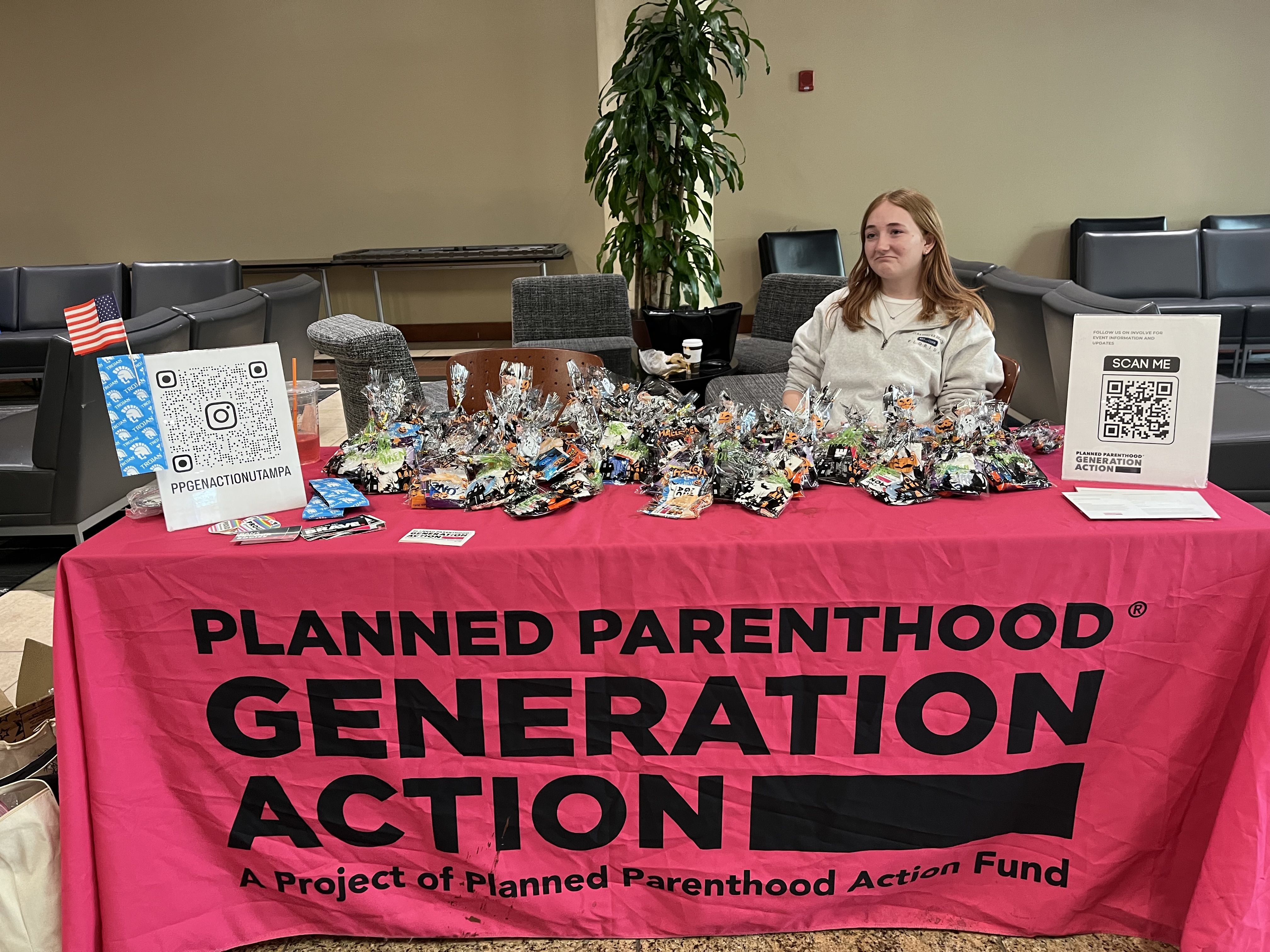
On Oct. 28, 2025, Planned Parenthood Generation Action (PPGA) had a tabling event in UTampa’s Vaughn Center. They gave out sexual resources to students in need. Photo courtesy of Jaide Edwards.
By Jaide Edwards
TAMPA, Fla. – Inside the Vaughn Center, tables line the main walkway — one draped with a bright pink tablecloth and the bold black lettering of Planned Parenthood Generation Action (PPGA). Behind it, Paige Horton, the club’s president, carefully arranges a row of pastel-colored goodie bags beside her teammate, Sofia Lenton-Childs, from Student Government. The two moved with calm determination, their voices low but steady, as students walked by.
Each Halloween, the club hands out decorated goodie bags containing a mix of condoms, candy, stickers, and a PPGA card — a small but intentional act of advocacy. The cards, printed and mailed directly by Planned Parenthood, help the organization track student engagement and membership on campus.
Across from their table sits the UTampa Republican Club. The two groups have shared this space before, but not without tension. Horton said that in past semesters, scheduling conflicts and strained interactions have made these setups “complicated.” But she has a job to do.
At first, most students walk by on their phones. A few talk to their friends after looking at the Planned Parenthood table, while others glance at the condoms before turning away. Only one male student stops, curious enough to ask what PPGA stands for and scan the QR code taped to the table.
Then, unexpectedly, the atmosphere begins to shift. A group of campus dining staff — the familiar lunch ladies from the cafeteria — approach the table, smiling. “I need this, it’s my birthday!” one of them laughs as she grabs a bag, her coworkers laughing with her. Their warmth breaks the cloud of tension. Slowly, more students begin to stop — some shyly taking a goodie bag, others scanning the club’s Instagram QR code.
By noon, the table is now surrounded by chatter, questions, and laughter. Horton smiles as she watches the people come by — the shift from hesitation to curiosity — proof that even in the face of criticism and restrictions, conversations about sexual health and education still have a place on campus.
For PPGA, the mission has always been clear: to empower young people to advocate for reproductive rights, comprehensive sexual education, and accessible health resources. As a student-led branch of Planned Parenthood, PPGA chapters across the nation give college students a voice in issues once thought to be too controversial for campus life — from abortion rights to gender equity to safe sex awareness.
But for The University of Tampa’s (UTampa) chapter, that mission has become more complicated in recent months. Following heightened political tensions and restrictions surrounding conversations about abortion on campus, PPGA leaders have had to reimagine what advocacy looks like. Instead of focusing solely on abortion rights — a topic that has led to pushbacks, harassment, and even a student restraining order — the group is shifting its energy toward being a resourceful and educational presence. Their recent tabling event reflects this change: less about protest, more about providing.
This new chapter unfolds against a national backdrop still reckoning with the 2022 Supreme Court decision to overturn Roe v. Wade, the landmark 1973 ruling that had protected the constitutional right to abortion for nearly 50 years.
Founded in 1939, the Planned Parenthood Federation of America has grown from a small, rebellious clinic to become the largest provider of sexual and reproductive health care and education in the country.
Student-led chapters like PPGA, which carry on the tradition of campaigning, education, and community support in the face of new legal and political difficulties, are set against the backdrop of Planned Parenthood’s long history of increasing access to contraceptive and reproductive health services.
Since its reversal, conversations about reproductive health have grown increasingly polarized, particularly on college campuses. In many ways, PPGA’s evolving identity at UTampa mirrors a broader generational response — one where advocacy meets adaptation, and education becomes its own form of resistance.
PPGA’s mission has never drifted from abortion advocacy, but during the election season of 2024, that advocacy drew attention that Horton and her members weren’t prepared for. The Yes on 4 campaign, which urged Floridians to vote on an amendment that would reverse the state’s six-week abortion ban, put a spotlight on the PPGA. Horton learned that visibility comes with a cost.
“We definitely find that we get the most pushback when we talk about abortion,” said Horton. “Our campus is heavily conservative. We’ve had people come up and make fun of us or try to trick us into saying something. We’ve even had to have campus safety on call for events.”
Students played a part in the tension, but other times, it came from organization chapters on campus, like the UTampa Turning Point USA chapter, whose members continuously questioned PPGA’s statements or crowded near their tables.
“People would walk by whispering, staring, or laughing,” said Horton. “It wasn’t always aggressive, but it was constant.”
But the most serious situation arrived early in the semester.
They hosted their educational event — “Myths and Realities,” led by founder Ally Schutz — which was meant to dispel misinformation about abortion using scientific evidence.
Instead, a female student aggressively challenged the presentation and escalated into hostility that left members visibly shaken. After arguing with Schutz and several others, she wrote notes filled with insults directed at the group and its mission.
Schutz, a senior political science student, founded PPGA on UTampa’s campus in the fall of 2022 following a period of thought about her role in politics and activism.
“I started this organization in 2022, fall semester, after a lot of self-reflection, and I found my way in abortion and reproductive politics,” said Schutz.
The idea to create the organization developed after she observed a “trans rights matter” sticker on her advisor’s office door and felt driven to act.
“It was originally just me, and I was like, I need members… I’m gonna throw the first event by myself,” said Schutz.
She made announcements, hosted the first call-out meeting alone, and provided her personal email and phone number to promote participation.
“I made the mistake of putting my email and my personal phone number on those flyers… I had people telling me… ‘you’re killing babies, you should kill yourself,’” said Schutz.
Despite the harassment, the effort brought her to Horton, the first interested member who contributed to the group’s growth and eventually assumed leadership before Schutz graduated.
For Schutz, the work became tied to her personal identity and the values she refuses to hide.
“I believe that the personal is political, so I can’t hide my politics,” said Schutz.
Her visibility put her in conflict with anti-abortion organizations on campus, including Young Americans for Freedom (YAF). After seeing a YAF display showing an image of a baby’s foot, she challenged the messaging publicly.
“I posted on my Instagram story, ‘Come join our first meeting, because this is terrible rhetoric. This is misinformation,” said Schutz.
The YAF member later appeared at a PPGA event and confronted her with statements she found extreme and inaccurate.
Schutz said the pattern of repeated appearances by the student at PPGA’s events felt like stalking, something she believed the university minimized by framing the situation as a free-speech issue.
“I feel like the school will do anything to protect Republicans and pro-life people… when this girl was high-key stalking me, like coming to every single tabling event… I felt like the school kind of was just like, ‘freedom of speech,’” said Schutz.
The situation caused significant emotional strain.
“I’m calling my mom crying. I’m like, ‘I don’t want this girl following me.’ And my mom’s like, ‘Well, that’s politics.’ I’m like, ‘that’s not politics, Mom,’” said Schutz.
As a young organizer, she struggled with the intensity of the backlash and the limited institutional support.
“She graduated. Never saw her again. But they just keep doing the same. There’s always a new one,” said Schutz.
Schutz said she remains proud of what she built but acknowledges the emotional toll. She emphasized that the fight over reproductive justice on campus continues.
PPGA had to make the tough but necessary decision to move away from abortion-centered advocacy in the aftermath of the election season and amid increasing hostility on campus. The group decided that while statewide advocacy mattered deeply to them, UTampa’s environment wasn’t the safest or most productive venue for that kind of political activity.
“Campus wasn’t the place for that,” said Horton. “We realized that our main work now is providing resources. We give out free Plan B anytime — no questions asked. That’s what we’re known for.”
The organization’s identity was altered by the pivot. Instead of protests, petitions, and myth-busting presentations, PPGA began focusing on approachable, inclusive programming founded in sexual education and student support. The focus of their events moved to providing students with useful supplies, such as condoms, emergency contraception, stickers, and instructional cards, in addition to social activities meant to soothe their anxiety.
Most planning begins informally, Horton said. Members suggest themes, discuss ideas in a group chat, and then plan events that resemble community get-togethers rather than lectures. “Sweet treat socials,” “craft nights,” and tabling sessions with candy or conversation starters have become their most successful events.
PPGA has established a solid base of partnerships that support its goal, which contributes to the success of this more relaxed, resource-centered approach. Their biggest sponsor is still Planned Parenthood.
“They send us all of the merch that we give out — all of the stickers, buttons, pins, magnets, bookmarks, like everything that we have to give out directly comes from Planned Parenthood,” said Horton. “They are our biggest supporter and our biggest funder.”
Other collaborations formed more naturally. Following a fundraiser where students created period bouquet arrangements in exchange for a $5 donation, they started working with Tampa Bay Period Pantry. Because of the high attendance, the pantry immediately contacted PPGA to request a partnership for future events. That cooperation now extends into resource drives, cooperative tabling, and co-hosted programs.
But redefining action has also meant negotiating difficulties — including resistance from UTampa’s Dickey Health Center over PPGA’s Plan B distribution. Like any other resource, members distributed emergency contraception at tables for months. Then they were reported.
The health center issued a severe mandate after a long Zoom meeting: PPGA could keep providing Plan B, but not in public. The club’s Instagram was no longer DM-able by students. All queries have to be routed confidentially through Horton herself.
Despite the limits, PPGA has refused to back down. “We’ve been very firm on that,” said Horton. “No matter what they try to do, we’re not going to let them stop us from providing resources.”
Partnerships continue to feed that determination. They work with Happy Tailes UTampa because they are aware that students frequently come for the dogs but leave with knowledge of PPGA. Together with USF’s Generation Action chapter, they are organizing an inclusive prom. They also intend to strengthen their partnerships with UTampa Pride, the Black Student Union, and potentially women’s shelters and crisis centers.
For Horton, the emotional weight of the situation was heavier than she first expected.
“We were just trying to educate,” said Horton. “And suddenly we had to worry about our safety.”
The backlash, the conservative pressure, and the student harassment incident created a turning point for the organization. What was once a passionate political movement on campus now had to be reevaluated. Members weren’t just exhausted — they were unsure how to keep advocating without putting themselves at risk or alienating students who viewed the group as “too political.”
Instead of doubling down, PPGA made a strategic shift. They stepped back from direct abortion advocacy and began focusing more on sexual health resources, inclusive education, and fun, community-centered events — a softer, safer point of entry for students who still cared about reproductive rights but didn’t want to be caught in the culture war surrounding them.
The new PPGA is still rooted in advocacy — but it’s advocacy built on accessibility, safety, and community. And for Horton, redefining activism hasn’t meant doing less. It has meant finding a way to do what matters most.
As PPGA president, Horton has established herself as the backbone of the organization, keeping meetings on schedule, paperwork done, and events from collapsing due to college regulations. Her everyday life is a combination of problem-solving, emotional support, and negotiating rigid university limits, even though the group’s aim is centered on reproductive justice.
Horton defines her work as a combination of crisis management, mentoring, and administration. She plans tabling events, schedules meetings, maintains statistics for student participation reports, and makes sure the group abides by institutional guidelines about what may and cannot be publicly advocated.
“As president, my job is to make sure everything runs smoothly,” said Horton. “We’re a small executive board, so I wear a lot of hats — data manager, planner, and sometimes therapist.”
“It’s a constant mental checklist,” she said. “But I do it because this community matters.”
Additionally, Horton’s leadership has influenced the club’s changing identity. She has led the group toward education-first programming, focusing on resource sharing, safer-sex information, and student-centered workshops, as they are restricted in how they can discuss abortion on campus. Her intention is to create an environment where students feel encouraged rather than lectured.
PPGA’s social media manager, Caitlin Clark, a senior English major at UTampa, expressed admiration for Horton’s ability to sustain the organization in the face of persistent obstacles and opposition from the college.
“She stepped in when everything felt unstable,” said Clark. “Paige really became the person holding the group together when we weren’t sure if we could even keep advocating.”
Clark said that despite limitations, members have remained motivated thanks to Horton’s consistent enthusiasm and dedication.
“She never lets us forget why PPGA matters,” said Clark. “Even when it gets tough, she keeps reminding us that someone on this campus needs what we offer.”


PPGA at UTampa held its last event on Dec. 2 in Grand Center. This event was merely to have fun, engage, and come together as a community. Photos courtesy Jaide Edwards (left) & Caitlin Carpenter (right).