
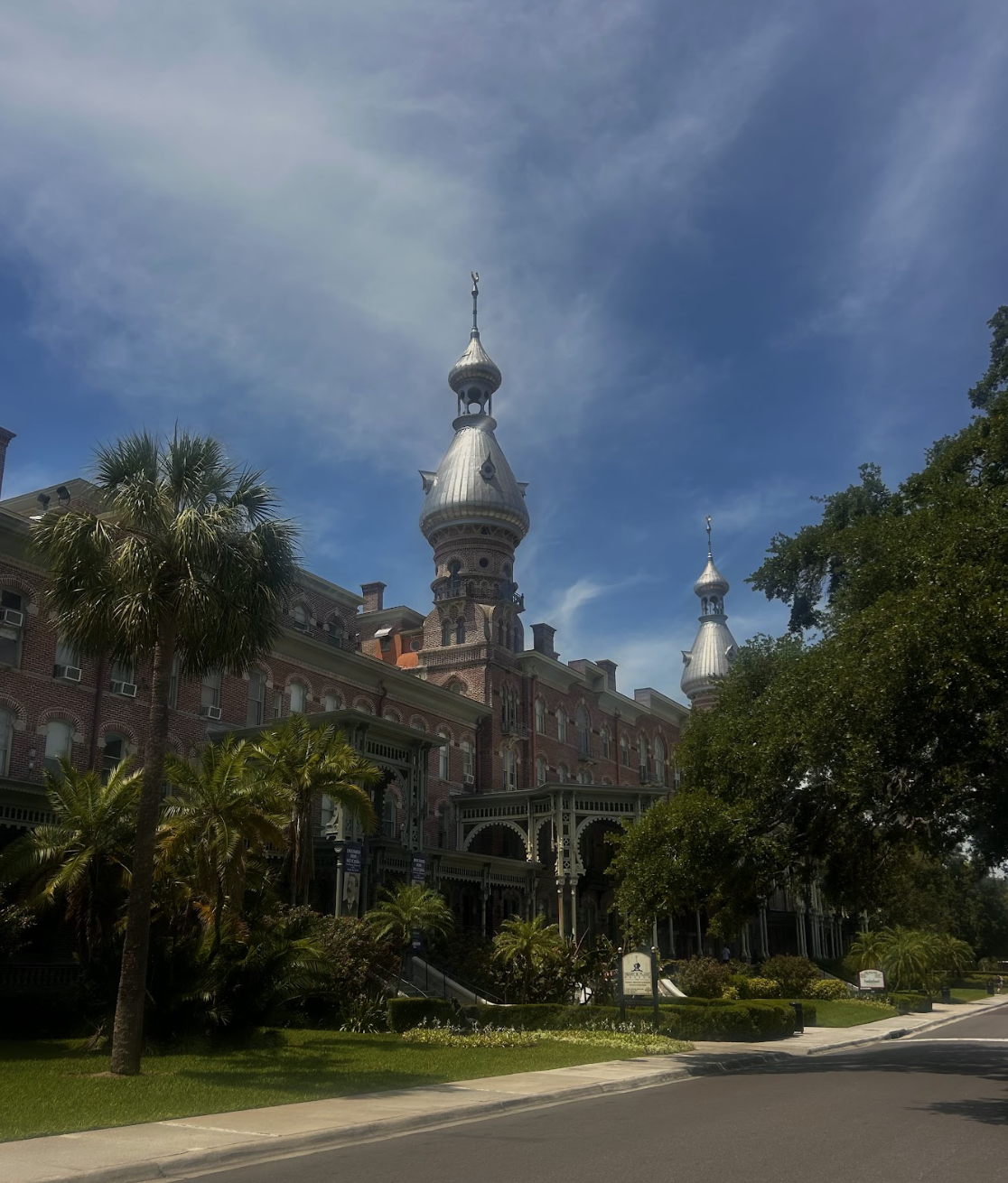
Photo courtesy of Olivia Gehm.
For a school that’s done nothing but rapidly expand, it may be time to take a step back.
–
By Olivia Gehm
TAMPA, Fla. — Ferman Center for the Arts, Palm Apartments, Grand Center, Maureen A. Daly Innovation and Collaboration Building, these are just a handful of spaces on The University of Tampa’s campus that did not exist 10 years ago. The actual list of new and renovated areas spans over a dozen buildings.
This construction boom is not what raises concern; these spaces are sleek, functional, and visually stunning. What is worrisome is what comes alongside these investments: a steady, unrelenting increase in undergraduate enrollment.
According to the university’s website, 2025–2026 saw record enrollment for both undergraduates and graduates, totaling 11,429. To put that into perspective, 7,752 students were enrolled in 2015. That’s a 48% increase over the past 10 years.
Moreover, the online university profile boasts “25 years of record enrollment since 1995.” With these figures in mind, UTampa’s enrollment doesn’t seem to be slowing down any time soon, and the school seems committed to growth.
Inherently, expansion is not a bad thing, and UTampa’s dedication to enlarging its campus is promising. However, the rapid nature of this expansion has the potential to squeeze students. The university needs to pause and examine whether the rate at which the school continues to grow is adding to the student experience or detracting from it.
Granted, growth was necessary at one point for the university to keep its doors open. Not just during the early days of the institution. As the Tampa Bay Times reported in 2015, the university’s enrollment dipped below 2,500 students in the mid-1990s, and its endowment similarly suffered.
The article noted that faculty worried about their jobs, some begrudgingly going along with rapid expansion, even if it meant sacrificing the intimate, personalized environment in which they cherished teaching.
Luckily for the thousands of UTampa students who currently enjoy the school, expansion plans worked, and the university’s endowment has grown from $12.7 million in 1995, adjusted for inflation, to nearly $60 million as of 2025.
So why does the school continue to expand enrollment? This is the question that undoubtedly runs through the minds of upperclassmen, who have likely felt the campus become more and more crowded each year.
Admitting the largest class possible is no longer as necessary as it once was. Yet, the school continues to welcome larger and larger freshmen classes, leading to less-than-ideal student experiences.
For example, the use of the Barrymore Hotel as student housing leaves many first-year students a 10-minute-plus walk away from the north edge of campus, and detached from campus life. While this problem was somewhat alleviated with the addition of Grand Center as a first-year dorm, the fact that first-year students are still being housed in the Barrymore, even temporarily, is unacceptable. A student’s first impression of their university experience can make or break their adjustment period; being put up in a hotel across the river from campus sets promising students up to fail.
Furthermore, parking woes add another level of frustration to students. As of 2019, there were roughly 1,000 more parking passes sold to students than there were spaces. While the Grand Center parking garage partially addressed this problem by adding 441 parking spaces in 2024, enrollment has increased by nearly 2,000 students since 2019. Such an increase has led to larger upperclassmen classes as time goes on, leaving a still large discrepancy between students who are allowed registered vehicles and available spaces.
The ongoing housing shortage compounds this problem, forcing juniors and seniors who have been pushed off campus to bring a car to school when they otherwise might not.
The time students must dedicate to finding a parking spot, coupled with long walks to class and often strict attendance policies, leaves many commuter students arriving on campus stressed.
UTampa’s relatively smaller class sizes and intimate campus are two reasons that many first-year students choose this school. Unlike a larger state university, students feel that they won’t be just another number. But by burdening school systems with an excess of students, there is a real risk of adopting that state school dynamic.
Ultimately, the university seems to have the room to take a step back and breathe. Most of the problems created by increased enrollment can be combated simply by waiting for the school’s infrastructure to catch up.
It’s difficult to know what goes on behind the scenes, and constructing new spaces for students is expensive. However, it would be wise for UTampa’s administration to evaluate if riding the existing wave of forward momentum is the right choice.