
By Franchesca Murrugarra and Kiley Petracek
TAMPA, Fla. – As The University of Tampa celebrates the end of its academic year, President Teresa Abi-Nader Dahlberg reflects on her first year in office –– a year marked by listening, learning, and looking toward the future. When she first stepped into her new role as UTampa’s 11th president, she inherited more than just a new position or title, but the strong foundation of a campus community ready for change.
Last June, Dahlberg became UTampa’s first female president, succeeding the decades-long tenure of former President Ronald Vaughn. As a first-generation college student who has been working in higher education for around 30 years, she believes in the powerful impact that education can have on one’s life.
Dahlberg reflects on her first day in office as the campus community welcomed her by setting up an ice cream social in the breezeway between GHS and TECH.
“People were there, so excited and all lined up to meet me and see what I’m all about,” said Dahlberg. “It was such a day of warmth, and I just felt like I was being given a big hug.”
Now, almost a year later, Dahlberg continues that warmth and welcoming spirit through her intentional presence on campus. To stay connected with the campus community, she instituted sessions called “Drop-In with Dahlberg,” where students, faculty, and staff could meet with her for a period of time to discuss matters on campus that are important to them.
“Those have been really fun because it’s a way to really get one-on-one,” said Dahlberg.
But her engagement doesn’t end there. Throughout the year, she could often be found walking throughout campus, dining at the cafeteria, popping into classrooms and meetings, and attending athletic events, all to connect with the community she leads.
“I do a lot of a whole variety of different types of engagements,” said Dahlberg. “And by engagements, I also mean work. It’s not just all about being with people that advance the university.”
She also is involved in various university operations. Her days consist of presentations, meetings, working on data governance and the budget, and focusing on specific initiatives such as “AI Across the Curriculum,” which is the upcoming initiative UTampa is establishing to prepare students for a workforce rapidly adapting to AI, and “Paid Internships for All,” which has an ambitious goal to have every student get an internship before they graduate.
During her first year in office, Dahlberg also had to make adjustments as a result of policy updates on state and federal levels. This includes changes to the university’s DEI Office, as it became the Office of Access and Community Programs in response to the “Dear Colleague” letter from the U.S. Department of Education in February.
Across the country, universities are navigating shifting political pressures that have led to restrictions on DEI initiatives. These changes come amid growing national debates on how higher institutions approach topics such as diversity, race, gender, and freedom of speech. While these changes have sparked concerns about the politicization of higher education, UTampa’s leadership has focused on balancing their compliance with federal regulations with their dedication to academic freedom.
“Academic freedom remains fundamental to our mission,” said Dahlberg, “and I have full confidence that the provost –– our current provost –– and then soon our incoming provost, will continue to support academic freedom while fostering open conversations on campus and in the student media.”
National changes are not the only adaptation Dahlberg has had to make in her first term, but there are other pages turning at the university that are marking a new era. A new team is coming, from the provost to head coaches.
“I think with a new chapter, it’s not necessarily about speeding things up,” Dahlberg said. “It’s about taking a fresh look at the direction that we’re going.”
However, growth might not look similar to what it did under former President Vaughn. In a faculty meeting on April 21, Dahlberg mentioned how UTampa “can’t grow forever.”
“There’s a practical matter of [being] landlocked, and like any institution or business, you can’t grow forever,” said Dahlberg. “So at some point, we need to hit a steady state of enrollment.”
Dahlberg pointed to the looming enrollment cliff that will occur in 2026 due to a population dip resulting from the Great Recession in 2008. Many universities are expected to face declining enrollment as a result. Florida may fare better compared to other states due to its population growth from immigration and people moving in from other states, but the university will eventually need to stabilize the size of its student body.
“I don’t think that we’ll ever admit less students, but right now, how many we admit increases each year, so it’s about leveling off, not going down,” said Dahlberg. “We’re still [growing] and we will be for a while because we’re still wanting to grow our reputation and add some more buildings to grow our qualities. But then we need to level off.”
When a university rests on a stable foundation, it can pave the way for enduring success for the entire campus community.
With a series of changes spanning from UT’s rebranding to UTampa to the fast preparation and mobilization in the face of two hurricanes that brought a whirlwind of activity to the area to the shifts made in higher education policies, the university has remained resilient through it all.
At the heart of this resilience is President Dahlberg’s forward-looking vision.
“I hope that my legacy is one of empowerment, building a university that supports students in achieving their dreams, and one that fosters a spirit of innovation and engagement and that magnifies UTampa’s positive impact on the world,” said Dahlberg.
–
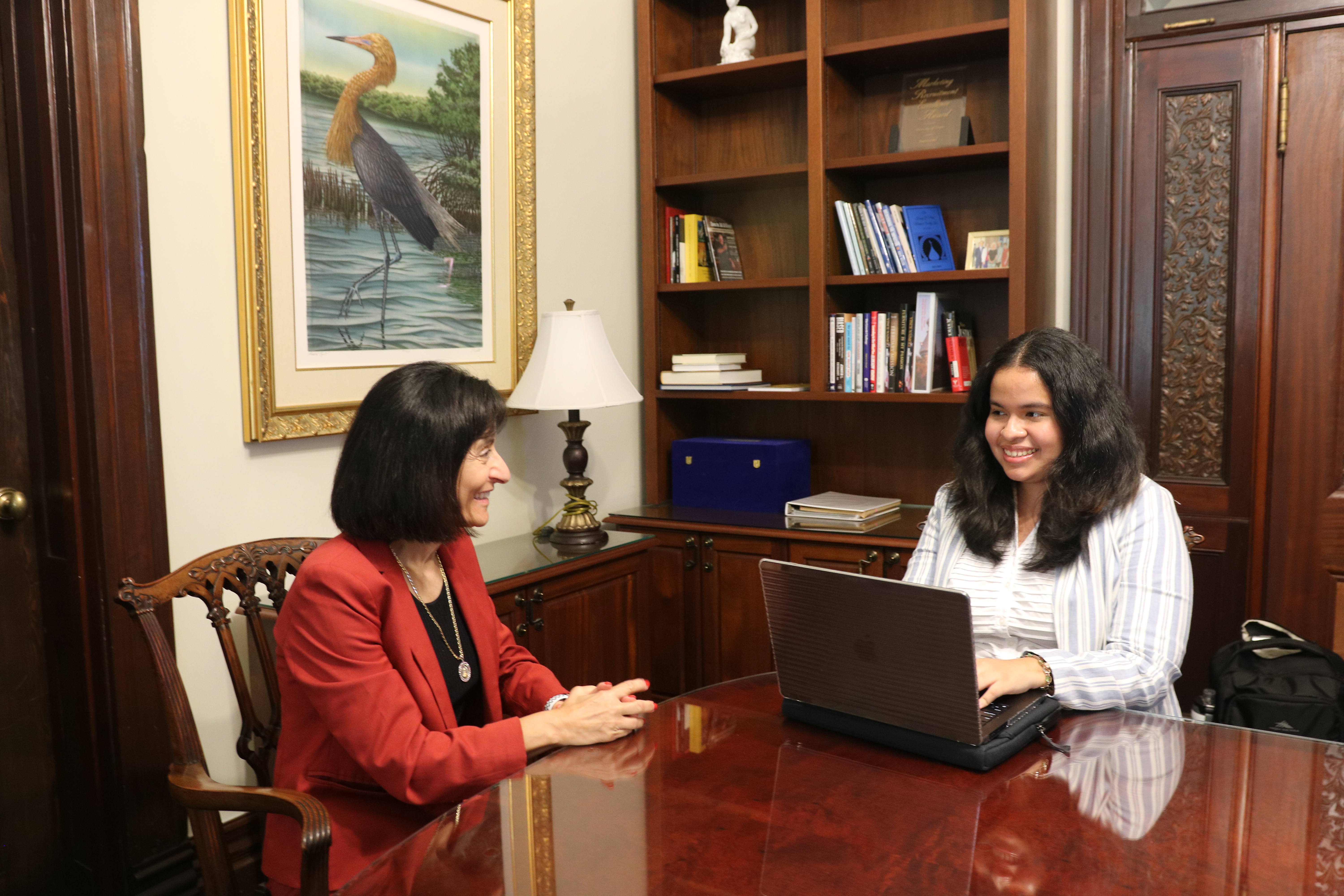
Franchesca Murrugarra, feature editor, interviews President Teresa Abi-Nader Dahlberg in her office. Photo courtesy of Kiley Petracek.