
By Matthew Restrepo
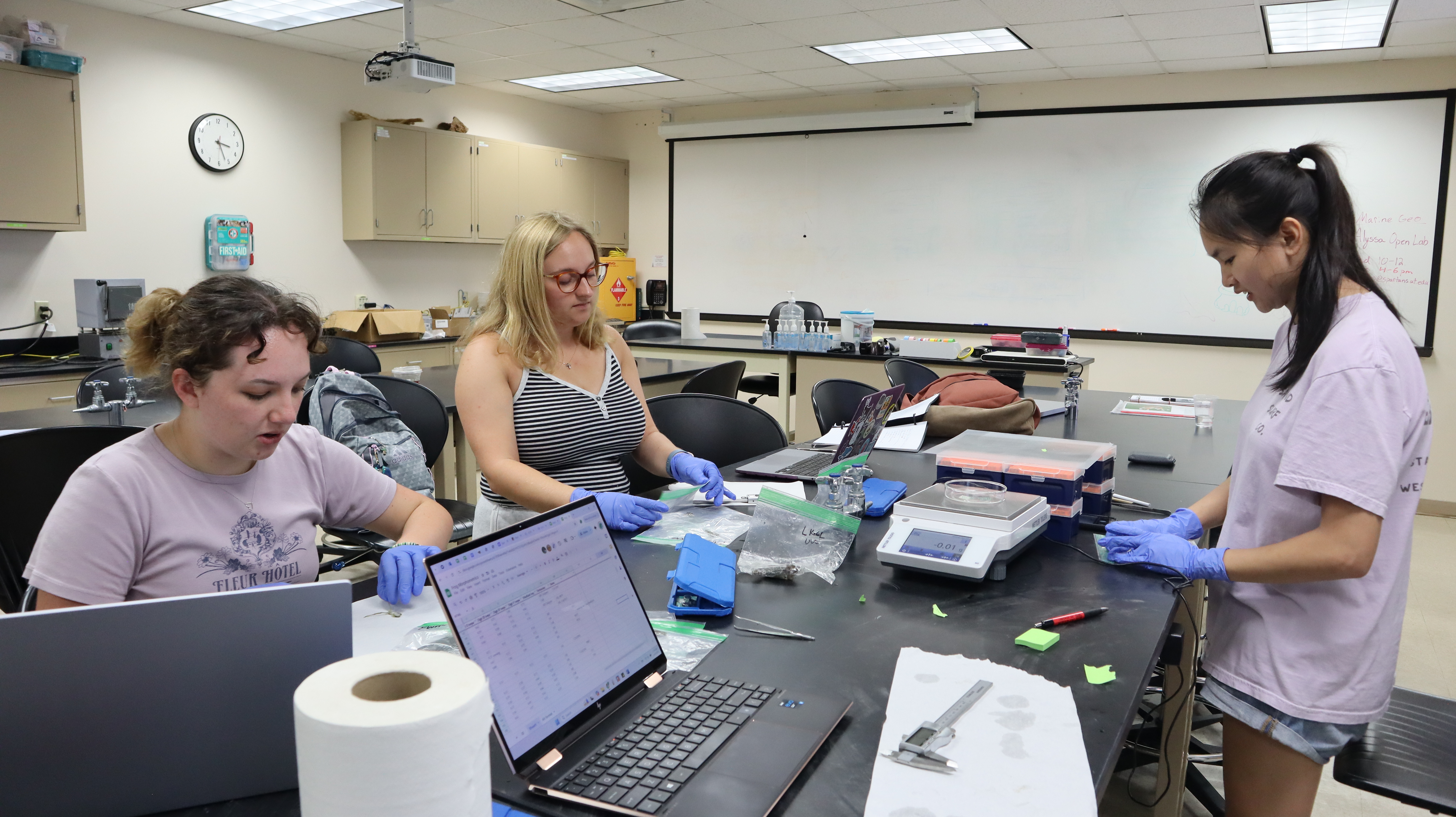
TAMPA, Fla. –– Three students at The University of Tampa — junior Gabriella Moraglia, senior Abigail Kirkpatrick, and freshman Carolyn Appleby — met on a Friday at 3 p.m. in a Cass Building laboratory. Snapping on blue gloves, they opened an Excel document and took out a scale and calipers to measure the euthanized invasive Cuban Tree Frog preserved in ice.
Going through the frogs one by one, they carefully measured them with the calipers before logging the data in Excel and finally weighing them.
The three students all study marine science and biology and have a passion for the outdoors.
Kirkpatrick recalled how her parents would tell her it was good for her to be outside, and she quickly ended up trying to catch fireflies or dig for worms. Moraglia said she has always loved to be outdoors and fishing. Appleby said that in the summer, she is not found inside but on a hike or on a boat.
In the summer of 2024, Kirkpatrick was approached by a biology staff member, laboratory coordinator, and instructor, Jacob LaFond, about whether she would like to start her research project.
LaFond allowed her to research anything she wanted, so she chose to research Cuban tree frogs, which are an invasive species in Florida.
“I thought that this was just an interesting species because no one had really done too much research on it,” said Kirkpatrick.
She said her project is about morphometrics. According to the chapter “Acquisition Methods, Methods, and Modeling” in the article Morphometrics, “Morphometrics refers to the quantitative analysis of form, which is a concept that encompasses both the size and shape of an organism or organ.”
She said her project is about urban versus rural populations of frogs and how the frogs are different in size between these two places. Appleby and Moraglia both began their research in Fall 2024.
Moraglia said she wanted to do research this year and was not having a lot of luck but decided to reach out to Professor LaFond and ask for guidance on research.
“Last year, I had taken [General Biology 2], and my lab professor was Professor Jacob LaFond, and he originally talked about how he studies frogs, and that’s what he did in his graduate research, so I thought it was very interesting,” said Moraglia.
Moraglia described how her professor wanted some students to help catch frogs for a research project.
“I thought this was a really cool idea, so I asked if I could tag along,” said Moraglia.
From there, they would go on late Friday night frog-catching trips.
“I also really enjoy fieldwork and just love the idea of it,” said Moraglia.
She proposed her idea of the hurricanes’ impact on these animals, and the data showcased a size change in the Cuban tree frogs from Hurricane Milton. Moraglia went to New College of Florida right after Hurricane Milton to catch the frogs because of how close the college was to where the storm made landfall.
“Ironically, there were so many frogs that night,” said Moraglia. “It was great.”
Appleby went on one of the frog-catching trips, and despite the exhaustion she felt on their way back, it led to an opportunity. She said they stopped at a gas station when Kirkpatrick approached her about an opportunity to join the research and eventually take it over.
Appleby later sat in the third row of the bus, eating a bag of Doritos and contemplating her future.
“I definitely sat just thinking and, like, looking out the window for a good 20 minutes, and I texted my friends about what had happened,” said Appleby
Kirkpatrick said she thought Appleby would be a good fit for the lab because she asked questions and was willing to engage with different creatures and search through a multitude of plants for the frogs.
“I would say the thing specifically with the research that catches people off guard is that I’m a freshman,” said Appleby.
She was inspired by the Steve Irwin family, but especially his daughter, after seeing Bindi Irwin engage with all sorts of animals, including dangerous animals such as crocodiles.
The students and volunteers have caught over 150 frogs at numerous sites, including at the University of Central Florida (UCF). On this trip, a volunteer named Federico Franco, a junior marine biology student, said LaFond gave him a herpetology hook, which is a long tool used to grab snakes.
As Franco passed by one of the lampposts, he saw something move on the lightbulb and realized it was a Cuban Tree Frog. He called his friend over and pointed out the frog. He said to his friend that he would need to catch it because he was going to go after it with the hook.
“So, I had, like, three people around me when I climbed the lamppost,” said Franco. “And since no one else could reach them, I just started climbing lampposts and going at them with the hook while the others tried to catch them midair.”

This type of experience is not always the case.
On Friday, April 18, LaFond and two student volunteers named Connor Hipp and Fiona Taft searched for frogs around UTampa. They checked the white PVC pipe traps placed in the ground vertically, and one frog was found that night in a trap adjacent to the creek in Plant Park, against a bush. Their search also took them to the courtyards near McKay, Urso, and Smiley Halls. They checked for the frogs in places such as walls and bushes, and LaFond even looked in a fire extinguisher holder, but their luck was limited to just one Cuban Tree Frog.
When they got back to the lab, LaFond euthanized the frog for research.
LaFond said in an email that he had gone back to check the traps and found five more frogs.
“This season is not predictable in any way,” he said in an email.
Kirkpatrick concluded that urban frogs and rural frogs were different sizes, with the urban frogs being larger than the rural frogs. Moraglia found that the size of the toe pads grew as a result of the hurricanes.
Overall, Cuban tree frogs are nocturnal and can grow up to five inches. They eat many Florida species, including those that are native.
“Cuban tree frogs are thought to be responsible for the decline of native species such as the southern toad and green and squirrel tree frogs,” wrote Hannah Farrow of the Tampa Bay Times. “They eat lizards and snails, and they compete with other tree frogs for habitat and food, according to the wildlife commission.”
In another article, “Invasive Cuban Treefrogs in Florida,” it was explained how it was believed that Cuban tree frogs were brought to the United States about one hundred years ago by cargo from Cuba and other islands.
The same article advised those who find Cuban tree frogs: “After you capture the frog, we recommend that you euthanize them humanely — in fact, it is illegal (and irresponsible) to re-release them into our ecosystem.”
Although other research has been done on animals such as island lizards that can adapt in a similar way that frogs do after hurricanes, LaFond said what makes these research projects different is not looking at the impacts of the invaders on the ecosystem or species, but looking at what adaptations these frogs have in urban environments or from changes related to hurricanes.
“So whether that’s the urbanization of Florida, or whether that’s potentially increases in hurricanes over the last few decades, we just want to understand how the species are actually able to evolve in response to these things, and if there are long-term evolutionary changes that happen in response to these stressors,” said LaFond, in regard to the future of the research projects.
—
Thumbnail image caption: Carolyn Appleby (left), Gabriella Moraglia (middle), and Abigail Kirkpatrick (right) conducting research on the Cuban Tree Frog specimens that were collected.. Photo courtesy of Matthew Restrepo.