
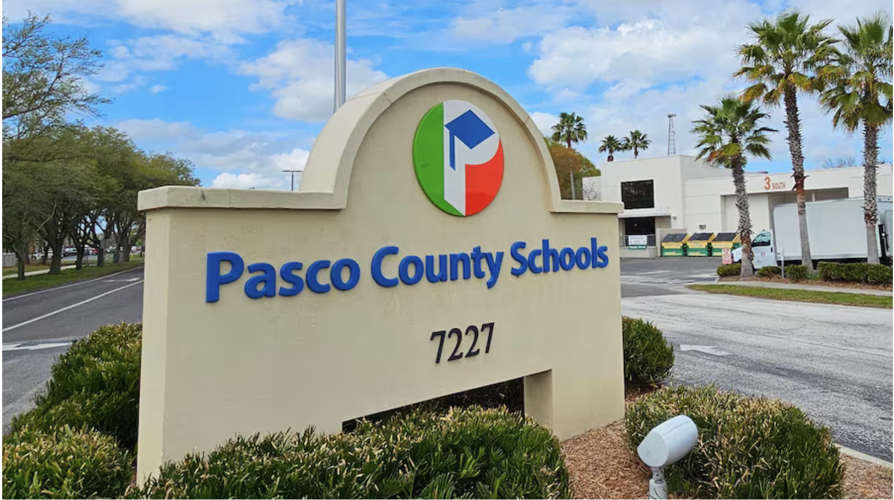
PASCO, Fla. — Pasco County’s student population is over half white, about a quarter Hispanic, and 8.1% Black, according to U.S. News. Despite this, Black and Hispanic students receive a disproportionately high share of suspensions.
The Florida Department of Education shows Hispanic and Black students account for 43.6% of in-school suspensions (ISS) and 42.4% of out-of-school suspensions (OSS), even though they make up far less of the total student body.
This trend is also observed statewide. Robert F. Smith said that the consequences of these racial discrepancies are significant and stem from systemic racism in schools that has been present throughout history.
The U.S. Census said in 1940, only 7% of the population nationwide had a high school education, and 24% of those were Black.
As of 2020, the percentage of Blacks or African Americans who possessed a high school diploma was just short of the national average at 88%.
Systemic racism is in every aspect of the education system, including funding, lack of diverse subjects, lack of opportunities, and disciplinary action.
School discipline doesn’t just punish students; it also has long-term effects on their academic trajectories, as they are more likely to fall behind academically, have lower graduation rates, and be more likely to drop out.
According to ProPublica, Black students are academically 1.3 grades behind, while Hispanic students are 0.7 grades behind white students.
Jess Aiken, a 2023 graduate from Pasco County, said she noticed a disparity in the number of Black and brown students attending higher-level courses, specifically Advanced Placement (AP) and honors courses.
“I feel like the demographic within those classes did not reflect the actual demographics within the school,” said Aiken.
White students are 1.5 times more likely to be enrolled in an AP class than Black students and 1.3 times more likely than Hispanic students, said ProPublica.
A large number of her female peers, particularly those of color, face repeated dress code violations and unequal punishment, said Aiken.
“I feel like it was obvious that it wasn’t to the same amount as the often less fuller white counterparts,” said Aiken. “It was almost never addressed, even though I know it was something that was brought up to teachers and school administrators.”
A 2021 study stated that 26% of Black students received at least one suspension for minor infractions, including dress code violations, compared with just 2% of white students.
This suggests a systemic issue in how discipline is applied, where certain groups of students are more frequently targeted for minor infractions.
Lilly Howell, a 2023 Pasco County graduate, shared her own experience of racial disparity.
“In eighth grade, my friend and I got in trouble on the bus,” said Howell. “I was punished and told to clean the bus for a whole week and almost got a referral, while no punishment was given to my white friend.”
In 2013–2014, Black students faced OSS at four times the rate of white students and three times the rate of Latin students, according to Ballard Brief. This harmful inconsistency shows how some students experience implicit bias while others do not.
Zero-tolerance policies in schools play into this bias as well, said the National Association of Secondary School Principals (NASSP). What was originally designed to address severe issues, particularly for violence or weapon usage, is now used frequently for subjective behavior like disrupting a classroom. This often results in harsh punishments like suspension or even expulsion, particularly for Black students, regardless of context.
Not all disciplinary measures are criminal offenses, and the school system’s approach should seek to minimize the long-term negative impact on students, said Stephen Thompson, director of community relations for the Sixth Judicial Circuit Pinellas County Justice Center.
Juvenile diversion programs, such as teen court, support students who have already faced disciplinary action in schools. If completed, these programs allow the student to have their record withheld.
“[The goal is to] affect the child as little as possible through the juvenile diversion program, so that any transgression doesn’t affect the kid,” said Thompson.
By offering a second chance, these diversion programs aim to ensure that students can move past their mistakes without facing long-term consequences, such as a permanent criminal record.
However, while 50% of cases involving white youth are diverted to these programs, only 39% of Black youth and 48% of Latinx youth receive the same opportunity.
As a result, Black and Hispanic youth are more likely to face formal prosecution, increasing their chances of incarceration, according to The Sentencing Project.
While there’s no single solution, schools and families can reflect on ways they support all students through inclusive curricula, more diverse leadership, and a commitment to equity in the classroom. These shifts take time, but they can create meaningful change.
Families and educators need to advocate for their underrepresented students more, both for personal and academic reasons, such as promoting diversity in leadership and providing financial assistance.
Pasco County schools have made little effort to combat this disparity, nor have they chosen to comment on it.
Twenty-four officials, educators, and students in Pasco County, as well as officials from nonprofits and the Florida courthouse, were contacted. Eight declined to comment, including the Pasco County superintendent, and 13 did not respond.
–-
Photo courtesy of Jeffrey S. Solochek from the Tampa Bay Times.