
By Franchesca Murrugarra
TAMPA, Fla. – When Melissa L. Sevigny stumbled across a nearly forgotten record at Northern Arizona University, she didn’t expect to find the seeds of her third book. Nestled within the record’s text was a mention of research papers donated by Lois Jotter, an American botanist, that had not yet been curated. It began the journey of piecing together an untold story that combined botany, women’s history, and the indomitable spirit of the first two white women who successfully rafted through the Colorado River in 1938 and cataloged the plants of the Grand Canyon.
During a time when women were seen as incapable in scientific fields compared to men, Elzada Clover was someone who was not afraid to take up space. She was an outlier of her time, obtaining her master’s and doctorate in botany at the University of Michigan. Her dedicated passion for botany overshadowed the sexism that fought to keep her down.
“Elzada was larger than life,” said Sevigny. “She was adventurous. She was obsessed with plants.”
Lois Jotter, Clover’s younger colleague at the University of Michigan and fellow botanist, exuded a quieter strength. Yet, at 24 years old, she had a youthful enthusiasm about life, and most especially about nature.
“Lois, I found to be very warm-hearted, very funny, very kind,” said Sevigny.
The botanists’ shared mission was as ambitious as it was unprecedented: to raft the entire length of the Colorado River through the Grand Canyon while mapping out the plants of the region, which was a feat that no American woman (and very few men) had dared to attempt before.
It was a research expedition that drew national headlines before the journey had even begun, and there was an underlying belief that the Colorado River was unsuitable for women in the 1930s. With its violent rapids and towering canyon walls, the river was feared by even experienced adventurers.
Many were doubtful that women were capable of conducting such scientific fieldwork in rough terrain and even more so when botany was originally written off as an effeminate discipline in the late 1800s and early 1900s.
“Botany’s virtues were women’s virtues: gentility, innocence, and modesty,” wrote Sevigny in her book. “Flowers, after all, reflected qualities most treasured in women: fragility, purity, and loveliness.”
However, the types of plants that intrigued Clover were not the precious flowers that one could pluck from the grass on a stroll but the ones that bristled and poked and were stubborn in the face of the droughts of the American West.
“I was surprised by the sexism that they faced,” said Sevigny. “I probably shouldn’t have been. But once I really started learning about their experiences and just how consistent it was for people to tell them that women couldn’t raft rivers and women shouldn’t be doing science … it ended up being a bigger part of the story than I initially intended it to be.”
However, despite all this, Clover and Jotter defied all expectations and successfully braved the Grand Canyon’s treacherous rapids in an effort to catalogue the plant life of the region. Over the course of 43 days, the women — accompanied by Norman Nevills and three inexperienced boatmen — faced danger head-on and dealt with runaway boats, skeptics, and the harsh rivers flowing throughout the gorges.
After the groundbreaking expedition, the news quickly shifted its skeptical tone.
Before the trip, news outlets would heavily emphasize the deadly dangers of the Colorado River and how it was impossible for women to undertake. However, once the journey was completed, the narrative suddenly shifted. Suddenly, the media downplayed the dangers, suggesting that the river might not have been so dangerous after all if even women could manage to survive.
This severely undermined the accomplishments that Clover and Jotter made in mapping the botany of the region, though it inadvertently paved the way for more women to participate in similar adventures.
“I don’t think [Clover and Jotter] were setting out to prove anything,” said Sevigny. “I don’t think they were trying to prove that women could do this sort of thing. I think they were just genuinely curious about this part of the world, and they wanted to make their mark on the field of botany, and this [research expedition was] how they were gonna do it.”
Despite their scientific contributions — including published papers and a botanical collection — Clover never really received the recognition that she yearned to get after the trip. The press sensationalized the trip so much that her colleagues just dismissed it as a publicity stunt.
It wasn’t until decades later, when Jotter revisited the Grand Canyon and saw their work still being utilized, that any real acknowledgment came along.
In light of this, Sevigny pointed out how sexism has not truly disappeared over time but simply showed up in a different form.
“I don’t think we have the same degree of sexism today for women in the sciences, but it’s the same type of thing,” said Sevigny. “Being told that they don’t belong out in the fields, struggling to get grant funding, struggling to get promotions … newspaper articles focusing on their physical appearance instead of on their words, on what they were saying.”
If Sevigny wanted people to take away one thing from Elzada Clover and Lois Jotter’s journey, it’s to follow your passion and not let anything — or anyone — stand in the way.
“We all have those things, that spark of something, that just draws us in,” said Sevigny. “And I think most of us have the experience of having obstacles in the way, things that stop us from pursuing those passions. And I think the story is about not letting those obstacles stop you … I’m hoping that’s kind of what people take away from that book: that inspiration.”
In fact, it was Jotter’s research and diaries that first impassioned Sevigny to want to learn more about the women’s journey through the Grand Canyon.
“Lois’ diary was there and the letters that she wrote during the trip,” said Sevigny. “And she was just so warm and funny, and the story was so amazing, and I really got drawn into it. At first, I thought I was gonna write an article about them. So I started doing that. I was like, ‘alright, I’ll write a short article about these two cool women and move on with my life.’”
Nearly 10,000 words into her article, Sevigny took a step back and admired her work on the Word document before it hit her, “Oh, this isn’t an article.”
It was the beginning of her newest book.
Sevigny soon began chasing down pieces of the women’s history across the country, inquiring at museums and archives, scouring through dusty, moldy records, all while handling setbacks at the height of the COVID-19 pandemic, where some archives were shut down for over a year.
Luckily, since Sevigny had already created a copy of both Clover and Jotter’s diaries, she was able to overcome the challenge of waiting by dedicating herself to their first-hand account of the research expedition. The story turned out all the better for it since it was centered on their personal story rather than the sensationalized news of the time.
Sevigny’s quest for knowledge was as adventurous as the story she uncovered, especially when her search had her rafting down the Grand Canyon, placing herself in the shoes of Clover and Jotter nearly 90 years back.
Sevigny described how one of the most rewarding parts of writing the book was speaking with people who had known Clover and Jotter personally — from family members to former students. Since the book’s release, even more people have reached out, trading memories that emphasized the women’s lasting impact and deep passion for the natural world.
“This is my third book, but I don’t think I’ve ever had this much fun writing something,” said Sevigny with a genuine smile on her face. “Like, I became very obsessed with the story. I really connected with these characters, with these two women, and I never had a chance to meet them in real life, but I felt like I had gotten to know them really well.”
To aspiring writers and historians who also want to excavate their own untold stories, Sevigny’s advice is simple: keep digging and question everything.
“What you’ll find is that history is kinda built up in layers, and not all of those layers are trustworthy layers,” said Sevigny. “I found a lot of things written about Lois and Elzada that appeared to be from trustworthy sources, such as newspaper articles at the time. But when you peel back the layers, you realize they were very colored by the sexism of the 1930s, and by the sensationalism of the 1930s press.”
The legacy of Elzada Clover and Lois Jotter serves as a reminder that real change begins with determination and refusing to give up on the greatest passions, regardless of society’s changing norms. Some of the most profound discoveries, whether in science or storytelling, are made by those who dare to look deeper and keep going, even when the world tells them they can’t.
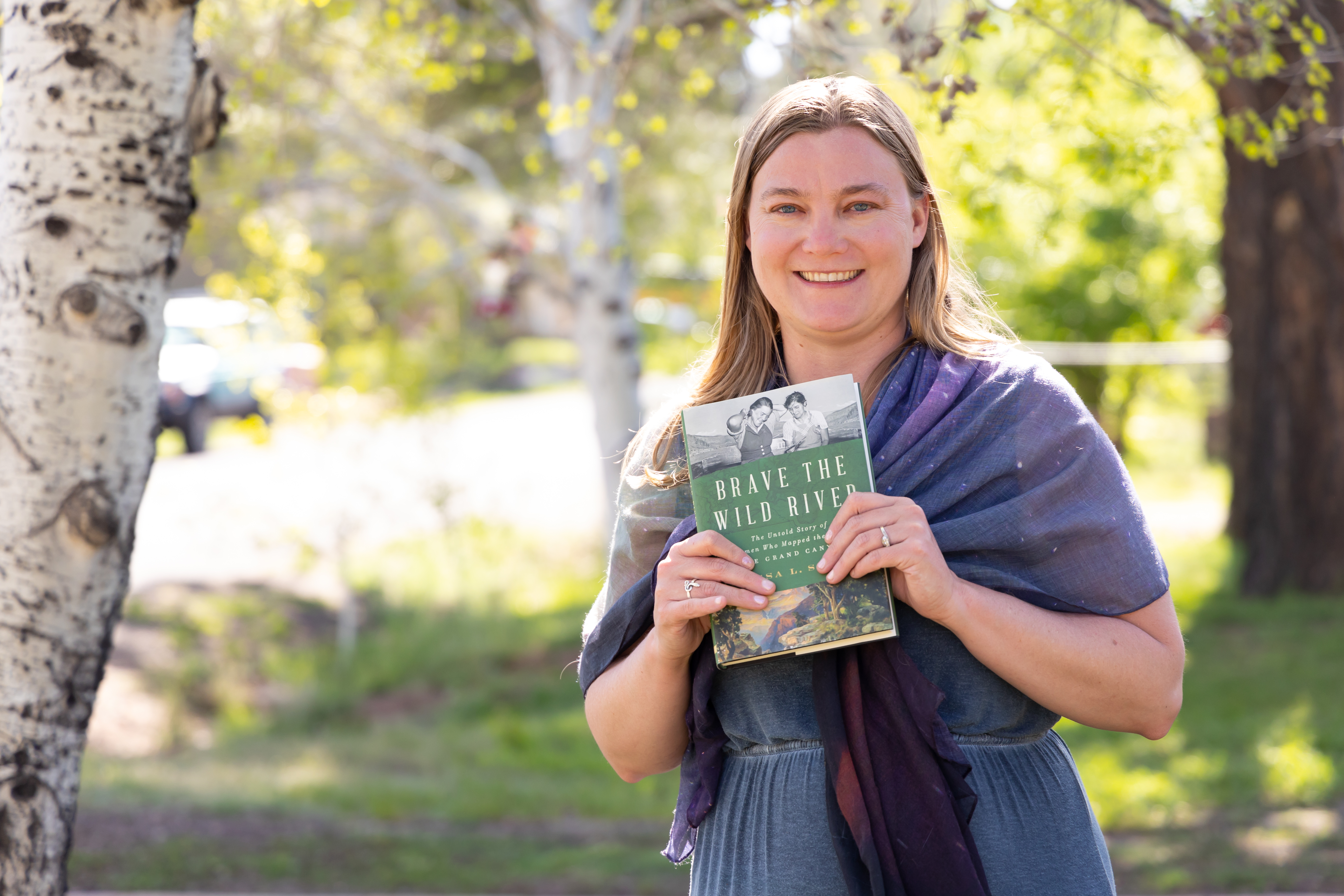
Sevigny’s book, Brave the Wild River: The Untold Story of Two Women Who Mapped the Botany of the Grand Canyon, is more than just a story of two women rafting down the Colorado River — it’s a story of curiosity, courage, and the power of reclaiming the untold stories.
And Sevigny’s final piece of advice:
“Trust yourself, trust your own voice,” said Sevigny. “And if you get advice that doesn’t jive with you, that’s okay. Don’t follow it. You know, you’ll find your own way.”
–
Melissa L. Sevigny will speak at The University of Tampa on Earth Day, April 22, at 5 p.m. at the Charlene Gordon Theater in the Ferman Center for the Arts.
Along with sharing the remarkable story of Elzada Clover and Lois Jotter, the first two women to raft the Colorado River in 1938 and undertake botanical research through the Grand Canyon, Sevigny will focus her discussion on a message that deeply resonates with the mission of Earth Day: the importance of slowing down and observing the natural world around us.
“Often we walk through the world without really noticing it,” said Sevigny. “Wherever you are — Florida, Arizona, anywhere — there are these extraordinary things all around us: the plants, animals, the weather, all of this is stuff that we just kind of just tend not to notice.”
Sevigny hopes her talk will inspire the UTampa community to open their eyes to how beautiful the world truly is. Her message, inspired by the legacy of Clover and Jotter, is rooted in the idea that meaningful environmental action begins with mindful awareness.
“Earth Day is about protecting the planet, but I think we first have to start with noticing the planet, like, noticing our own ecosystems, our own surroundings,” said Sevigny. “And that’s really what Elzada and Lois were all about: stopping and noticing and naming the plants around them.”
–
Thumbnail image caption: Melissa L. Sevigny holding her newest book Brave the Wild River: The Untold Story of Two Women Who Mapped the Botany of the Grand Canyon. Photo courtesy of Alexis Knapp.