
By Kennedy Gilbert
She speaks softly, but her mind is loud. She is always doing something, always thinking about something. In fact, thinking and knowing are exactly what brought her to where she is today.
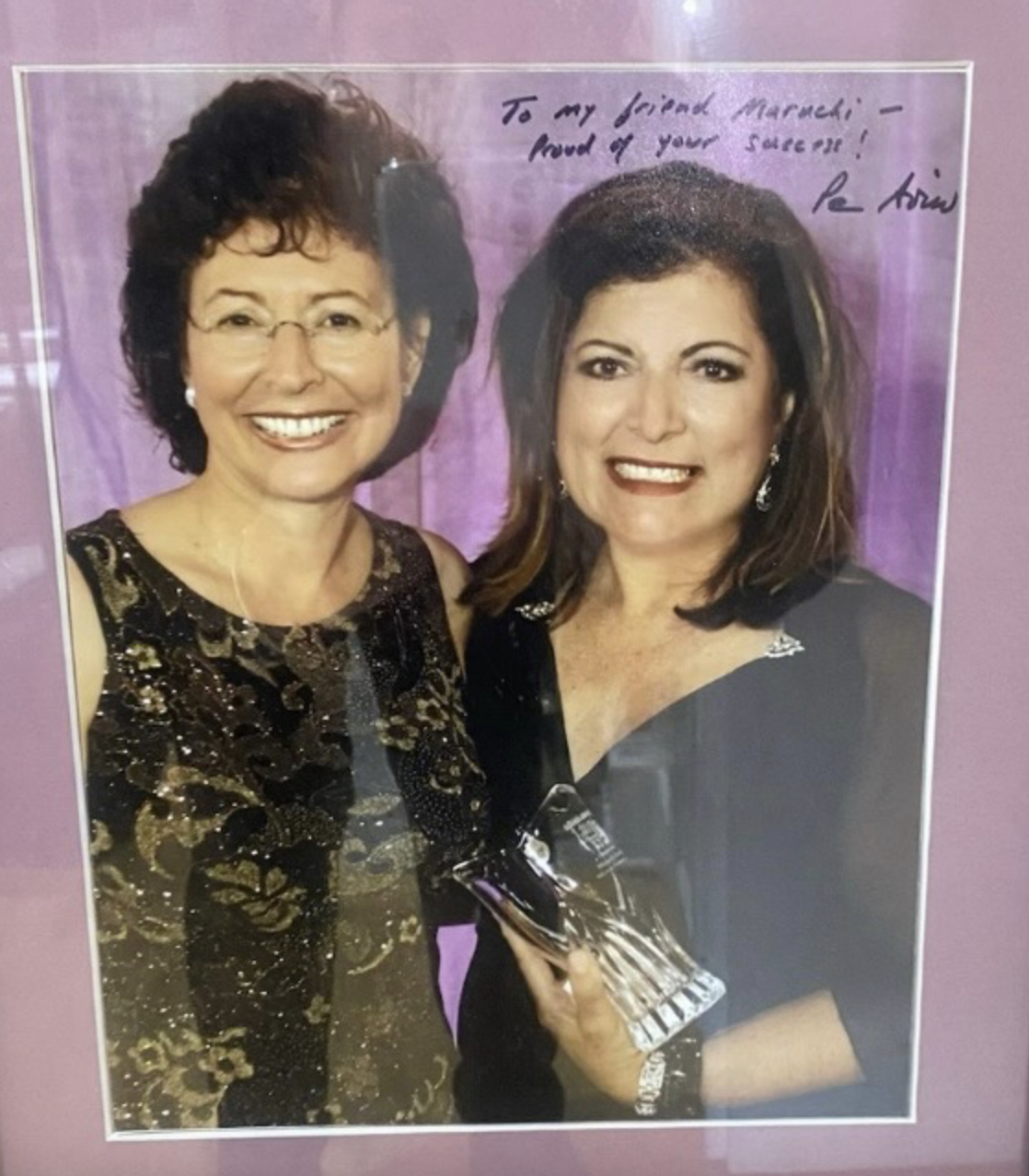
Her name is Maruchi Azorin, a successful business owner of Villa Rosa Distinctive Linens. She is an advocate for all children and their education, a community activist, and is responsible for the birth of Le Blanc Linen Wash. That is just a piece of what Azorin has accomplished in her lifetime.
August 2025 will mark the 40th anniversary of Villa Rosa Distinctive Linens, a retail store that Azorin has carefully crafted over the years. The store offers linens, home accessories, towels, baby items, and of course, the one-of-a-kind linen wash.

Azorin’s entrepreneurial nature goes back generations. Her family was originally from Spain, where they owned and produced a successful brick manufacturing company, but they fled to Cuba after anarchists began to take over the country.
“My father was a naturally smart man, and he was great at math, so as he grew up, he led the business,” said Azorin.
The family moved to Cuba specifically because these handmade bricks from the company were made from clay, and Cuba had organic clay.
Additionally, Azorin’s mother was the only one who spoke proficient English because she had gone to a girl’s school in the United States. So she often played the vital role of being a translator. Azorin and her family would frequently travel from Cuba to Miami and North Carolina to conduct business deals because American companies had the right equipment that the Azorin family needed for their business. One, in particular, was a North Carolina steel company.
Then, in 1960, Fidel Castro became the dictator of Cuba. This changed everything for Azorin and her family. The Castro Regime “nationalized” their business and their home. This meant that what was theirs would become property of Castro.
“We were told, if you choose to leave, you can only leave with one suitcase and personal items because everything in this home has been inventoried,” said Azorin.
Azorin was eight when this happened. Azorin and her family had to leave, and they were the last ones of the family to leave. At that point, they moved to Miami.
“We were able to afford a very small motel room in Miami, and we used to walk 13 blocks to my aunt’s for meals because we couldn’t afford to buy food for the motel,” said Azorin.
No matter what, the family stuck together and made the most out of scary times.
Thanks to Azorin’s father, they were later able to move to North Carolina to see if their business friends would help them find jobs. Thus, they loaded up all six family members in a beat-up 1963 Chevrolet truck and drove to a better future.
Harlem, Georgia, was the place where the business friends from North Carolina sent them, and it was a tiny town.
“It became the most wonderful experience because the people in the town could not have been more helpful, gracious, and giving,” said Azorin.
Azorin still remembers the names of her school teachers and how education had such an impact on her.
After a while, the business became so successful that Azorin’s father thought that they could start their own company again, and the family began to save money.
By the time Azorin was 10 years old, the family made another move to Plant City, Florida, and started to build their own brick plant from scratch.
“We started digging holes, literally the kids after school, because we needed to pour the concrete to build the sheds and the workplaces where the machines were going to go to produce bricks,” said Azorin.
The kids excelled in school, and education would soon become a central theme of Azorin’s life.
“My father always used to say, ‘They can’t take away what you know. They can take away your home, they can take away your bank account, they can take away anything, [but] they can’t take away what you know,’” said Azorin.
From then on, success followed Azorin, or rather, Azorin followed success.
In a list of successes, Azorin became a cheerleader, “The Girl of the Year in 1971” at her high school in Plant City, and a representative for the American Legion Auxiliary Girls State, where girls would learn about government and leadership.
Azorin graduated from the University of Florida (UF) with an MBA, and she became the first Hispanic president of the UF Panhellenic Council. She funded Dr. James Robert Cade (founder of Gatorade), who was a professor at UF and head of the Pediatric Dialysis Division. He needed money for a dialysis machine, and Azorin teamed up with the Interfraternity Council to raise money through a dance marathon for him to purchase that machine. She was also the first Hispanic woman in the UF Student Hall of Fame.
Her time at UF did not stop after graduating college.
“I still serve as an advisor to Florida Blue Key at UF,” said Azorin. “I still serve as an advisor to Student Affairs at UF, and I’m on the University of Florida’s Library Leadership Board.”

In 1987, Mayor Sandy Freedman appointed Azorin to the City of Tampa Hispanic Advisory Council. Azorin had met her when Freedman shopped at the store. This council provided Latinos with basic information and resources on what the government could do for them, and Azorin pointed out something that was missing.
“I said, wait a minute, what about the kids? How can we make sure that those kids get an education?” said Azorin.
Azorin ended up becoming the chairman of the council for eight years. During this time, Azorin played a crucial role in including The University of Tampa for scholarships for Spanish kids. She went to Mayor Pam Iorio, who was a UTampa graduate, and questioned why UTampa wasn’t a part of the scholarship program when other schools like the University of South Florida were. From then on, UTampa was recognized.

Azorin served as the chair of the Museum of Science & Industry (MOSI) as well. She is responsible for the National Hispanic Scientist of the Year event at MOSI, which also provided scholarships and introduced scientists from all around the world. Some of the guests that Azorin hosted were Mario Molina, who was responsible for discovering the threat to the ozone layer from chlorofluorocarbon gases, and Antonia Novello, the first Hispanic female surgeon general in the United States.

“My purpose of this whole thing was I want these kids to say ‘I want to be like you’ when they see that scientist, and ‘how am I going to be like you?’” said Azorin. “And that’s what the scientist would dwell on. ‘You want to do what I do? Go to college.’”
Becoming a market research analyst gave her the inspiration to research, and through that came a desire to grow her own business.
Her grandmother taught her about embroidery as a little girl and Azorin started researching “beautiful” textiles and fabrics, which at the time were coming from Europe. She decided to go to a market and the key word that she would base her shop on popped into her brain: “linens.”
Thus, Villa Rosa Distinctive Linens was born. Azorin founded the store in 1984. The front of the building was originally a gas station, and Azorin added onto the building.
At the same time as starting Villa Rosa, Azorin realized that no linen wash took out tough stains like “lipstick or blood.” So, she asked her father-in-law, who was a chemist, to help create a formula that would remove these stains. She marketed it as Le Blanc Linen Wash, and it ended up being the first item she sold.
Interestingly enough, Yves Delorme private labels Le Blanc Linen Wash.
“They sell it on their website, [so] that’s pretty big stuff,” said Azorin.
Azorin’s store is enchanting, and every corner is eye-catching and colorful. There are sheets, towels, monogrammed napkins, linen wash, Viennese ostrich eggs with “Tampa” hand painted on them, and seasonal home decor. She also partners with brands like Yves Delorme France.
“We’re unique and we’re creative,” said Azorin.
The store reflects Azorin’s exquisite taste and flair for interior design.

She credits her success of the store to her contributions and support to the community that she has given, which has come back to her through making connections with all sorts of people.
Maruchi Azorin perseveres, and if there is one thing that she knows it is that everything all comes back to this: “They can’t take away what you know.”