
By Hayden Davis (The Daily Gamecock), Carter Ozburn (The Paladin), and Walker Smith (The Paladin)
Editor’s note: This article was written in collaboration between The Minaret, The Daily Gamecock, and The Paladin.
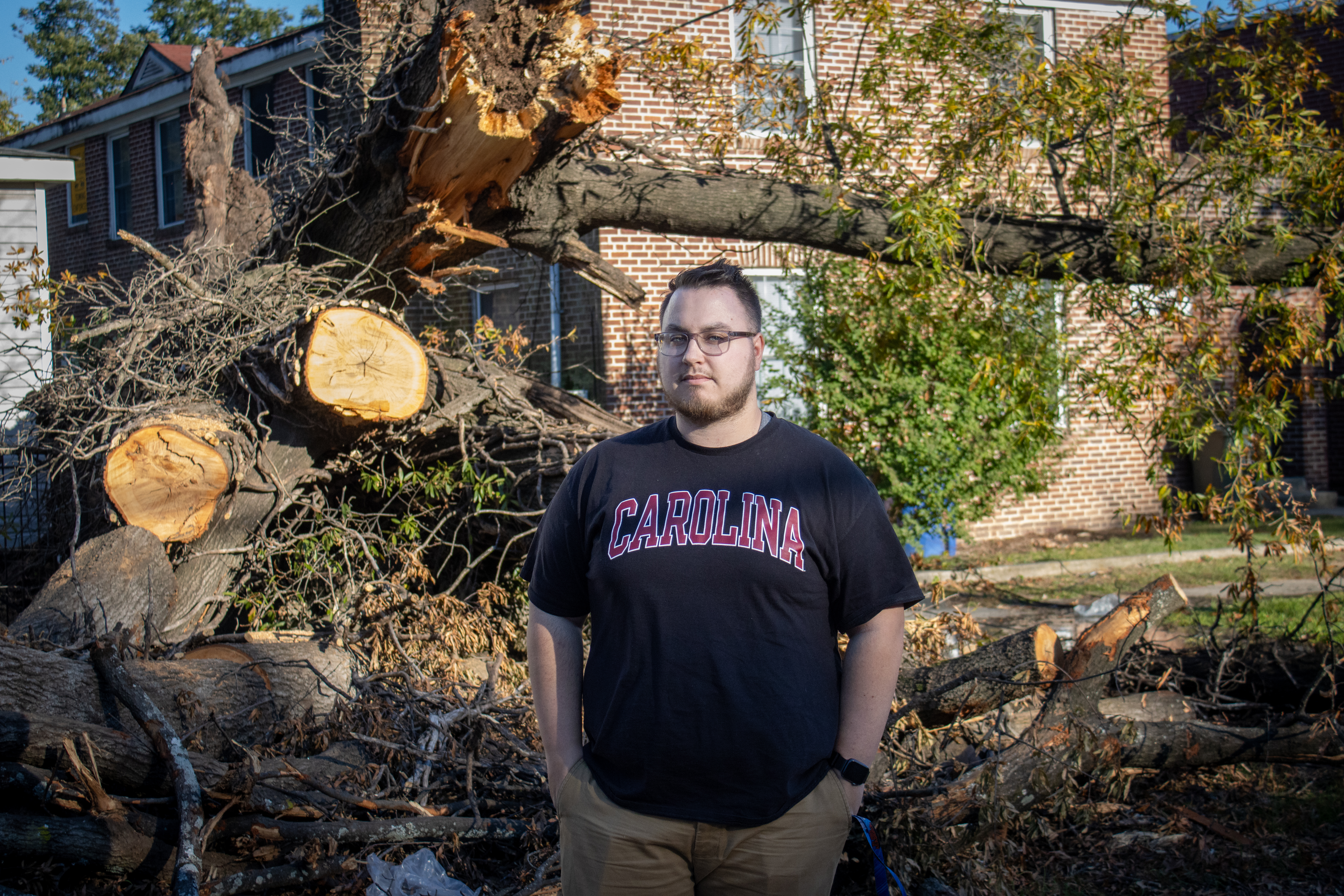
University of South Carolina (USC) student Matthew Snyder lived without power for two weeks after Hurricane Helene knocked out electricity to more than 190,000 homes in Richland County on Sept. 27.
That morning, Snyder, who is a graduate student in the master of sport and entertainment management program, was startled by what he thought was a thunderstorm.
“Around 5 a.m. I saw a blue flash and a big thud, and I thought, ‘Oh crap, here comes a thunderstorm,’” he said. “Power went immediately off, because I usually have the TV on when I sleep. So I knew exactly when the TV went off, power went off.”
Once Helene had passed, Snyder said he looked outside and saw a large oak tree had fallen on the street, taking a number of wires and cables with it, he said. Two cars were left shattered underneath the tree, and it would be six days before the oak was moved.
Hurricanes Helene and Milton wrought historic levels of destruction on the Southeast. Deadly floods occurred in North Carolina, widespread power outages ranged from Florida to Tennessee and high winds damaged or destroyed homes.
Several climate, hurricane, and environmental experts across the region told The Daily Gamecock that the storms brought on by the 2024 hurricane season were likely influenced by changes in the world’s climate and continued warming may worsen their effects.
Weeks earlier on Sept. 24, Greenville, South Carolina, was inundated with rainfall of just under 4 inches before the bulk of Hurricane Helene hit. Within Greenville lies Furman University, where students dealt with power outages and canceled classes.
Helene’s high rainfall resulted in flooding in South Carolina’s upstate.
A rainfall event prior to Helene saturated the ground in the area, according to Gustavo Coelho, a professor of water resources at Furman University. Saturated soil prevents water from seeping into the ground and can cause flooding, he said.
The already moisture-packed soil contributed to significant damage in the area, leaving trees less secure and many areas more prone to flooding.
International student from Liberia, Roger Abim-Karmon, remained on Furman University’s campus for the entirety of the aftermath of Helene.
“I’ve never had anything like this happen back home,” Abim-Karmon said. “It was an interesting experience. I’ve only seen this on TV. Seeing things on TV and then having the reality of it is very different.”
Once the storm reached the area by the morning of Sept. 27, the rainfall totaled 11.3 inches. Coupled with the up to 68 mph winds, many trees were knocked down and homes were destroyed throughout campus and the surrounding area.
“I thought it was gonna be minimal damage, and we’re just gonna get things done until Thursday. I think Friday was when it hit, [I realized] this was actually a very big deal,” Abim-Karmon said. “When power went out, and we lost the cell service, I couldn’t let my family know that this was happening.”
Nearly 260,000 were without power in Greenville county, including Furman’s campus for five days, leaving students without hot water, typical dining options, and cell service.
Many students, like Abim-Karmon, did not anticipate the severity of the disaster, thinking it would be no bigger than a typical storm.
Students had received an email from the university with the notice of cancellation of class on Sept. 28, with an email to students and faculty the day before the storm that it was a, “major storm that is expected to cause significant damage.”
Many roads were impassable due to fallen trees and power lines, especially those in and around the campus. Additional damage on Furman’s campus included large amounts of debris, flooding and damage to student housing and campus infrastructure from downed trees.
The university was still scheduled to have their annual Family Weekend on Sept. 29 and stated in the same email that ,“Helene will cause disruptions and inconveniences as families travel to campus for Family Weekend.”
Classes at Furman were canceled from Sept. 28 through Oct. 4, leaving students without knowledge of deadlines or syllabus changes. It wasn’t until that later Friday when the Wi-Fi was fully restored in student housing.
Some students weren’t able to leave Furman’s campus because of travel complications. Students that stayed received power and Wi-Fi through the Physical Activities Center, the dining hall and at the Furman University Police Department (FUPD) with the help of external generators.
“FUPD was a huge help because they had electricity and Wi-Fi,” Abim-Karmon said. “I was going there at 9 or 10 a.m. to get my stuff charged and chat with the officers. That was a really good experience.”
In Columbia, South Carolina, Snyder was dealing with the aftermath of Helene, where he had to adjust to life without power or even a refrigerator to store food in, while the oak tree was still down.
The loss of power meant the loss of weeks’ worth of his refrigerated food, he said.
“And I cried when I had to throw away all the food that I just bought,” he said. “I was like, this is like three or four weeks of food for me that I’m literally throwing away because they all got spoiled.”
Snyder initially attempted to continue living in the apartment. Once that became impossible, he sought out alternative places to stay.
“In the very beginning where it was like the first few days, and I was like, screw this, I can’t,” he said. “It was getting up to 80 plus degrees in my apartment with no airflow. I couldn’t sleep. It was rough, to the point where I was just like, I need to get out of here.”
Snyder’s employers in USC’s student union provided him a place to charge his devices and work on assignments, he said. For everything else, he settled on a hotel.
But circumstances sullied that option for him. On Oct. 5, the same day the news of Hurricane Milton hit UTampa’s campus, costs increased at the hotel Snyder stayed at, due to South Carolina’s game against Ole Miss.
“It went up $150 a night because of the game in the area,” he said. “It went from like $91 a night to $240 a night. It was ridiculous.”
Fortunately, a friend of Snyder’s provided him a place to stay for several days after leaving the hotel, he said.
After staying with his friend, Snyder returned to his apartment in the hopes that power would be restored that night, he said. Unfortunately, power remained off until the next day, he said.
He spent one final, uncomfortable night in the apartment.
“What made it really unbearable is that my building’s a historic building, so the windows were designed to be nailed shut,” he said. “I couldn’t even open up the windows for airflow.”
As with Milton, warm sea temperatures caused the rapid intensification of the storm.
“If actions are not taken to limit climate change, then tough choices will have to be made,” Claudia Benitez-Nelson, an associate dean in USC’s College of Arts and Sciences said. “This may include moving homes away from coasts and adjusting fresh water usage.”
“We’ve got to make changes now, or we need to think about adaptation and sustainability, and what are we going to do to adapt, and what are we going to do to sustain,” she said. “That’s going to mean we have to make some tough choices.”
Until then, students across the cities impacted are still dealing with the aftermath.
Snyder’s power was restored, but other issues remained. His water supply was not adequately restored, he said.
“It’s low pressure, but it’s at least livable,” he said. “It’s still clean coming out, it doesn’t look brown or anything. I just think, because it’s leaking out of the one pipe that’s lowering our pressure, so that’s the only downside to that, but still enough to take a shower and still enough to get water to drink and stuff like that.”
When the oak tree fell, it damaged a water pipe in a neighboring building. Debris from the tree, including a large section of the trunk, remain on both sides of Gregg Street, preventing crews from fixing the pipe.
“There’s actually water still running down the street that no one’s been able to turn off, because it actually damaged the pipe, and no one’s touching it,” Snyder said.
Gregg Street remained closed until Nov. 6 when crews came to remove the remaining debris and fix the damaged pipe.
Snyder continues to progress academically despite the two-week interruption. He plans to graduate in December and enter the job market, but he’s now looking to live elsewhere.
“Even if I… get a job here at the university, I’m still going to be looking to move somewhere else at the end of December,” he said.
In the aftermath at Furman, students had access to limited dining options from the dining hall. But the Furman staff played a role in maintaining services and support for students on campus, Abim-Karmon said.
The dining hall workers cooked meals using gas grills outside to keep food available as much as possible.
“At the end of the day, I think throughout my experience with staying on campus, it was good to know that I wasn’t in it alone, because we have staff working overtime,” Abim-Karmon said. “They were amazing.”
Despite the overall destruction and tragedy that Helene brought to the region, Abim-Karmon found silver linings in the circumstances that he and other students faced.
“The hurricane was a good way to be outside and think through what’s happening. No one had electricity or anything, so everyone’s socializing. … As much as a lot of people were affected by Helene, staying on campus made me feel connected more to Furman and the people at Furman.”
Many students on campus, like Abim-Karmon, used the time away from their studies to pour back into the community around them. Furman’s administration organized events for students to make toiletry kits for linemen staying on campus.
Abim-Karmon volunteered with a group in Greenville that helps international students. He found that the hurricane offered an opportunity for the Furman community to reflect on what happened and how to respond better in the future. Abim-Karmon hopes they can use the hurricane as a way to strategize how students can receive help in these times.
“We need to know this is coming, and based on past experience, we can put mechanisms into place to make sure students who live very far can get the time to go home, or for students who cannot actually go home to have good resources to help them throughout the experience,” Abim-Karmon said. “But in the future we might still be affected by this experience, regardless of what happens.”