
By Liv Dennis
TAMPA, Fla.– Hurricane Helene’s winds ripped through Tampa Bay, knocking down power lines and clawing away at tree limbs. The water proved just as relentless as it rose over the seawalls and spilled onto the streets and neighborhoods.
This was not the first storm to have left the city with extensive damage. As residents returned to their homes and floodwaters receded, a harsh reality remained: With worsening sea level rise and its impact on storms’ intensity, Tampa needs to learn to adapt.
Julia Guatto, a freshman at The University of Tampa, was one of the many students forced to evacuate campus because of the hurricane.
“I’m from Canada, so this was my first time experiencing a hurricane evacuation,” Guatto said. “Seeing everyone in a panic and worrying about flying home was really scary.”
Guatto said that she was worried about the flooding the most.
“Last week I was walking in knee-deep water and watching cars float away near campus from a normal thunderstorm,” Guatto said. “So I couldn’t even imagine what would happen with a hurricane.”

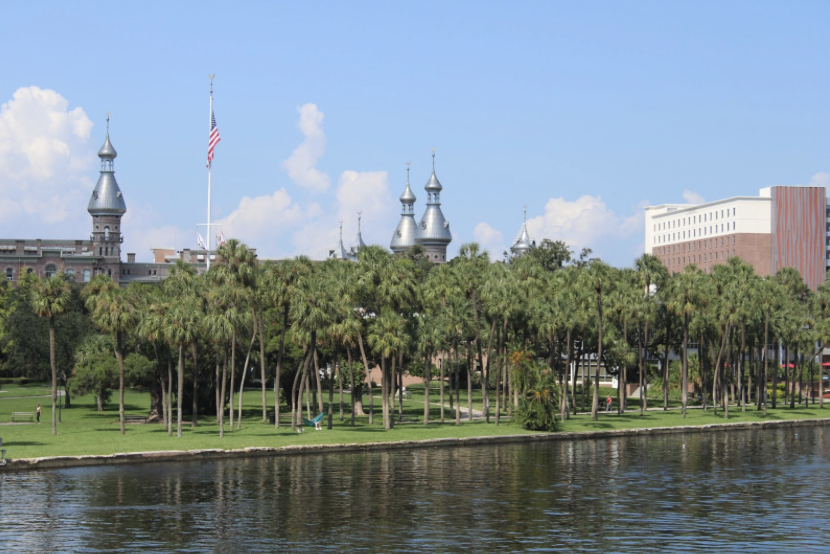
A view of The University of Tampa’s proximity to the water. Photo by Liv Dennis.
As the Tampa Bay sea levels have continued to rise and show no signs of stopping, Guatto is among the many people who have been affected and show concern for the city’s future.
The concern of the residents is not unjust. Out of all the coastal metropolitan areas, Tampa Bay is the most vulnerable to sea level rise (SLR) because of its dense population, location, and increasing urban development.

Tampa’s skyline is made up of many larger buildings, and more are continuing to be developed. Photo by Liv Dennis.
Tyler Cribbs, a visiting assistant professor of environmental studies at Eckerd College, added that Tampa’s vulnerability is also a result of the shape and characteristics of its continental shelf and shoreline.
“Continental shelves that are wider and more gently sloping, combined with shallow, funnel-shaped bays and estuaries can be a recipe for disaster,” Cribbs said.
An analysis report was done to assess future SLR in Tampa. According to the report, the Tampa Bay region can expect to see approximately 1 to 2.5 feet of SLR by 2050 and between 2 to 8.5 feet by 2100. This anticipated rise in sea levels will impact the city’s ecosystems, drainage systems, drinking water, and create more dangerous and destructive storms.
With rising concerns about these effects, Tampa officials have begun to spring into action to protect the city’s future.
Tampa City Councilman Alan Clendenin said that a lot of new projects have been put into place to adapt to the effects of SLR within the city.
“We’ve done a lot of work, including seawall restoration and enhancements. We lift infrastructure like our pumping stations for, you know, sewage, and as we replace and rebuild these, we lift them up above potential stormwater intrusion,” Clendenin said.
Cribbs pushed back against Clendenin’s statements on the effectiveness of seawall restoration. He argued that this solution is not effective in the long term.
“Although this has been effective, when we heavily influence the coastline and build this infrastructure it is difficult to adapt to changing conditions caused by sea level rise,” Cribbs said. “It should also be noted that the lifespan of these projects and the effectiveness to hold up to coastal conditions decreases over time.”
Cribbs instead suggested that “green infrastructures” like living shorelines have proven to be far more effective in mitigating SLR effects when compared to seawall utilization.
“One of the most popular efforts as of late, is the reintroduction of living shorelines all along Tampa Bay … living shorelines have the ability to adapt to changing conditions. They also have the ability to increase their effectiveness to withstand coastal conditions over time and can, in theory, last indefinitely,” Cribbs said.
Cribbs is not alone in his thinking. Christopher Meindl, a Florida native as well as a geography professor and director of the University of South Florida’s graduate-level Florida Studies Program, agrees that seawall restoration is not enough.
“Any seawalls we might build will ultimately be overtopped, so I think they are a waste of money,” Meindl said. “Sea level rise will not stop just because we add infrastructure to cope with the problem at time X.”
To address these concerns, Clendenin said that raising infrastructure is not the only thing the city is doing and that officials realize this solution is only good for so long.
“We’re doing things as little as talking about shading and trees for cooling areas because when you plant trees, you can reduce the temperature of an area,” Clendenin said. “Different types of trees absorb water, so you can help with flooding by planting live oak trees and minimize the destruction.”
However, all of these changes require tremendous amounts of funds. And the truth is that Tampa does not have it.
“We’re never short of great ideas. We’re always just short of the money to be able to implement those great ideas,” Clendenin said. “I know people always think ‘Well, we should be doing this. We should be doing that.’ Most of the people who are in elected positions understand that, yeah, we should be doing that, but unfortunately, you just don’t have the money to do it. And I think that’s part of the challenge.”
With a lack of funding and changes that can only hold off the elements of nature for so long, Meindl said that the only reasonable action is to retreat from the waterfront.
Although this view on SLR may appear grim, his suggested action of simply retreating may not be too far off. With SLR creating a plethora of social issues, there may be no other choice.

This view shows that much of the city borders the water, which puts them at SLR risk. Photo by Liv Dennis.
Cribbs stated that the cost burden of living in coastal areas would begin to worsen in the form of flood and storm insurance, maintenance, and recovery from high tide and storm events. This will leave many residents with no other choice than to simply leave.
“Those who cannot keep up with these costs are forced to move from homes they may have had for 20-30 years or have even been passed down through their families,” Cribbs said. “This cost only goes up as sea level rise increases, creating a reinforcing feedback loop of higher and higher prices, pushing more and more families out of their communities.”
Residents of Tampa remain anxious as the future of their city is hazy. Hurricane Helene isn’t the first storm to have wreaked havoc, and it will be nowhere near the last.
As of now, it comes down to three things: proper education on SLR, greener infrastructures, and finding ways to fund the city’s future projects.
“This process is never going to end. We live in a coastal community, so it’s always going to be a project that we’re going to have to be dealing with for my lifetime and your lifetime,” said Clendenin.