
By Franchesca Murrugarra
The birthday of The University of Tampa (UT) sophomore Lexi Smith was celebrated the weekend before Hurricane Ian wrought devastation in Southwest Florida in September 2022. The occasion was filled with the shared laughter and joking of her friends as they enjoyed their time at Fort Myers Beach, not knowing the destruction that would soon be brought to the people, structures and historical builds in the area, including the long-standing pier built in the 1930s.
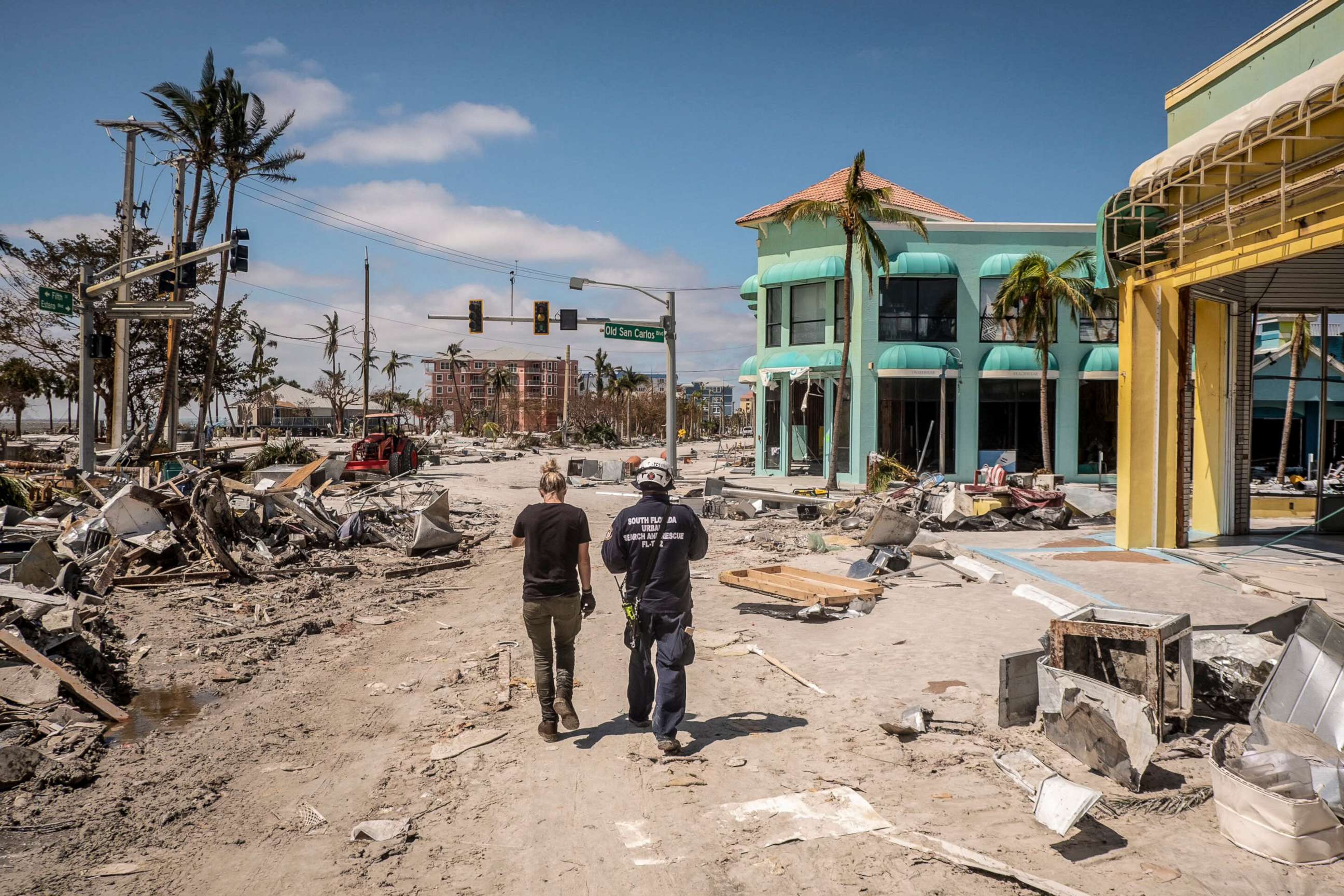
On Sept. 28, 2022, Hurricane Ian made landfall in Southwest Florida as a Category 4 storm. Its powerful winds and devastating floods that rushed onshore contributed to approximately 150 deaths and billions in property damage, according to an article by the Associated Press.
Two years later, sitting casually in front of her bed, with the dorm wall behind her pinned with a collection of Polaroid photos, photo booth pictures and a cream-colored “Walt Disney World” poster, Smith — a marine biology major with a business and leadership studies double minor — held a gray ceramic bowl filled with pasta in her hands as she recalled one of the memories from that birthday weekend before the harrowing storm.
“We were joking about a sign,” Smith recalled, her eyes shifted upward as she remembered the sign with a tied-up coconut that predicted the weather. “If the coconut’s wet, it’s raining. If the coconut’s moving, it’s windy. If the coconut’s gone, it’s a hurricane. All that was completely gone [after Hurricane Ian]. And I have a photo of that sign. I’m like, ‘Well, the coconut’s really gone now.’”
Smith also reflected on the week leading up to Hurricane Ian, remembering how the storm was the talk of her high school despite its original trajectory to Tampa — far from the reaches of her home on Marco Island, Florida, and the rental property that her dad owned right on Fort Myers Beach. There was not much initial worry about the storm at that time, even when the trajectory changed “not even 24 hours before it hit Fort Myers Beach,” according to Smith.
In typical Floridian fashion, her school still managed to host a homecoming event for its students the day before the storm hit. It was the last calm before the storm.
When describing the preparations that her father, Larry Smith, had accomplished, Lexi Smith detailed with an expressive gesture of her hand, “My dad had been very vigilant of watching all the patterns, all of the predicted models, and he started hurricane prepping the property that we had in Fort Myers Beach that we did rentals out of. … My dad was up at like 2, 3 a.m. watching everything about this storm, and then when it turned, he’s like, ‘OK, we got to do stuff. We gotta go now.’ Next morning, he was like, ‘You guys gotta get up early. We have to do stuff.’”
Soon before the storm made landfall, and after Larry Smith, Lexi Smith, and her brother finished doing all that they could to prepare the properties for the storm, they evacuated to Miami and stayed the night at Miami International Airport, waiting for their mother’s international flight to come back in (her plane had to pull back up after it nearly touched down because of a tornado). “We were just watching the news as everything’s coming in,” said Lexi Smith.
In a separate interview with Larry Smith, where he sat in front of a beige wall displaying a detailed portrait of a section of Florida’s map, he explained, “I have three properties in Florida that were affected. There’s a house in Marco Island that we live in. Then I have a rental on Marco Island, and then I had a house in Fort Myers Beach that got totally destroyed. So the real impact was Fort Myers Beach, but we had more minor impacts at the two houses in Marco Island from flooding.”
They ended up watching the live cam of the rising storm surge the day Hurricane Ian hit Fort Myers Beach, where their rental house was stationed only a block away, as the water just “kept getting higher and higher.”
Lexi Smith ran her bracelet-clad hand over her short, wavy hair and simply said, “We knew that property was going to be gone. … It was really old, very old.”
Larry Smith, back in his interview, rubbed his chin and said, “My [rental] house, because it was a wood structure, and it was built in 1937, I’m pretty sure, got blown over by the wind first. And then four hours later, the water came in.” He demonstrated the lopsided shape that the house collapsed in with his hands. “The house was sitting on its side like this, and there was a water line in there that was parallel to the ground, so the water wasn’t in there before the house fell down. I’m 100 percent sure the house got blown over, and then the water came in.”
He also went through the list of damages that occurred to all three properties, including 30 inches of water in the garage of the home he and his family lived in on Marco Island, which led to the belongings in that garage having to be thrown out. On the rental property on Marco Island, the shingles were lost on the roof, there was 10 inches of water in the garage and storage area, and anything that was on the ground level was ruined. But the real damage occurred at the property on Fort Myers Beach. Larry Smith said, “The house fell down on top of the storage area and lower-level apartment, and it couldn’t be fixed. I mean, the walls were ripped out, all the windows were blown out, and we had 14 feet of water there.”
His daughter focused more on sentimental items that were lost, such as her baby photos and her parents’ high school, college and after-college photos, which were left behind in the garage of the rental house and were unfortunately unsalvageable. But she said that what her family lost in the rental property did not compare to what other people lost.
Lexi Smith, back in her interview, looked downward a little bit and began telling the stories of others she knew: “I knew a kid where his bedroom had about 2 feet of water in it, and there’s a photo of him sitting on a paddleboard in his bedroom afterwards. I knew a kid where some relative was actually staying in Fort Myers Beach, and they didn’t evacuate. A lot of people didn’t choose to evacuate, which was unfortunate. A lot of elderly passed away, and a lot of their bodies were found, which was just heart wrenching to hear on the news. I think it was a cousin, or someone related to someone I know, where they stayed and she had a baby — like a several months old baby — and it was getting to the point where it was flooding the second floor of their house. She had to get a tub, seal the baby, and swim down and bust her door open to be able to get up to the street and go down to a neighbor who had a much higher concrete house with a lot more height to stay there so they didn’t die. … So many people, so many people died. They kept finding bodies in the mangroves because people wouldn’t evacuate. So many people were stuck in Sanibel and all that whole area.”
Larry Smith himself related that, “It was a pretty bad scene. I mean, there’s a lot of people that I know, friends of mine, who lived on the beach, that stayed through the hurricane or evacuated, that have total PTSD. I mean, they can’t even think about it, you know? Some of them just aren’t the same. You know, to me, it just was a rental property, and I did what I could, and then I got out of there and evacuated.”
What often happens in Florida, once people live in the state long enough, is that they no longer see the worth in evacuating for a storm less than a Category 3 or 4. However, for Hurricane Ian, it reached speeds of 155 mph before landing in Florida, and unexpectedly changed trajectory sooner than most people anticipated. That made it dangerous and fatal to remain in an evacuation zone.
However, for Larry Smith, the true aftermath came after the hurricane. He stated as he ran his hand over his forehead, “What was even worse was trying to collect money from your insurance companies.” He continued, remarking, “The crazy thing is, the bank made me insure the house for full replacement cost, including inflation.”
In Florida, there is both flood and wind insurance. According to Larry Smith, the Federal Emergency Management Agency covered up to $250,000 for flood damage, while the wind insurance covered for $530,000.
Although he received the $250,000 in flood insurance, the wind insurance only offered $77,000, as the structural engineer argued that the damage was initially due to flooding, not wind, despite the fact that storm surges were often caused by hurricane-force winds, not the other way around. His neighbor, next door to the rental property on Fort Myers Beach, received his payments quickly with coverage through a Florida-based insurer named Citizens, while Larry Smith struggled with being underpaid by his own London-based insurance company, Lloyd’s of London, which had poor communication and unresponsive adjusters. Their engineers insisted the damage was from flooding because the roof was still intact (not blown off by the wind), even though the wind had caused clear damage to windows.
Through the help of a public adjuster (who works with policyholders rather than for the insurance company), Larry Smith explained that they managed to negotiate with the insurance company and were able to secure an additional $140,000 for the damage.
With the high cost of rebuilding to meet new Florida building standards — around a million dollars — Larry Smith explained that he plans to get his license as a general contractor in Florida (similar to the one he had in Virginia) to lower the cost of rebuilding the Fort Myers Beach rental property in the future.
Coming back to Lexi Smith, she twirled a strand of hair as she reflected on the present and said, “I still know Fort Myers Beach is still struggling to rebuild, because soon after they started to rebuild, a tropical storm came through, and a lot of those buildings lost roofs. It was a whole mess. So now it’s almost impossible to get insurance there or try to get covered there, but it’s nothing like it used to be. It’s been a few years, and they’re still trying to regain everything. … Driving through almost a year afterward, it kind of looked like a war scene where everything’s under construction. Most things are in disrepair.”
When asked about how her preparedness and resilience continued after witnessing the aftermath of Hurricane Ian, she said, “Even now [at UT], I mean, my mom got me stuff like inflatables, camping lights, headlamps. I got a bunch of stuff. I have a battery-powered charging bank.” She turned around and began to pull out different emergency equipment from underneath her mattress. “And an emergency weather radio. It has a rechargeable battery, LED light, SOS alarm, AM/FM, radio access, solar power, and an axe.”
This emergency radio, as Lexi Smith described, is called the FosPower NOAA Emergency Weather Radio (Model D2), and she keeps it tucked underneath her mattress in her dorm at UT just in case of another disastrous emergency.
“I know for my family. I mean, we always had a hurricane box,” Lexi Smith related. “We had all the food and everything for my family, for the dogs, for my brother’s bearded dragon named Kodo.” She paused to briefly (and humorously) talk about her brother’s pet. “I don’t like reptiles, but he likes me. He also likes when I talk to him and I sing to him.”
At the end of the day, for Lexi Smith, it was better to be prepared even if it looked like everything would be fine. Even if there were hurricane-proof windows at her dorm or a hurricane model projected to head away from her city, nobody can ever know what kind of destruction the future holds.
But despite the damage and destruction that was done two years ago in southwestern Florida, Larry Smith concluded his interview with a declaration of hope: “The town’s coming back. People are still going there for the beach. There’s people vacationing there. The Margaritaville is open, and that was pretty crowded during the season, and still crowded during the summer. So it’s going to be a long process. … But the thing is, when it’s built back, it’ll be built to the new standards, like the houses that were built in the last 20 years that survived the Category 4, Category 5 hurricane and 14 feet of flood water. So you know, that’s a good sign that you build it back the correct way, it should be OK in the future.”