
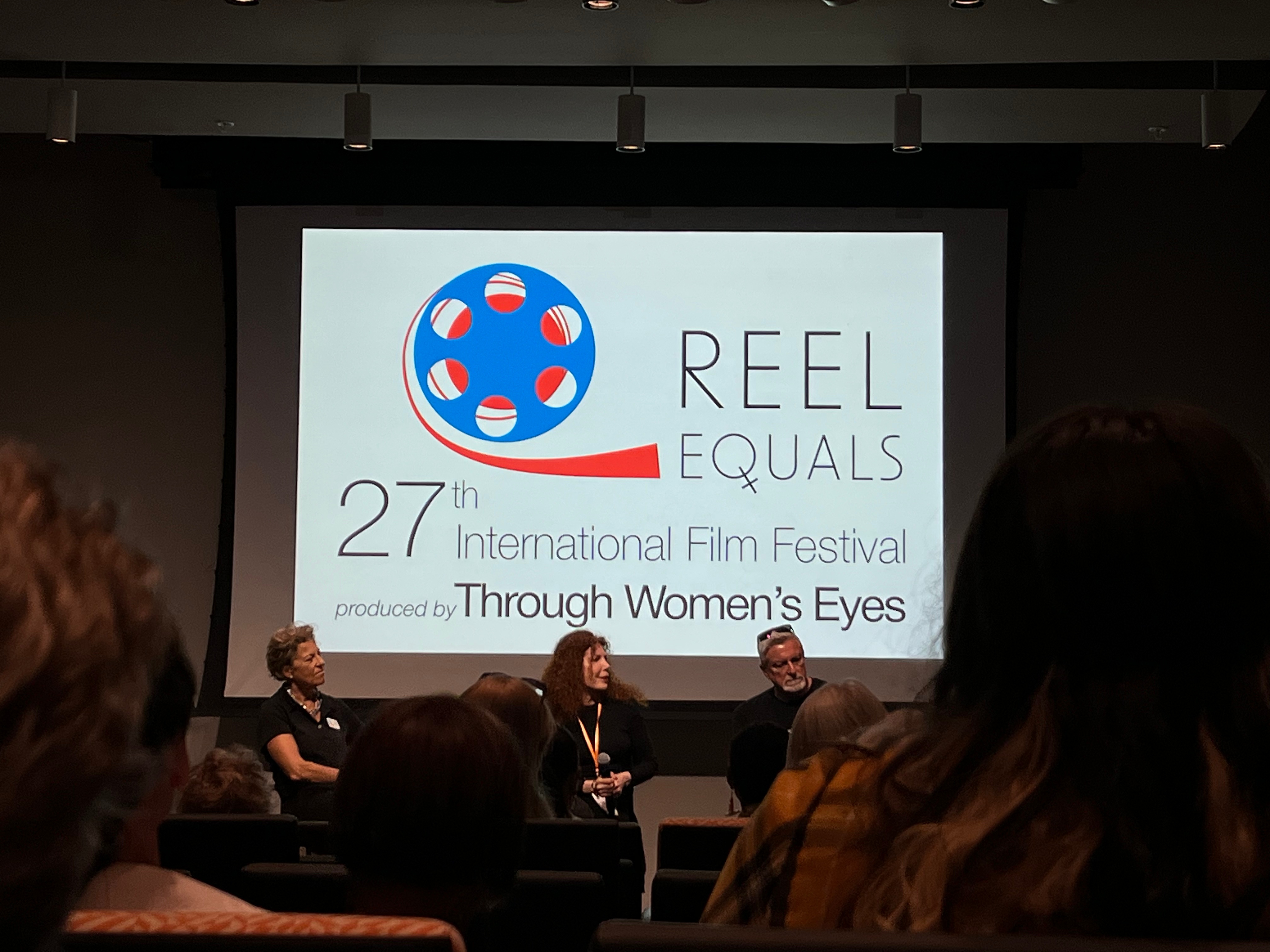
On March 8, 2026, at the Sarasota Art Museum’s 27th Through Women’s Eyes International Film Festival, panelists interacted with attendees. Participants had the opportunity to ask questions while analyzing the film’s themes of acceptance and identity. Photo courtesy of Jaide Edwards.
At the 27th Through Women’s Eyes International Film Festival, a showing of Mistake intrigued viewers and stirred conversations about acceptance, identity, and belonging.
–
By Jaide Edwards
SARASOTA, Fla. — As the last minutes of Mistake unfolded on screen, loud gasps erupted around the auditorium, leaving viewers clearly in shock as the credits started to roll. Filmmakers, local leaders, and an undeniable number of people attended the screening, which took place on March 8 at the Sarasota Art Museum auditorium as part of the 27th annual Through Women’s Eyes International Film Festival.
Viewers responded emotionally to the film’s plot throughout the evening, laughing at the lighter parts and gasping quietly at the more dramatic ones. After the screening, they stayed seated to talk with the panelists.
Mistake, which was directed by Honey Lauren, centers on Larry Benson, an intersex person who was raised as a man in the American South in the 1970s. The film examines issues of gender identity, social expectations, and the pursuit of acceptance through Larry’s life. Lauren and the other panelists discussed the film’s inspiration and research with the audience after the screening.
For Lauren, the development of Mistake can be traced back to a very intimate childhood event.
“When I wrote Mistake, I knew where the seed of the idea came from,” Lauren said. “When I was growing up, from the time I was born until about seven years old, I really thought my parents made a mistake — that I was a boy. I was convinced of it.”
Lauren clarified that the emotion was not only a child’s fantasy but something deeply personal.
“It was a soul thing,” Lauren said. “It was disturbing for me.”
The character of Larry Benson, who was born in 1941 with ambiguous sex traits and whose parents must choose whether to raise him as a boy or a girl, was ultimately inspired by that early experience. In the film, Larry’s father decides to raise him as a man, which shapes his life through identity conflict and expectations.
Taking place in 1971, centers on Larry as an adult who works on his family’s tobacco farm while juggling internal conflicts over identity and belonging.
Lauren said the historical backdrop was chosen because it depicts a period when people going through comparable difficulties had minimal resources or support mechanisms.
“There were no cell phones. There was no internet,” Lauren said. “This kid was alone. He was truly alone. There was no one for him to reach out to.”
Additionally, the early 1970s were a time when cultural conceptions of gender and identity were starting to change.
“Musically, it was a time when things became more androgynous,” Lauren said. “You had artists like David Bowie and the rise of glam rock, and this idea of gender fluidity was starting to enter the cultural consciousness.”
The relationship between Larry and Lily, his childhood friend who embraces him without passing judgment, is at the emotional core of the film.
According to Lauren, their relationship is the central theme of the film.
“For me, it was really the Romeo and Juliet romance between these two,” Lauren said. “What turns me on more than anything on the planet is love and romance.”
Lauren emphasized that although the story is fictional, extensive research was conducted to authentically capture the time period and the characters’ experiences.
“I did a ton of research,” Lauren said. “From the type of tobacco there would be, to the color and what it would smell like, to of course everything intersex for this character at this time.”
To better understand how someone like Larry might have been treated in that era, Lauren also consulted with medical experts and people who are knowledgeable about intersex issues.
Following the screening, attendees had the opportunity to reflect on the film’s topics and pose questions regarding the creative process during a panel discussion.
Lauren was on the panel with E. Scott Osborne, president of the Through Women’s Eyes International Film Festival; Patrick Arthur Jackson, vice president of learning and engagement at Embracing Our Differences; and Tom Edwards, executive director of the festival.
Participants answered questions about the film’s themes and message and offered insightful commentary. Several people thought the story was poignant and thought-provoking, highlighting situations that are sometimes misinterpreted.
Norman Burton, a psychotherapist and minister, identifies the film as clear and impactful.
“It was such a powerful film because it dealt with the raw emotions of people facing human difference and the anxiety that comes with it,” said Burton. “We’re here to do our shadow work — to look into the face of difference, and what makes us afraid, or scared, and to look for the gift in that, and take that gift, and transmute it into a power that we need to have for transformation.
Burton emphasizes that the film illustrates how everyone must do that in today’s world.
Nisha Burton, a filmmaker, speaker and creative director, also commended the film’s emotional power and story.
“I thought it was a really powerful film, just beautifully done,” Burton said. “The cinematography was exceptional, and the ending really leaves you thinking. That’s what films should do — start conversations and touch your heart.”
Burton continued that she hopes viewers leave with a deeper awareness of empathy and compassion.
“There’s kind of two choices. There’s fear or love in life,” said Burton. “The path of the heart, the path of love, really is the direction we should all be going, and whatever brings us fear in life, we need to look at and slow down and take time with, to dissect, but heal so that we can be in the space of love more.”
For many attendees, Mistake was more than a film screening; it was an opportunity to reflect and have conversations about identity, acceptance, and empathy. The film’s compelling story and rich emotional content made people consider not just the characters on screen but also how society navigates diversity and understanding in the real world.