
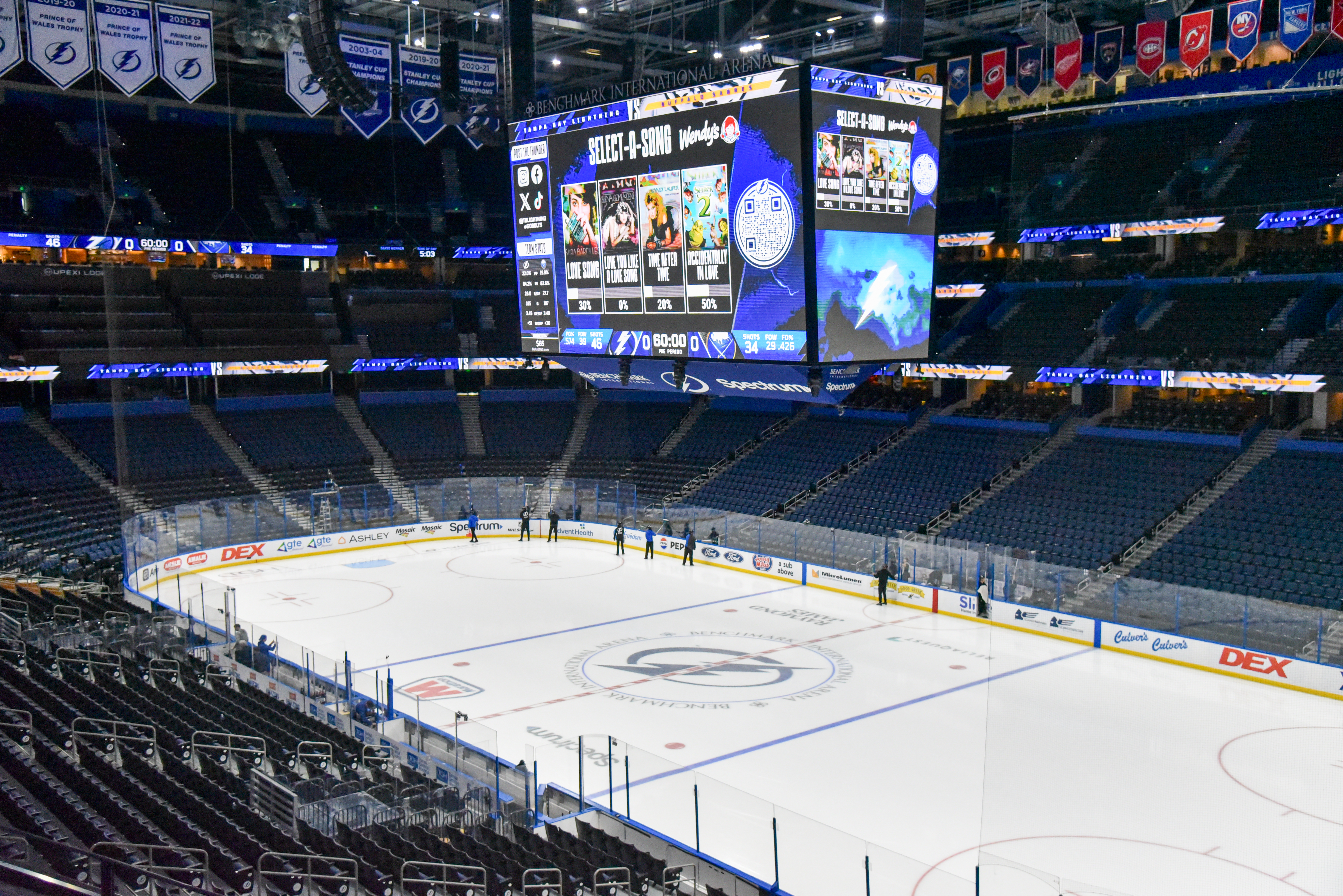
Benchmark Ice Arena and home of the Tampa Bay Lightning. Photo courtesy of Hannah Walls.
The University of Tampa environmental studies students had the opportunity to tour the newly named Benchmark International Arena to examine its sustainability and efforts to maintain environmental responsibility despite high demands.
–
By Genesis Muckle
TAMPA, Fla. — On Tuesday, Feb. 3, environmental studies students from the University of Tampa got the opportunity to speak with the vice president of facility operations, Rhett Blewett, about the sustainability of the ice arena that is home to the three-time Stanley Cup winners, the Tampa Bay Lightning.
The Benchmark Arena, previously known as Amalie Arena, announced its fifth name change since it opened as the Ice Palace in 1996 on Aug. 13, 2025. This name change has not affected the sustainability of the arena. There are many other factors within how the arena is able to operate while preserving as much energy as possible.
Rhett Blewett began the tour by highlighting the three main focus points for the sustainability of the arena: operational efficiency, making everything cost-efficient, and environmental responsibility.

Rhett Blewett and students from the University of Tampa. Photo courtesy of Hannah Walls.
Blewett explains that while the arena does not have a fully established sustainability framework, active progress has been made through increasing operational changes and consistent planning. Many of these sustainability decisions and efforts are determined by the city of Tampa, along with the arena’s corporate partners.
One of the most significant challenges of the ice arena is energy, particularly when it comes to maintaining the ice within Florida’s climate. During times when Lightning does not have home games, the ice is covered. On game days, the ice is dried to improve efficiency.
The arena relies on a central energy plant that cost $13 million and was built approximately three years ago to help address energy efficiency. Blewett said that the system has helped the arena reduce energy usage by approximately 8% to 13%.
“While it cost 13 million to build, it’s probably saving us somewhere between 8% to 13% on energy,” said Blewett.
While there have been improvements, Blewett notes that the arena still consumes more energy than Raymond James Stadium. However, the energy usage does improve during concert season, when ice demands are reduced.
Additionally, waste reduction has become a major focus and accomplishment for the arena. Blewett introduced UTampa students to the new composting system that was implemented just a week prior.
“We just introduced composting last week; they did 12 [barrels] last week and increased it to 15 this week,“ said Blewett.

Compost barrels are behind the Benchmark Arena. Photo courtesy of Hannah Walls.
The composting system is supported through the arena’s partnership with Waste Connections and has been designed to make it as easy as possible for the staff working there. The kitchen and food preparation areas all include buckets that are easy to access and roll around, allowing the staff to dispose of the kitchen’s organic waste efficiently, without disrupting the flow of the kitchen.
“If you’re trying to get them to make the right decision, you’ve gotta be easy,” said Blewett. “You have to make it easy, and you have to make it simple.”
Blewett also expresses the importance of understanding behavioral design in regard to sustainability. He goes on to explain that even small inconveniences can simply impact individual participation.

Back-of-house kitchen in the Benchmark Arena. Photo courtesy of Hannah Walls.
The tour also took students behind the scenes to look at the arena’s operations. The behind-the-scenes facility has extensive amounts of storage for staging equipment. When hockey season is over, the facility also has an in-house kitchen with an energy-efficient laundry room. There are designated recycling areas throughout. There is a designated space for all of the cardboard boxes disposed of, where they are placed before they are picked up.
Blewett also opened up about the ongoing discussion surrounding partnerships with beverage sponsors. He shared that the arena is currently looking into alternatives for plastic bottles, such as aluminum packaging, though factors like cost and compatibility complicate the process. While these ideas and solutions have not yet been finalized, Blewett says that having these conversations alone is a step forward.