
By Sade Reyes
The last few weeks have been riddled with discord on the First Amendment, raising questions about the security of free speech in the United States. This month, the Jimmy Kimmel Show was temporarily suspended after the Federal Communications Commission (FCC) publicly commented on how the fatal shooting of Charlie Kirk was discussed in an episode.
This week, the U.S. Defense Department moved to require journalists to acquire approval from press officers before reporting information from the government. Ultimately, First Amendment rights are changing, and it’s our job to recognize attacks and defend free speech.
The question surrounding censorship is often one of protection. By restricting what people can consume, are we protecting them from harsh or unsettling realities? Many Americans say yes. According to a poll done in 2023 by the Pew Research Center, over 50% of Americans believe that the government and technology companies should take steps to censor false information that is seen on the internet.
Censorship does not provide a solution. The First Amendment is what allows us to speak up and protest against things we think are wrong. By allowing the government or other companies to restrict what we see, we cannot determine what we should speak up against.
It is not the job of the government or tech companies to monitor what information is put out to the public. Allowing this control over what is published will lead to nothing but curated media that will reflect a positively skewed narrative of those in power.
Mike Hiestand, a member of the senior legal counsel with the Student Press Law Center (SPLC), says that while it is understandable that the American public may want some form of restriction, it is ultimately a dangerous prospect that could descend into outright censorship.
“The government deciding what counts as ‘false information’ creates enormous risk — political leaders may label inconvenient truths as false and silence them, which is something we’re seeing now,” Hiestand said.
By allowing restrictions on media, we trade our free speech for a security blanket that can prevent us from not only exercising free speech but also using truth to perpetuate accountability. It is a pillar essential to democracy.
Dominic Coletti, the program officer for FIRE’s Foundation for Individual Rights and Expression, said, “Any effort to allow the government to restrict expression based on its content — including its truth or falsity — should set off alarm bells for anyone who cares about free expression.”
Just this week, Secretary of Defense Pete Hegseth aimed to change rules regarding journalism in the Pentagon. The objective is to ensure that journalists who cover national security must pledge to only report information approved by an appropriate government official. This raises concerns about what reporters will be free to write about.
Requirements like these have the potential to be destructive for journalists’ commitment to truth. They will not be able to report any news that the White House bars access to. Additionally, should journalists break their pledge and report unapproved information, they will face losing their press pass credentials.
Some Americans are still wary of the threat to their free speech.
According to FIRE, “Only 1 in 4 Americans (25%) think the right to free speech today is either ‘very’ or ‘completely’ secure.”
That number is simply not enough. It is essential that Americans, especially young Americans who are the future of our voting population, feel secure in their ability to express free speech.
Many students do recognize the immediacy of this issue as well. Hiestand said the SPLC has seen “more attempts by schools in recent years to suppress student reporting around certain sensitive topics like race, Gaza, and some LGBTQ issues. But we’ve also seen students fighting back.”
Students fighting back indicates the importance of the issue to young people. It could mean a promising future of support for the First Amendment.
Free speech is a vital ideal of democracy and a tool for accountability and connection. We must identify threats to it and continue to exercise and defend the right to free expression in the United States.
––
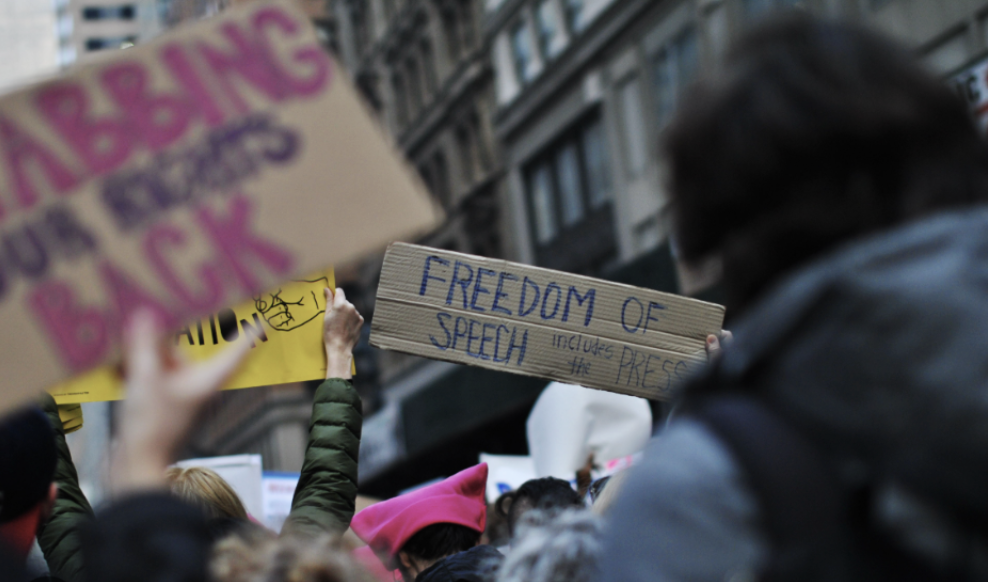
Women’s March in New York. Photo courtesy of Narih Lee, CC BY-SA 3.0, via Wikimedia Commons.
