
By Logan Mullins
Love her or hate her, you can’t deny her: Sabrina Carpenter’s new album Man’s Best Friend is shattering records. As of Sept. 5, Man’s Best Friend had the second-largest daily debut on Spotify in 2025, with 64.4 million streams.
Man’s Best Friend surpasses Short n’ Sweet’s debut of 57 million first-day streams in 2024, making this Sabrina’s best-performing album yet.
Not only is this Sabrina’s biggest success, but she outperformed established players in her industry: Lady Gaga’s 2025 album Mayhem opened to 45.7 million streams, and Ariana Grande’s 2024 album Eternal Sunshine opened to 58.2 million streams. Sabrina’s newest debut outpaces popstar pioneers by millions of streams – a once-niche artist now at the forefront of the industry.
But this success isn’t a coincidence — it’s by design. Carpenter shows how to succeed in the new age of music through shorter songs, unique songwriting, and calculated controversy. In a streaming economy, attention is currency, and Sabrina Carpenter has crafted the “prfct” transaction.
Carpenter keeps it Short n’ Sweet
With each passing decade, songs are reverting to their radio roots and becoming shorter. In the 1980s and 1990s, the average song would last upwards of four minutes. Danny Wright at VICE reported that the average song today is only three minutes long.
Dr. Ian Chapman, a music researcher at the University of Otago, told RNZ (Radio New Zealand) that the shortening of songs is due to streaming.
“It’s all about streaming… artists only earn a royalty on a song if the listener keeps listening for at least 30 seconds,” said Chapman. “So there’s a big temptation to eliminate or shorten the introductions and get straight into the hooks and the choruses that will keep the listener on board.”
The average runtime of the songs on Man’s Best Friend is three minutes and thirteen seconds — the perfect pace for the streaming platforms and their retention metrics.
Three songs — “Tears,” “When Did You Get Hot,” and “House Tour” — run under three minutes; not only are these songs concise, but they are also perfectly suited for short-form content.
In an era of ever-decreasing attention spans, short-form content becomes increasingly addictive. Low runtime songs have less material to comb through, making it easier to select a catchy segment. Both “Tears” and “House Tour” are among the top 50 trending audios on Instagram, with the former being #2 and the latter being #21 on the date of publication. This level of traction on social media turns influencers into free marketers, as it gives the attention of their fans to Carpenter.
Sabrina has crafted songs with incredibly catchy beats meant for Instagram and TikTok — songs meant to steal the listener’s attention. One viral hook from a catchy song on a social media’s For You page can turn a casual scroller into a devoted fan — and Carpenter knows it.
Nobody does pop like Sabrina
In 1941, his essay “On Popular Music,” German musicologist Theodor Adorno describes popular music as substitutable.
“The whole structure of popular music is standardized, even where the attempt is made to circumvent standardization,” said Adorno.
Even 84 years later, that criticism holds, as Luca von Burkersroda describes modern pop as “formulaic sound.”
Pop songs tend to cover similar topics and frequently receive criticism for not conveying anything meaningful. Sabrina breaks the mold and crafts her own. While Man’s Best Friend is a breakup album, the most popular theme for pop music, she covers aspects of a modern breakup that musicians overlook, and with a level of wit and wordplay rarely seen elsewhere.
Consider “We Almost Broke Up Again Last Night” as Carpenter describes a toxic, cyclical relationship — one where both know they should be apart, but they cannot stand being alone. She cuts deep into her own heart to tear at her listeners’ souls. She doesn’t sing about love or a breakup; she sings about being mutually trapped. Few lyrics better echo the pain of such an addictive relationship than the words of the bridge: “Big deal, we’ve been here before, and we’ll be here tomorrow.” This blend of cynical despair with such casual wordplay distinguishes Carpenter from her peers, giving her somber music a distinctive sound.
Take “House Tour,” for instance: on the surface, Sabrina sings about taking her date on a tour of her house, backdropped by a classic 80s and 90s synth. But the lyrics carry a double entendre: Sabrina is singing about sex. Lines such as “the first, second, third floor” and “be a little reckless cause it’s insured” give the song an intense sexual innuendo: first, second, and third base, as well as being on birth control. It’s these little innuendos that are often special to Sabrina’s songs; wordplay rarely matched in mainstream pop. If a listener can’t get it anywhere else, they’ll turn to her.
Controversy makes money
In nearly every industry, scandal is bad for business; in music, it is business. Take one of the most influential figures in the music industry: Elvis Presley. According to Alan Hanson’s Elvis History Blog, Reverend Carl Elgena described Presley as “morally insane” and “leading other young people to the same end” to his 1956 Iowa congregation. Presley’s manager, Tom Parker, sold “I Hate Elvis” pins to capitalize on his controversy. Yet, all of the controversy helped Elvis rise to become the best-selling solo artist of all time, with over 500 million record sales.
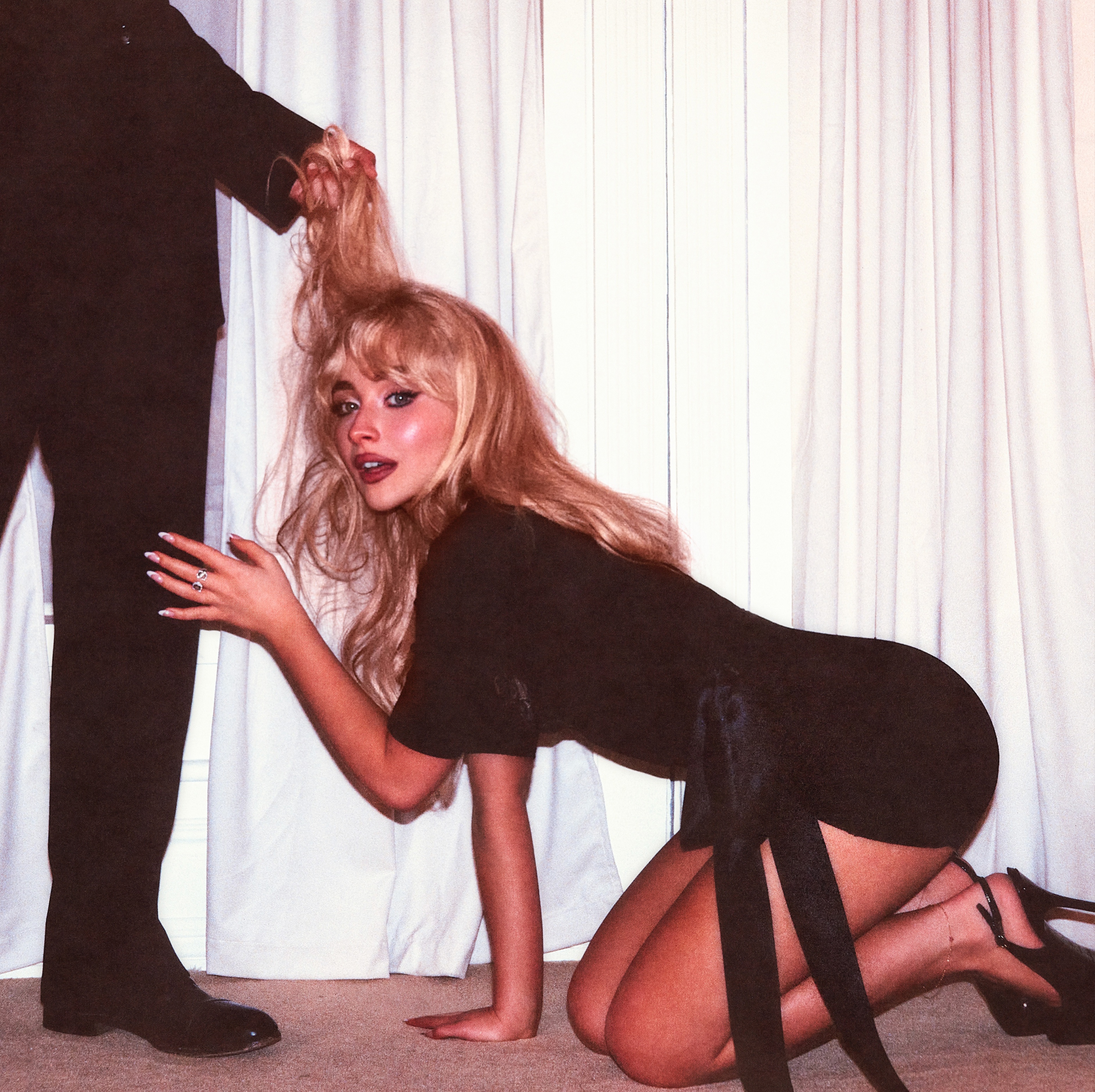
The same principle applies today, with algorithms pushing outrage content because it gains more attention. The cover album for Man’s Best Friend features Carpenter on all fours with a man pulling her hair, which is an intentionally provocative image. The image sparked immense backlash as thousands rushed to X within the first few days to post that the cover “reinforces” a misogynistic stereotype. Some even claimed that Sabrina attempted to profit from “domestic violence.” Fans defended her, with one X user framing the image as “obvious commentary” rather than exploitation.
But Sabrina didn’t stop there; she fueled the outcry even further when she had a “funeral party” after the release of the album, celebrating her “killing men” in her music videos. Critics see exploitation and marginalization, while fans see metaphors and satire.
Even those who despise Sabrina still have to engage with her content. To bash a song, one must play it. For the hater, it’s spite; for Sabrina, it’s just another stream.
Such hot-button issues have sparked intense debate across all social media platforms about sexualization and stereotypes surrounding women in music, creating a cultural firestorm about gender, power, and performance in pop music. At the center of it all: Sabrina Carpenter.
Her formula works
Carpenter’s musical reign isn’t accidental — it’s a model of intent. Rising to stardom in 2023 and topping charts in 2024, Sabrina’s calculated mastery of algorithm-driven music, clever wordplay, and controversy cemented her at the top. Most artists focus on one lane. Sabrina owns them all by design.
Carpenter doesn’t just harness attention, she transforms it into strategic success. Her ascent isn’t luck — it’s a blueprint for today’s music world. Sabrina’s formula proves she is rewriting the rules of pop. Whether you stream her music or you never liked her anyway, nobody does pop like Sabrina Carpenter.
––
Photo courtesy of Island Records / Chuffmedia.